EU-Azerbaijan relations in focus at European Parliament event (Updated)

Equality and mutual respect are the hallmarks of the new phase in relations between Azerbaijan and the European Union. This was reiterated by a number of speakers from both sides at an event held at the European Parliament on Tuesday. Deputy Foreign Minister Mahmud Mamed-Guliev in his speech reiterated that Azerbaijan is ready for continued, enhanced, and inclusive co-operation with the EU based on mutual interest and joint ownership. Various speakers raised the case of the arrest of blogger Mehman Husseynov as part of a discussion on issues related to governance and human rights in Azerbaijan. Azerbaijani MPs expressed concern at recent visits of MEPs to Nagorno-Karabakh, and economic activity by EU based entities in the territory

Update 2 13.00 CET / 16.00 Baku

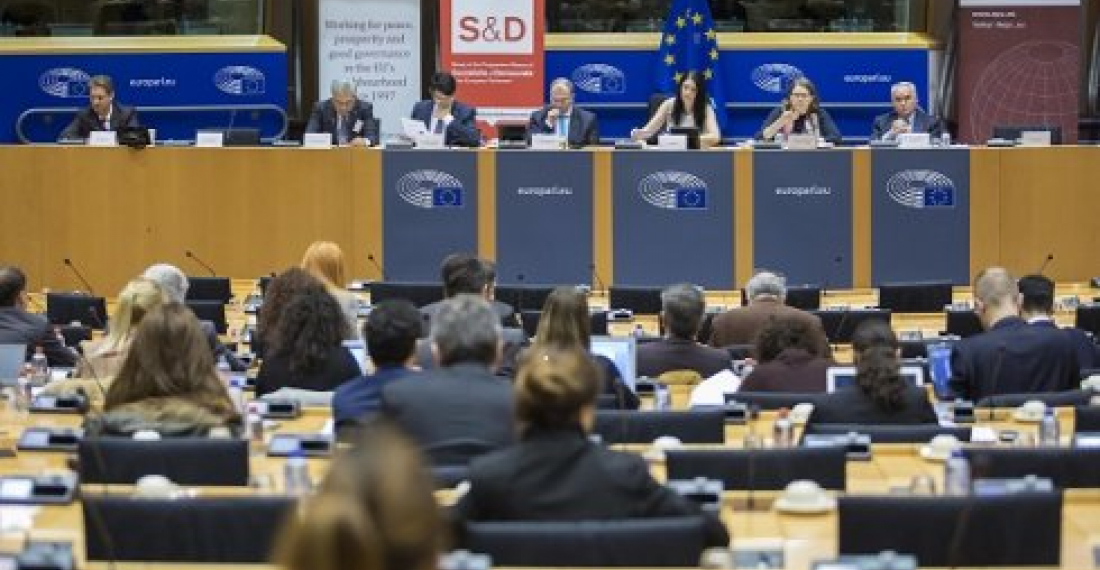
An open and frank discussion on the state of EU-Azerbaijan relations was held in the European Parliament on Tuesday, 7 March, with the particiaption of Azerbaijan government officials, MPs and civil society members, and Members of the European Parliament, representatives of European institutions, think tank and civil society representatives and others. The event entitled "EU-Azerbaijan relations: taking the relationship to a higher level" was hosted by Heidi Hautala MEP (Greens) and Andrejs Mamikins MEP (Socialists and Democrats) and organised by the European Policy Centre and LINKS (Dialogue, Analysis and Research).

Azerbaijan's human rights, record, the imprisonment of Mehman Husseynov. the attitude of the Azerbaijan government to civil society, the European Union position on Nagorno-Karabakh and the visit of MEPs to Nagorno-Karabakh were some of the hot issues raised in the meeting, wiith interventions from MEPs, Azerbaijani MPs and other participants.

MEP Heidi Hautala said that relations with Azerbaijan had improved in the last year after falling to a low point in 2014/15. She said both sides now have opened a new chapter in the relationship between them. The European Parliament was looking forward to tne new agreement with Azerbaijan that has just started being negotiated. Mrs Hautala raised the issue of the arrest of blogger Mehman Husseynov, and called on the Azerbaijani government to show a sense of proportion in dealing with this matter, also suggesting that the Novruz holiday can be used as an opportunity for an amnesty for imprisoned journalists and activists.

The issue of Mehman Husseynov was also raised by other speakers. Dennis Sammut, Director of LINKS DAR said that Husseynov's arrest was a matter of pain and concern to him and many others who knew the young blogger. Those who raise the issue are not enemies of Azerbaijan, he said, but rather want to see the country make the necessary reforms to establish good checks and balances. Dr Sammut said the EU needs to engage with Azerbaijan at all levels - government, politics, civil society, buisness and others. He criticised the EU for being a decade late in opening a Delegation in Azerbaijan after independence and said that the absence of what could have been done then continues to be felt today.

Various Azerbaijani speakers spoke about the Nagorno-Karabakh conflict. Fuad Muradov MP said that various MEPs and European entities were violating Azerbaijani laws by visiting Nagorno-Karabakh or engaging in economic activity in the territory. He said that this was a painful matter for Azerbaijan and urged the European Parliament to deal with the issue.

The discussion was held in a friendly and amicable atmosphere and many speakers commended the fact that issues were now being discussed openly and in a manner of equal and mutual respect.

Update 1 1030 CET/ 13.30 Baku

The Deputy Foreign Minister of Azerbaijan, Mahmud Mamed-Guliev in a key note speech at a conference with the theme: EU-Azerbaijan relations: taking the relationship to higher level, which took place at the European Parliament on Tuesday, 7 March 2017.


Mr Mamed-Guliev in his speech reiterated that Azerbaijan is ready for continued, enhanced, and inclusive co-operation with the EU based on mutual interest and joint ownership. He said that the conference was very timely, coming at a time when the two sides embarked on a negotiating a new strategic agreement between them. The Deputy Foreign Minister said that Azerbaijan was entering the negotiations with a belief that the new agreement will provide a strong basis for EU-Azerbaijan co-operation, which are already very strong.


The Deputy Foreign Minister said that the new agreement will have three main blocks: political and security; trade and investment; and sectorial areas, including economic and humanitarian). The Deputy Foreign Minister said the Government of Azerbaijan wanted to focus on the first block. He said that Azerbaijan had already made its ideas known to the EU, and was awaiting now the response of the EU. He called for a timely process of negotiations.

Deputy Foreign Minister Mamad Guliev spoke at length on the Karabakh conflict and Azerbaijan's vision for resolving the conflict. The speaker said that the Azerbaijan government has concerns regarding illegal economic activity in Nagorno-Karabakh, and the participation of European entities in such activity. He said that the Azerbaijani Foreign Ministry had made representation to the EU on these issues.

Referring to Azerbaijan's human rights record, the Deputy foreign Minister said that he did not want to say that everything is perfect, but Azerbaijan was actively taking steps to make the situation better for civil society in the country, and Azerbaijan is aware of the EU's interest in these areas.

The event is hosted by MEPs Heidi Hautala from the Greens group and Andreijs Mamikins from the Socialists and Democrats group, and is organised by the European Policy Centre and LINKS (Dialogue, Analysis and Research).

source: commonspace.eu


Related articles

Editor's choice
News
Council of Europe launches new International Claims Commission for Ukraine

Council of Europe launches new International Claims Commission for Ukraine

Thirty-four countries and the European Union have signed a new convention establishing an International Claims Commission for Ukraine at a diplomatic conference co-hosted by the 46-nation Council of Europe and the Netherlands in the Hague. The diplomatic conference was attended by leaders and high-level representatives from over 50 states, including the President of Ukraine, Volodymyr Zelenskyy, the President of the Republic of Moldova, Maia Sandu, and the Prime Minister of the Netherlands, Dick Schoof.  “Today marks a major step forward in ensuring accountability for Ukraine. The International Claims Commission represents justice and hope for tens of thousands of victims—our determination that those who have suffered will not be forgotten. I call for quick ratifications so we can get the commission rapidly up and running for the people of Ukraine,” said Council of Europe Secretary General Alain Berset. Ukrainian President Volodymyr Zelenskyy said: “We expect that every mechanism for compensation from the Register of Damage and Claims Commission to the actual payments – will start working and receive strong and sufficient international support, so that people can truly feel that any kind of damage caused by the war can be compensated. This war, and Russia’s responsibility for it, MUST become a clear example – so that others learn not to choose aggression.” “Accountability is about creating the conditions for peace that endures. And therefore, accountability is a condition of security – today and for the future. But accountability is not only about Ukraine. And it is not only about one aggressor and one victim. Accountability is about Europe. About every country in Europe. It is about whether Europe, as a whole, is willing to defend its peace,” said Maia Sandu, President of the Republic of Moldova, which currently holds the Presidency of the Council of Europe’s Committee of Ministers. The Prime Minister of the Netherlands, Dick Schoof, said: “Every day Russia is deliberately bombarding homes, destroying businesses and damaging infrastructure in Ukraine. Russia must compensate Ukraine for the damage caused. That is why we have launched the International Claims Commission for Ukraine and we are honoured to host it.” The International Claims Commission will be the second part of a comprehensive compensation mechanism related to Russia’s war of aggression, building on the existing Register of Damage for Ukraine. The claims commission will be established within the framework of the Council of Europe and will also be open to other countries. The Register of Damage for Ukraine, created in 2023, collects and records compensation claims submitted by individuals, organisations and public bodies in Ukraine. Forty-four states and the European Union have so far joined the Register, which has already received 86,000 claims. The International Claims Commission will review, assess and decide upon claims submitted to the Register of Damage for Ukraine and determine the amount of compensation, if any, which is due in each case. The convention establishing the commission will enter into force once it has been ratified by 25 signatories, as long as sufficient funds have been secured to support its initial work.

Popular

Editor's choice
News
Council of Europe launches new International Claims Commission for Ukraine

Council of Europe launches new International Claims Commission for Ukraine

Thirty-four countries and the European Union have signed a new convention establishing an International Claims Commission for Ukraine at a diplomatic conference co-hosted by the 46-nation Council of Europe and the Netherlands in the Hague. The diplomatic conference was attended by leaders and high-level representatives from over 50 states, including the President of Ukraine, Volodymyr Zelenskyy, the President of the Republic of Moldova, Maia Sandu, and the Prime Minister of the Netherlands, Dick Schoof.  “Today marks a major step forward in ensuring accountability for Ukraine. The International Claims Commission represents justice and hope for tens of thousands of victims—our determination that those who have suffered will not be forgotten. I call for quick ratifications so we can get the commission rapidly up and running for the people of Ukraine,” said Council of Europe Secretary General Alain Berset. Ukrainian President Volodymyr Zelenskyy said: “We expect that every mechanism for compensation from the Register of Damage and Claims Commission to the actual payments – will start working and receive strong and sufficient international support, so that people can truly feel that any kind of damage caused by the war can be compensated. This war, and Russia’s responsibility for it, MUST become a clear example – so that others learn not to choose aggression.” “Accountability is about creating the conditions for peace that endures. And therefore, accountability is a condition of security – today and for the future. But accountability is not only about Ukraine. And it is not only about one aggressor and one victim. Accountability is about Europe. About every country in Europe. It is about whether Europe, as a whole, is willing to defend its peace,” said Maia Sandu, President of the Republic of Moldova, which currently holds the Presidency of the Council of Europe’s Committee of Ministers. The Prime Minister of the Netherlands, Dick Schoof, said: “Every day Russia is deliberately bombarding homes, destroying businesses and damaging infrastructure in Ukraine. Russia must compensate Ukraine for the damage caused. That is why we have launched the International Claims Commission for Ukraine and we are honoured to host it.” The International Claims Commission will be the second part of a comprehensive compensation mechanism related to Russia’s war of aggression, building on the existing Register of Damage for Ukraine. The claims commission will be established within the framework of the Council of Europe and will also be open to other countries. The Register of Damage for Ukraine, created in 2023, collects and records compensation claims submitted by individuals, organisations and public bodies in Ukraine. Forty-four states and the European Union have so far joined the Register, which has already received 86,000 claims. The International Claims Commission will review, assess and decide upon claims submitted to the Register of Damage for Ukraine and determine the amount of compensation, if any, which is due in each case. The convention establishing the commission will enter into force once it has been ratified by 25 signatories, as long as sufficient funds have been secured to support its initial work.