


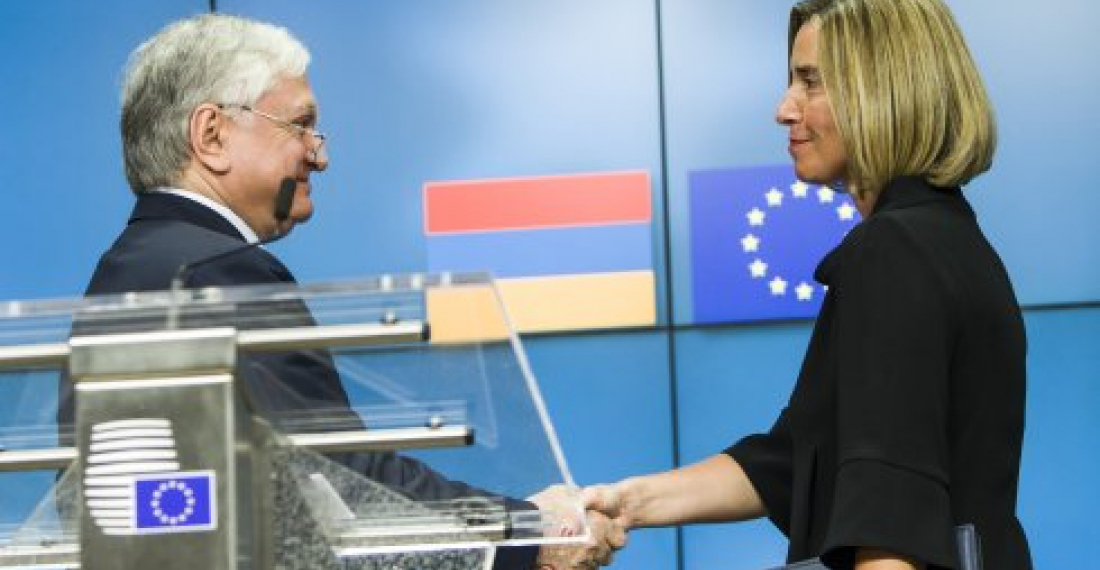
EU-Armenia Co-operation Council successfully held in Brussels

The European Union (EU) and the Republic of Armenia successfully held their seventeenth Cooperation Council on 23 May 2017 in Brussels. A statement published on the website of the European External Action Service (EEAS) stated:

The EU and Armenia welcomed the end of the negotiations on the recently initialled EU-Armenia comprehensive and enhanced partnership agreement and called for its swift conclusion.

The Cooperation Council also welcomed the launch of negotiations on a comprehensive EU-Armenia air transport agreement and encouraged further cooperation in all possible sectors.

Both sides looked forward to the early adoption of the joint partnership priorities, as these will have a key role in shaping the EU assistance to Armenia in the next programming cycle (single support framework 2017-2020).

The Cooperation Council reviewed recent political, economic and social reforms in Armenia. The EU took note of progress achieved in implementing these reforms and of Armenia's commitment to continue on this positive trajectory. The EU encouraged Armenia to accelerate reforms in specific areas.

The EU recalled that the shortcomings observed during the recent parliamentary elections needed to be properly addressed. It encouraged an impartial, credible and effective investigation of all alleged human rights violations, including the reported misconduct by the police during the 2016 "Erebuni crisis". The EU also called on Armenia to ensure a fair trial for all.

The EU underlined the importance for Armenia to tackle problems in the justice sector and to counter discrimination on all grounds, to speedily adopt and implement legislation against discrimination and against domestic violence. A continued concerted fight against corruption and strong support for the rule of law is essential.

The EU expressed appreciation for Armenia's participation in the Eastern Partnership framework, whose inclusiveness is complementary to the more differentiated and tailored bilateral relations. The EU is looking forward to Armenia's proactive and constructive stance in preparation for the upcoming Eastern Partnership foreign ministers meeting in Luxembourg on 19 June and Summit in Brussels, on 24 November 2017. The next Summit will focus on tangible benefits of the Eastern Partnership for citizens both in the EU and in the Eastern Partnership partner countries.

The Cooperation Council addressed also regional issues of common interest, and the prospects for the resolution of the Nagorno-Karabakh conflict.

The Cooperation Council was chaired by the EU High Representative for Foreign Affairs and Security Policy, Federica Mogherini. The Armenian delegation was led by Edward Nalbandian, Minister of Foreign Affairs of Armenia.

commonspace.eu with the press service of the European External Action Service

photo: Eduard Nalbandian and Federica Morgherini in brussels on 23 May 2017 (picture courtesy of the press service of the EEAS)
 

Related articles

Editor's choice
News
Council of Europe launches new International Claims Commission for Ukraine

Council of Europe launches new International Claims Commission for Ukraine

Thirty-four countries and the European Union have signed a new convention establishing an International Claims Commission for Ukraine at a diplomatic conference co-hosted by the 46-nation Council of Europe and the Netherlands in the Hague. The diplomatic conference was attended by leaders and high-level representatives from over 50 states, including the President of Ukraine, Volodymyr Zelenskyy, the President of the Republic of Moldova, Maia Sandu, and the Prime Minister of the Netherlands, Dick Schoof.  “Today marks a major step forward in ensuring accountability for Ukraine. The International Claims Commission represents justice and hope for tens of thousands of victims—our determination that those who have suffered will not be forgotten. I call for quick ratifications so we can get the commission rapidly up and running for the people of Ukraine,” said Council of Europe Secretary General Alain Berset. Ukrainian President Volodymyr Zelenskyy said: “We expect that every mechanism for compensation from the Register of Damage and Claims Commission to the actual payments – will start working and receive strong and sufficient international support, so that people can truly feel that any kind of damage caused by the war can be compensated. This war, and Russia’s responsibility for it, MUST become a clear example – so that others learn not to choose aggression.” “Accountability is about creating the conditions for peace that endures. And therefore, accountability is a condition of security – today and for the future. But accountability is not only about Ukraine. And it is not only about one aggressor and one victim. Accountability is about Europe. About every country in Europe. It is about whether Europe, as a whole, is willing to defend its peace,” said Maia Sandu, President of the Republic of Moldova, which currently holds the Presidency of the Council of Europe’s Committee of Ministers. The Prime Minister of the Netherlands, Dick Schoof, said: “Every day Russia is deliberately bombarding homes, destroying businesses and damaging infrastructure in Ukraine. Russia must compensate Ukraine for the damage caused. That is why we have launched the International Claims Commission for Ukraine and we are honoured to host it.” The International Claims Commission will be the second part of a comprehensive compensation mechanism related to Russia’s war of aggression, building on the existing Register of Damage for Ukraine. The claims commission will be established within the framework of the Council of Europe and will also be open to other countries. The Register of Damage for Ukraine, created in 2023, collects and records compensation claims submitted by individuals, organisations and public bodies in Ukraine. Forty-four states and the European Union have so far joined the Register, which has already received 86,000 claims. The International Claims Commission will review, assess and decide upon claims submitted to the Register of Damage for Ukraine and determine the amount of compensation, if any, which is due in each case. The convention establishing the commission will enter into force once it has been ratified by 25 signatories, as long as sufficient funds have been secured to support its initial work.

Popular

Editor's choice
News
Council of Europe launches new International Claims Commission for Ukraine

Council of Europe launches new International Claims Commission for Ukraine

Thirty-four countries and the European Union have signed a new convention establishing an International Claims Commission for Ukraine at a diplomatic conference co-hosted by the 46-nation Council of Europe and the Netherlands in the Hague. The diplomatic conference was attended by leaders and high-level representatives from over 50 states, including the President of Ukraine, Volodymyr Zelenskyy, the President of the Republic of Moldova, Maia Sandu, and the Prime Minister of the Netherlands, Dick Schoof.  “Today marks a major step forward in ensuring accountability for Ukraine. The International Claims Commission represents justice and hope for tens of thousands of victims—our determination that those who have suffered will not be forgotten. I call for quick ratifications so we can get the commission rapidly up and running for the people of Ukraine,” said Council of Europe Secretary General Alain Berset. Ukrainian President Volodymyr Zelenskyy said: “We expect that every mechanism for compensation from the Register of Damage and Claims Commission to the actual payments – will start working and receive strong and sufficient international support, so that people can truly feel that any kind of damage caused by the war can be compensated. This war, and Russia’s responsibility for it, MUST become a clear example – so that others learn not to choose aggression.” “Accountability is about creating the conditions for peace that endures. And therefore, accountability is a condition of security – today and for the future. But accountability is not only about Ukraine. And it is not only about one aggressor and one victim. Accountability is about Europe. About every country in Europe. It is about whether Europe, as a whole, is willing to defend its peace,” said Maia Sandu, President of the Republic of Moldova, which currently holds the Presidency of the Council of Europe’s Committee of Ministers. The Prime Minister of the Netherlands, Dick Schoof, said: “Every day Russia is deliberately bombarding homes, destroying businesses and damaging infrastructure in Ukraine. Russia must compensate Ukraine for the damage caused. That is why we have launched the International Claims Commission for Ukraine and we are honoured to host it.” The International Claims Commission will be the second part of a comprehensive compensation mechanism related to Russia’s war of aggression, building on the existing Register of Damage for Ukraine. The claims commission will be established within the framework of the Council of Europe and will also be open to other countries. The Register of Damage for Ukraine, created in 2023, collects and records compensation claims submitted by individuals, organisations and public bodies in Ukraine. Forty-four states and the European Union have so far joined the Register, which has already received 86,000 claims. The International Claims Commission will review, assess and decide upon claims submitted to the Register of Damage for Ukraine and determine the amount of compensation, if any, which is due in each case. The convention establishing the commission will enter into force once it has been ratified by 25 signatories, as long as sufficient funds have been secured to support its initial work.

