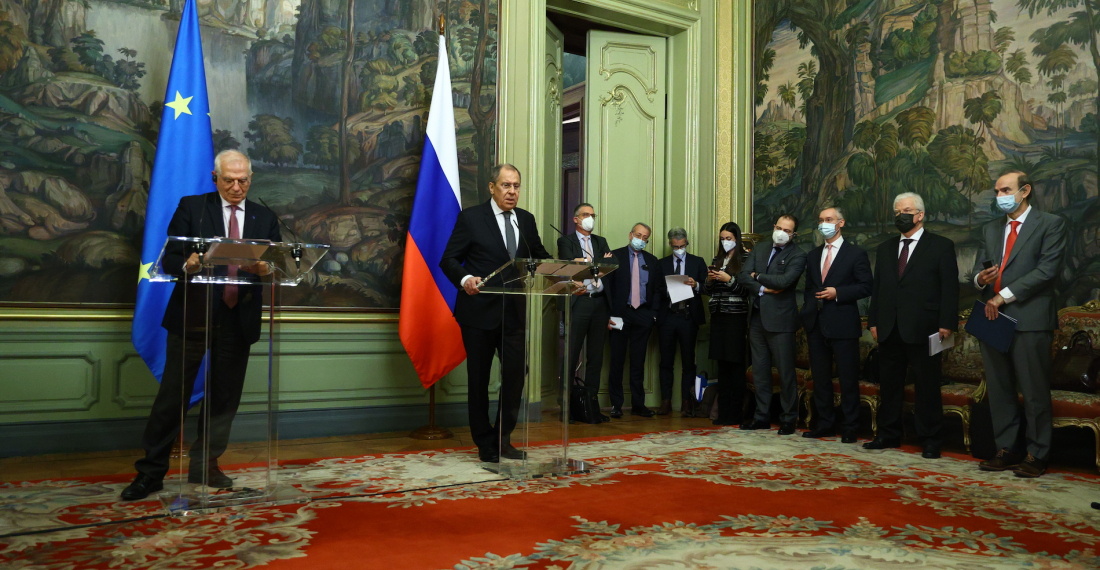
Russian Foreign Minister, Sergei Lavrov, and EU High Representative, Josep Borrell, met in Moscow on Friday (5 February). In a press conference after the first part of their talks the two senior diplomats appeared to be struggling to identify common ground for future co-operation whilst wanting to sound tough on their respective positions, especially on the ongoing controversies surrounding Alexei Navalny and Russian clampdown on his supporters.
"We have to recognise that, over the last years, our relations have been marked by fundamental differences and a lack of trust. We are seeing each other more as a competitor or rival, rather than a partner", Borrell said in his opening remarks.
My visit coincides with the arrest and sentencing of Alexei Navalny, and the arrest of thousands of demonstrators. As you can expect, I have conveyed to Minister Lavrov our deep concern and reiterated our appeal for his release and the launch of an impartial investigation over his poisoning.
Borrell and Lavrov however both emphasised that there were issues on which the EU and Russia can work together, including culture, research, health, COVID-19, the Arctic, climate change, and the digital economy.
Borrell said,
On the international arena, I think that the Minister has made reference to that, there are places and issues on which we can also work together: the Joint Comprehensive Plan of Action (JCPoA) is a good example. On the Middle East Peace Process, we agree on the need to engage in this process, to reinvigorate the Quartet and to try to work together and engage also the new United States administration.
On the situation in the European neighbourhood, Borrell said:
In line with the Helsinki Final Act, stability in Europe must be based on cooperation, respect for the territorial integrity and sovereignty of nations, respect for human rights and fundamental freedoms. And in this framework, we need to find spaces for understanding and to build mutual trust.
Ahead of the visit, the Russian foreign minister had warned that "Russian politeness should not be misunderstood for weakness". Speaking on the eve of Borrell's arrival, and referring directly to Borrell's visit, Lavrov said
I understand those who think that Russia could be more aggressive in reacting to the openly high-handed, unseemly rhetoric from Western leaders. In our diplomatic and political culture, we are not used to resorting to thuggish rhetoric. We are polite people and are used to achieving our goals in a polite and cultivated manner. As we say: “God is not in power but in truth.” We also have a good proverb that should be remembered: “Honey is sweet, but the bee stings.” Those who take our polite manners for a sign of weakness are making a big mistake.
At Friday's press conference Lavrov was polite enough, but he made it clear Russia does not respect the criticism thrown at it on the Navalny case. He also expressed his frustration at the current state of Russia-EU relations:
I would like to emphasize once again that we are ready to discuss any topics that interest you today,including regional conflicts and other issues. The main problem we all face is the lack of normalcy in relations between Russia and the European Union - between the two largest players in the Eurasian space. This is an unhealthy situation that does not benefit anyone.
Sporadic discussions on this or that hot international topic or on issues of mutual concerns and claims cannot replace a systematic, comprehensive approach to our relations. This approach existed before. It was embodied in the appropriate mechanisms, but then was downgraded by the European Union unilaterally. Therefore, the question of the need for a detailed, honest review of the state of affairs in relations between Russia and the EU is due and already overdue. I hope that in addition to other issues that you plan to discuss, we will be able to reflect on this fundamental topic too.