The US Secretary of State Antony Blinken has headed to Kazakhstan and Uzbekistan on his first official visit to the region as President Biden’s top diplomat.
Announcing his departure from US soil overnight on 26-27 February, Secretary of State Blinken said that he was looking forward to “advancing our Central Asian partnerships”. After visiting the Kazakh and Uzbek capitals, he would then head to India for the coming G20 summit.
The timing of the visit is notable, coming only days after the first anniversary of Russia’s disastrous full-scale invasion of Ukraine, which as one of its consequences has seen Central Asia reassert itself regionally and rapidly explore ties with other neighbouring power blocs including the EU, the Middle East, and China.
On 28 February, Blinken had a joint meeting in Astana with the foreign ministers of all five Central Asian nations: Mukhtar Tileuberdi of Kazakhstan; Jeenbek Kulubaev of Kyrgyzstan; Rasit Meredov of Turkmenistan; Sirojiddin Muhriddin of Tajikistan; and Bakhtiyor Saidov of Uzbekistan. He also met with each FM in person in Astana, with the exception of the latter, whom he met later in Tashkent.
Washington pushes cooperation with Central Asia as region looks beyond Moscow
Speaking at a joint press conference with the Kazakh Foreign Minister Mukhtar Tileuberdi on Tuesday (28 February), Blinken made a pointed reference to the concern that Kazakhstan - which has a large ethnic Russian populations mostly concentrated in the north of the country - is also at risk of Vladimir Putin’s irredentism.
Blinken said:
“I’m here to underscore that the strong partnership, and in particular the enhanced strategic partnership between the United States and Kazakhstan, is moving forward strongly. Ever since being the first nation to recognize Kazakhstan in December of 1991, the United States has been firmly committed to the sovereignty, territorial integrity, and independence of Kazakhstan – and countries across the region.
“In our discussions today, I reaffirmed the United States’ unwavering support for Kazakhstan, like all nations, to freely determine its future, especially as we mark one year since Russia launched its full-scale invasion of Ukraine in a failed attempt to deny its people that very freedom.”
Blinken also announced a number of measures designed to “empower and connect the people of Central Asia”. Mentioning that the US already committed some $16.5mn to food and security in Central Asia in September 2022, Blinken also announced a second $25m tranche for the Economic Resilience Initiative for Central Asia, “to expand regional trade routes, establish new export markets, attract and leverage greater private sector investment, providing people with practical skills for the modern job market”, according to Blinken.
On top of this, Blinken also announced an effort to increase English-language proficiency in over 1,000 young professionals in government and civil society.
On his part, Kazakh Foreign Minister Mukhtar Tileuberdi noted the increasingly encouraging trade statistics between the US and Kazakhstan. Due to the fact that the US has been one of the largest investors in the Kazakh economy since 1993, according to Tileuberdi, bilateral trade has grown 37.2% over the last year.
He continued:
“The total inflow of foreign direct investments from the U.S. to Kazakhstan exceeded 62 billion U.S. dollars, and in the first three quarters of 2022 the volume of American investments increased by 58.8 percent compared to the corresponding period of 2021. About 590 enterprises with the participation of the American capital function are present in Kazakhstan, and more U.S. companies are showing they’re interested in the Kazakh market.”
Blinken takes the same message to Tashkent
Arriving in the Uzbek capital of Tashkent shortly after concluding his meeting with the five Central Asian foreign ministers, Antony Blinken reiterated the fact that Russia’s invasion of Ukraine has “fostered deep concern across the region”.
Speaking at a press conference after his talks with the Uzbek Foreign Minister Bakhtiyor Saidov, Blinken said:
“After all, if a powerful country is willing to try to erase the borders of the sovereign neighbor by force, what’s to stop it from doing the same to others…Countries across Central Asia understand this. So does the United States and so do partners and allies around the world. And that’s exactly why we’ve been committed and remain committed to standing for the sovereignty and territorial integrity, the independence not only of Ukraine, but for countries across Central Asia and indeed around the world.”
Meanwhile, speaking before their meeting, Foreign Minister Saidov echoed Blinken’s words, saying “I want to underline that we share common priorities for a prosperous, stable, and peaceful Central Asia,” adding that he was looking forward to discussions on “shared priorities for expanding cooperation between Uzbekistan and the United States in political dimension, commerce and investment, science and technology, education, and human capacity building”.
Central Asia seeks multi-vector foreign policy as competing international interest intensifies
Traditionally considered by Moscow to be in Russia’s “sphere of influence”, the Russian full-scale invasion of Ukraine has indeed caused a great deal of consternation in Central Asian capitals and triggered an exploration of new ties to the region’s west, east, and south.
Blinken’s visit to Central Asia and meetings with high-profile officials from the five Central Asian countries is only the latest in a string of developments over the past few months which have demonstrated Central Asia’s desire to develop a multi-vector foreign policy after traditional ties with Russia soured somewhat over the February 2022 invasion, and amid growing international interest in the region.
On 7 September 2022, the inaugural meeting of the Gulf Cooperation Council - Central Asia Strategic Dialogue took place, and has been followed by a raft of smaller bilateral visits.
Then, only one week later, China’s President Xi held a regional meeting with the five Central Asian republics, and Turkmenistan has also agreed to double gas exports to China.
At the end of October 2022, European Council President Charles Michel also visited Kazakhstan and Uzbekistan, and also met with high-level officials from all five Central Asian countries.
Russian President Vladimir Putin has also visited each of the Central Asian republics at least once in recent months in an attempt to shore up Moscow’s influence, but this “gave a sense of Putin being somewhat desperate”, according to Crossroads Central Asia researcher Emil Joroev. Speaking to the New York Times, he cautioned however that Russia still has much more leverage in Central Asia than the US.
Indeed, while the increasing engagement from Washington is being welcomed by Central Asian capitals, the quantity of the region's trade with Russia and China still dwarfs that of Europe and the US.
source: commonspace.eu with agencies
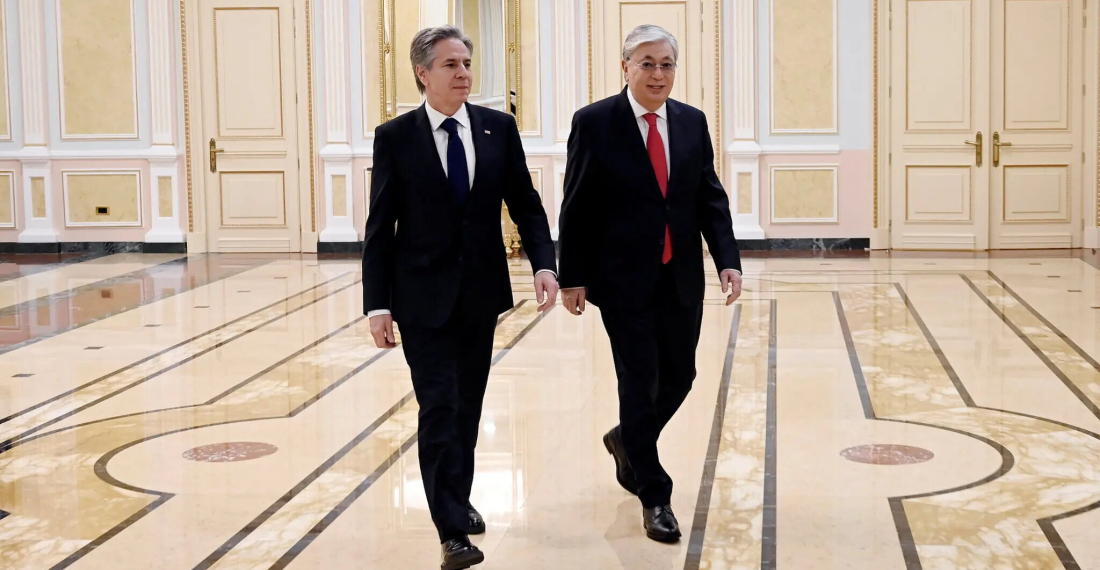
photo: The U.S. secretary of state, Antony J. Blinken, and the Kazakh president, Kassym-Jomart Tokayev, in Astana, Kazakhstan, on Tuesday. Pool photo by Olivier Douliery.