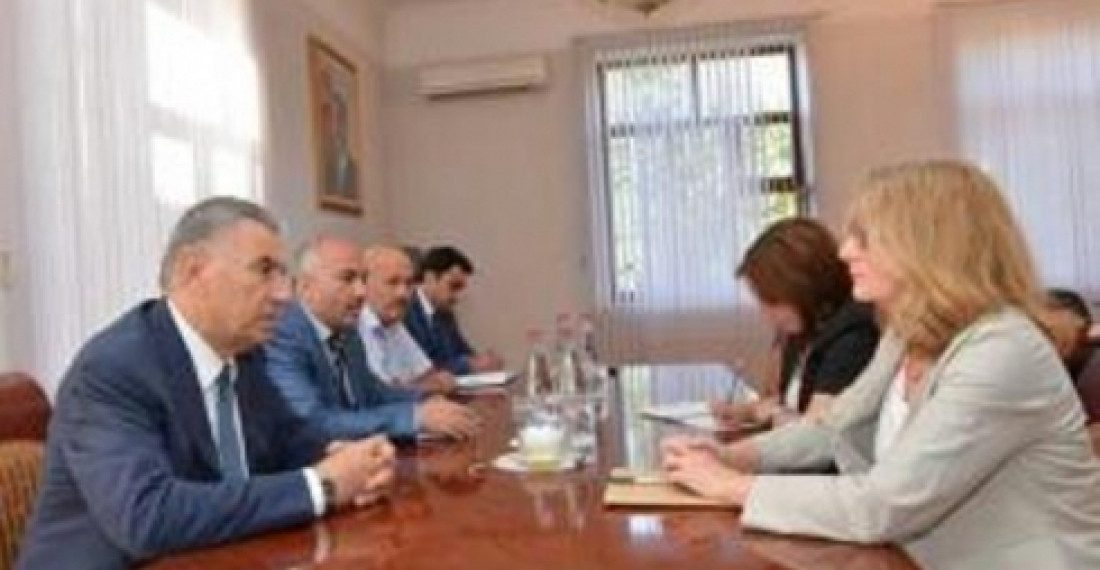
For the second time in less than a week the Azerbaijani government has brought public pressure on the International Committee of the Red Cross (ICRC) following the capture of Azerbaijani civilians near the village of Khaljabar. Deputy Prime Minister, Chairman of the State Committee for Work with Refugees and IDPs, Ali Hasanov again met with Head of the ICRC Delegation to Azerbaijan Denise Duran on July 30 to discuss the issue of Shahbaz Guliyev and Dilgam Asgarov, who were who are in Armenian captivity, and the return of the body of Azerbaijani citizen Hasan Hasanov, who was reportedly killed in the same incident. The senior Azerbaijani official publicly rebuked the work that the ICRC has done over these incidents and said that the work on the return of Hasan Hasanov's body and the release of the two other captives should be conducted more actively. He also noted that all this causes the distrust of civil society, including IDPs to international organizations.
Armenia and Azerbaijan have given different explanations to the incidents that happened in Khaljabar earlier in July. The Azerbaijani side says that the three men were from the areas, which currently is controlled by Armenian forces, and crossed the line of contact because they were nostalgic for their places of birth. On the other hand the Armenian side says that the three were part of a terrorist group, and that since they were in civilian clothes they do not benefit from the protection of the Geneva Convention on prisoners of war.
Armenia initially refused the ICRC access to the two captured men, but the ICRC managed to meet with them at the end of last week. In the meantime the dead person has been buried by the Armenian authorities in Karabakh.
In an ominous development on Monday a car of the ICRC was fired on whilst monitoring the cease fire during the time of harvest in one of the border villages. The ICRC has refused to comment publicly as to where the fire came from. Armenia blamed Azerbaijan for the incident but the Azerbaijani Ministry of Defence categorically denied that Azerbaijani forces fired on an ICRC vehicle.
The situation in Karabakh remains tense and Armenia over the weekend reported one of its soldiers dead and two injured.
In the meantime Armenian Defence Minister Seyran Ohanian over the weekend visited the conflict zone accompanied by the Defence Minister of the self-proclaimed Nagorno-Karabakh Republic. Armenian media says that Ohanian gave instructions on response in view of increased activity by the Azerbaijani side. No details were given.
Source: commonspace.eu
Photo: The Deputy Prime Minister of Azerbaijan Ali Hassanov in a meeting with the Head of the ICRC Delegation in Baku on 30 July 2014 (picture courtesy of APA).