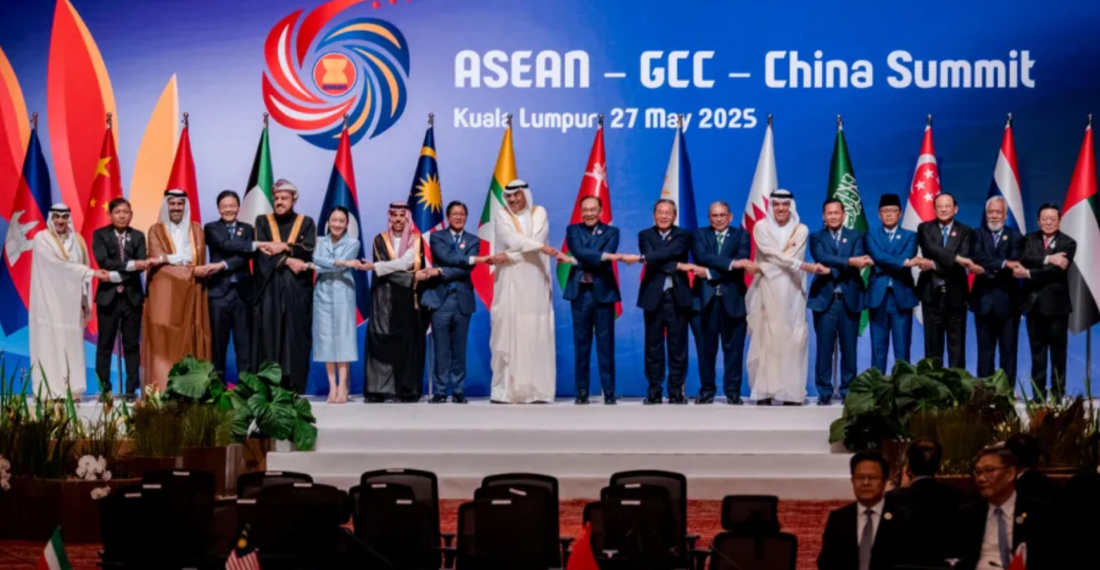
China wants to be first in the world, but its first stop is Asia. While the rest of the world debates and sometimes agonises over whether and how to engage with China, Asian countries have no choice but to engage. And in most cases, they will have to do so on China's terms. Most countries have to play a balancing game, but China is taking no chances. Chinese leader Xi Jinping's recent trip to Southeast Asia in April was a case in point. Another was the China-GCC-ASEAN summit in Kuala Lumpur on 28 May, attended by Chinese Premier Li Qiang and the leaders of the six Gulf monarchies and the ten ASEAN countries.
China-GCC-Asian
Those attending the Kuala Lumpur summit pledged to foster closer cooperation with a strong emphasis on economic integration and energy. The influential South China Morning Post described the summit as “marking a milestone in enhancing tripartite alignment to tackle regional and global challenges”.
In a 4200-word joint statement, which observers described as “comprehensive” the representatives of China, GCC and ASEAN countries reaffirmed their commitment to a rules-based multilateral trading system and economic globalisation. Malaysia currently holds the rotating chair of ASEAN, which also includes Brunei, Cambodia, Indonesia, Laos, Myanmar, the Philippines, Singapore, Thailand and Vietnam. The GCC comprises the six Gulf monarchies: Bahrain, Kuwait, Saudi Arabia, Oman, Qatar and the United Arab Emirates.
In case there was any doubt, the joint statement recognised China’s “critical role in promoting regional and global peace, stability, prosperity and sustainable development”. The statement outlined a broad framework for trilateral cooperation, in line with China’s Belt and Road Initiative and its policy to expand global economic ties.
Communist China and the six hereditary monarchies of the Gulf
One would have thought that China, with its Communist system, the all-pervasive role of the Chinese Communist Party, and the six Gulf hereditary monarchies with their archaic governance and free market economics, were not an easy fit. But China stopped trying to export communism a long time ago, and the two sides have found enough areas of cooperation and mutual benefit, to become bosom friends.
It is worth remembering that the GCC supplies over a third of China’s crude oil imports
US President Donald Trump last month paid a high-profile visit to Saudi Arabia, UAE and Qatar. Big deals were announced, many in the field of defence and security. The GCC mantra in recent years has been based on having the US as the main partner for security, and China as the main partner for trade and economics. Some unkind people have paraphrased this as being with the US for the serious stuff, and with China for everything else. In real life, things cannot be divided so neatly. AI and high tech are areas where the US and China are competing aggressively. Sooner or later, the Gulf Monarchies will have to choose. But for the moment they are happy to say to Trump what he wants to hear, and to sign up for a Chinese-inspired statement in Kuala Lumpur.
Still, China takes no chances, and it wants to show to the Gulf Monarchies that it is a more reliable partner at the international level. The Kuala Lumpur statement highlighted support for the Arab position on Gaza and for a two-state solution for resolving the wider Palestinian problem. China is still basking in the glory of the deal it brokered in 2023 which saw Iran and Saudi Arabia normalising relations.
For China, the Asian space is crucial
If good relations with the GCC countries are a Chinese priority, relations with the geographically closer ASEAN countries are vital. This is not easy for China primarily because of Chinese claims, and increasingly Chinese actions, in the South China Sea. This brings China into direct confrontation with Asean. The Kuala Lumpur statement did not mention the issue at all. But within days the Chinese were flexing their muscles in the Spratley Islands. The Chinese military on Saturday (31 May) launched a sea and air combat readiness patrol around the Scarborough Shoal. According to an official statement issued in Beijing China wanted “to further strengthen its control and defend its sovereignty”.
Vietnam
It is no coincidence that President XI Jinping visited Vietnam during his trip to Southeast Asia in April. Vietnam, like China, has a Communist government, and there were changes in the top leadership of the Vietnamese Communist Party recently. Yet in both countries, the nationalist agenda dominates both the discourse and the actions of the Communist leadership. The two countries fought a war in 1979. In this century Vietnam has developed relations with the US as a counterweight to China. However, China and Vietnam are keen to manage relations to avoid another conflict.
Philippines and the South China Sea
The situation is much more difficult for China when it comes to the Philippines. Chinese ambitions in the South China Sea are being rejected and challenged openly by the government in Manila, led by President Marcos Jr, who has restored the historic relationship between the US and the Philippines.
On Sunday (1 June) the Philippines defence minister Teodoro told the BBC that China has been "absolutely irresponsible and reckless in appropriating most, if not all, of the South China Sea and the world cannot tolerate this."
The Philippines has often complained of aggressive and violent tactics by the Chinese coast guard. The Defence Minister echoed the call for the preservation of the international order, saying that "the takeaway of a lot of defence ministers is that Europe and the US must continue to lead" on this.
EU pushback; Macron in Singapore
Is Europe interested in leading in Asia? In theory yes. The new defence policy sees Europe as a global power. In practice, only two European countries are active Asian players: France and the UK. French President, Emanuel Macron was in Asia in the last days, making the keynote speech at the opening of the Shangri-La Security Forum in Singapore. Usually, the Chinese are central at the Forum, seen also as a good place for Sino-American contacts, especially on defence. Last year the Defence Minister led the Chinese delegation. This year the Chinese presence was low-key, made up of people from the military academies.
That did not stop Macron from setting up his stall. He called for the building of a “new special relationship” between the European Union and Asian countries in the Indo-Pacific region. Macron stressed the need for “new coalitions” between “mid-size countries”. The French president said Asia and Europe have a common interest in preventing the disintegration of the global order.
"The time for non-alignment has undoubtedly passed, but the time for coalitions of action has come and requires that countries capable of acting together give themselves every means to do so," Macron said.
Macron is following leaders of China, Japan and other European countries in visiting the region in recent weeks, in a sign of Southeast Asia's strategic importance amid uncertainties on global supply chains and trade.
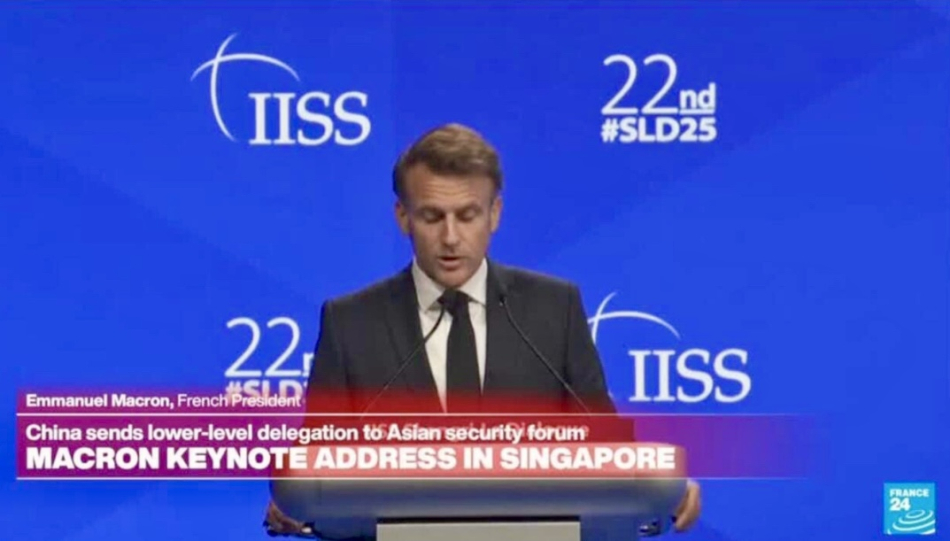
In his keynote address to the Shangri-La security forum, Macron urged China to stop North Korea (DPRK) from sending forces to help Russia's war in Ukraine if it wanted to avoid NATO expanding its role in Asia. "If China doesn't want NATO being involved in Southeast Asia or in Asia, they should prevent DPRK from being engaged on European soil," France’s News 24 news channel quoted Macron as saying.
Taiwan
Of course, the elephant in the room is Taiwan, which China considers as its errant province. China insists that a military move to bring Taiwan back to the Chinese fold is an option. If China moves militarily against Taiwan, the rest of the world will have to act. That is the moment Western leaders dread, but one they must prepare for.
India and Japan
In the end, the breaks on China in Asia will not be the US or Europe. It will be two Asian powers, India and Japan, that China will have to take into account. India-China and Japan-China relations are complex and multifaceted. Slowly but surely both India and Japan are preparing for the moment they have to stand up to China.
Asia’s moment is full of perils for Asian countries
The 21st century is often described as Asia’s moment. Certainly, the continent is the new economic powerhouse. Its military strength is also increasing. Yet this moment is also full of perils to the Asian countries, who must tread with caution.
Please click here to download this week's Monday Commentary.
Source: Dr Dennis Sammut is the Director of LINKS Europe and Managing Editor of commonspace.eu.
The views expressed in opinion pieces and commentaries do not necessarily reflect the position of commonspace.eu or its partners.