


Karabakh: Diplomacy swings into action, as violence takes a respite.

Commentary: This is a commentary prepared by the political editor of commonspace.eu

After four days of violence that claimed dozens of lives and left many wounded, a fragile cessation of hostilities was agreed as from midday on Tuesday (5 April)  between Armenian and Azerbaijani forces in the Nagorno-Karabakh conflict zone. The debacle of the last days starkly exposed the dangers that face the region if this conflict is allowed to fester. It also raised the spectre that outside third parties may easily become embroiled, with huge consequences.

The diplomatic offensive of the last days has been three pronged, even if ostensibly complimentary.

The Russians moved first, they moved fast and they pulled out all the stops. Within hours of the first shots being fired president Putin was calling on the sides to cease hostilities, and the Russian Defence and Foreign Ministers engaged with their Armenian and Azerbaijani counterparts and worked tirelessly to broker a cease fire. Russia has a lot at stake in the region and does not want a large scale war. Informally Russia blamed Turkey of stoking up the trouble by instigating Azerbaijan to launch hostilities, but in public Russia stopped short of blaming Azerbaijan. President Putin was on the phone to president Aliev of Azerbaijan and president Sargsyan of Armenia on Tuesday, apparently using language more reminiscent of Kremlin leaders in Soviet times when dealing with the Union Republics. Prime Minister Medvedev and Foreign Minister Lavrov are visiting the region in the next days. That means that the Russians now have something tangible to propose to the sides. A Russian plan has been in the pipeline for several months. It now looks as if the Russians will use the latest crisis to push it forward.

Russia needs to have its actions in Karabakh acquiesced to by the international community. It has therefore remained committed to the format of the Minsk group co-Chair trio which it chairs with the United States and France. It has resisted calls for a re-configuration of the group, a position also shared by Armenia. But it knows that the failure of the co-Chair to deliver any progress in the negotiations is directly linked to the recent crisis. Russia has therefore allowed for the first time space for the full Minsk Group - the co-Chairs plus a number of other countries including Germany and Turkey, to be involved (or at least appear to be involved) in managing the crisis. Germany currently holds the Chairmanship of the OSCE. It convened the Permanent Council of the organisation in special session on Tuesday, and German diplomacy played some role behind the scenes to get the sides to move to a cessation of hostilities. The president of Armenia embarked this week on a pre scheduled visit to Germany, and no doubt there are plans for contacts with Azerbaijan at the highest level also.

The third element in the diplomatic offensive involved the United States. Vice President Biden met with the presidents of Armenia and Azerbaijan in Washington hours before the latest surge in violence. He was again on the phone to both of them as the fighting ensued. The US is wary to get too embroiled in the Caucasus, and has to balance a number of domestic and international interests - the Armenian diaspora; the strategic relations with Turkey; Azerbaijan's energy resources; the big picture with Russia, etc. It therefore, like Russia, prefers to wrap itself in the mantel of the Minsk Process. In that way it can be fully involved without appearing as if it is competing with Russia in a sensitive region which Mr Putin considers as his backyard.

So as violence takes a respite, diplomacy has now swung into action. But to do what exactly? To put  a lid on the violence only or to try to take the bull by the horns and push for a comprehensive settlement? Time will tell, but given previous experience it is quite possible that after a flurry of activity, once the searchlight of media attention is off, things will slip back to the lethargy of the past, until somebody once more resorts to brinkmanship as a solution to a problem that in fact can only be resolved by cool-headed reasoning.


This is a commentary prepared by the political editor of commonspace.eu

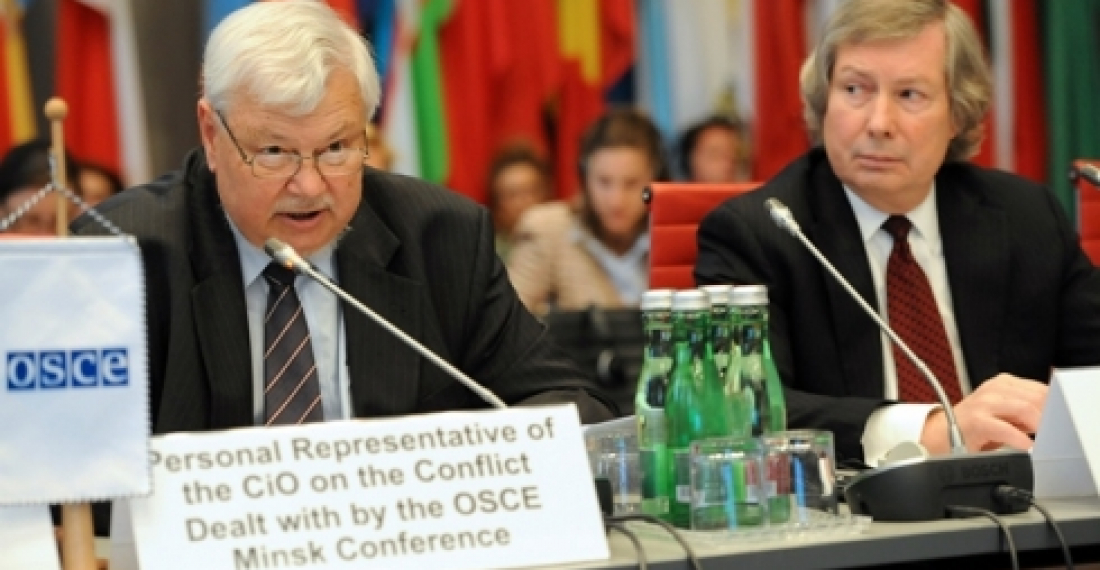
Ambassador Andrzej Kasprzyk (l), the Personal Representative of the Chairperson-in-Office on the conflict dealt with by the OSCE Minsk Conference, speaking alongside James Warlick of the United States of America, one of the three Co-Chairs of the OSCE Minsk Group, Vienna, 5 April 2016. Picture courtesy of the OSCE
Related articles

Editor's choice
News
Council of Europe launches new International Claims Commission for Ukraine

Council of Europe launches new International Claims Commission for Ukraine

Thirty-four countries and the European Union have signed a new convention establishing an International Claims Commission for Ukraine at a diplomatic conference co-hosted by the 46-nation Council of Europe and the Netherlands in the Hague. The diplomatic conference was attended by leaders and high-level representatives from over 50 states, including the President of Ukraine, Volodymyr Zelenskyy, the President of the Republic of Moldova, Maia Sandu, and the Prime Minister of the Netherlands, Dick Schoof.  “Today marks a major step forward in ensuring accountability for Ukraine. The International Claims Commission represents justice and hope for tens of thousands of victims—our determination that those who have suffered will not be forgotten. I call for quick ratifications so we can get the commission rapidly up and running for the people of Ukraine,” said Council of Europe Secretary General Alain Berset. Ukrainian President Volodymyr Zelenskyy said: “We expect that every mechanism for compensation from the Register of Damage and Claims Commission to the actual payments – will start working and receive strong and sufficient international support, so that people can truly feel that any kind of damage caused by the war can be compensated. This war, and Russia’s responsibility for it, MUST become a clear example – so that others learn not to choose aggression.” “Accountability is about creating the conditions for peace that endures. And therefore, accountability is a condition of security – today and for the future. But accountability is not only about Ukraine. And it is not only about one aggressor and one victim. Accountability is about Europe. About every country in Europe. It is about whether Europe, as a whole, is willing to defend its peace,” said Maia Sandu, President of the Republic of Moldova, which currently holds the Presidency of the Council of Europe’s Committee of Ministers. The Prime Minister of the Netherlands, Dick Schoof, said: “Every day Russia is deliberately bombarding homes, destroying businesses and damaging infrastructure in Ukraine. Russia must compensate Ukraine for the damage caused. That is why we have launched the International Claims Commission for Ukraine and we are honoured to host it.” The International Claims Commission will be the second part of a comprehensive compensation mechanism related to Russia’s war of aggression, building on the existing Register of Damage for Ukraine. The claims commission will be established within the framework of the Council of Europe and will also be open to other countries. The Register of Damage for Ukraine, created in 2023, collects and records compensation claims submitted by individuals, organisations and public bodies in Ukraine. Forty-four states and the European Union have so far joined the Register, which has already received 86,000 claims. The International Claims Commission will review, assess and decide upon claims submitted to the Register of Damage for Ukraine and determine the amount of compensation, if any, which is due in each case. The convention establishing the commission will enter into force once it has been ratified by 25 signatories, as long as sufficient funds have been secured to support its initial work.

Popular

Editor's choice
News
Council of Europe launches new International Claims Commission for Ukraine

Council of Europe launches new International Claims Commission for Ukraine

Thirty-four countries and the European Union have signed a new convention establishing an International Claims Commission for Ukraine at a diplomatic conference co-hosted by the 46-nation Council of Europe and the Netherlands in the Hague. The diplomatic conference was attended by leaders and high-level representatives from over 50 states, including the President of Ukraine, Volodymyr Zelenskyy, the President of the Republic of Moldova, Maia Sandu, and the Prime Minister of the Netherlands, Dick Schoof.  “Today marks a major step forward in ensuring accountability for Ukraine. The International Claims Commission represents justice and hope for tens of thousands of victims—our determination that those who have suffered will not be forgotten. I call for quick ratifications so we can get the commission rapidly up and running for the people of Ukraine,” said Council of Europe Secretary General Alain Berset. Ukrainian President Volodymyr Zelenskyy said: “We expect that every mechanism for compensation from the Register of Damage and Claims Commission to the actual payments – will start working and receive strong and sufficient international support, so that people can truly feel that any kind of damage caused by the war can be compensated. This war, and Russia’s responsibility for it, MUST become a clear example – so that others learn not to choose aggression.” “Accountability is about creating the conditions for peace that endures. And therefore, accountability is a condition of security – today and for the future. But accountability is not only about Ukraine. And it is not only about one aggressor and one victim. Accountability is about Europe. About every country in Europe. It is about whether Europe, as a whole, is willing to defend its peace,” said Maia Sandu, President of the Republic of Moldova, which currently holds the Presidency of the Council of Europe’s Committee of Ministers. The Prime Minister of the Netherlands, Dick Schoof, said: “Every day Russia is deliberately bombarding homes, destroying businesses and damaging infrastructure in Ukraine. Russia must compensate Ukraine for the damage caused. That is why we have launched the International Claims Commission for Ukraine and we are honoured to host it.” The International Claims Commission will be the second part of a comprehensive compensation mechanism related to Russia’s war of aggression, building on the existing Register of Damage for Ukraine. The claims commission will be established within the framework of the Council of Europe and will also be open to other countries. The Register of Damage for Ukraine, created in 2023, collects and records compensation claims submitted by individuals, organisations and public bodies in Ukraine. Forty-four states and the European Union have so far joined the Register, which has already received 86,000 claims. The International Claims Commission will review, assess and decide upon claims submitted to the Register of Damage for Ukraine and determine the amount of compensation, if any, which is due in each case. The convention establishing the commission will enter into force once it has been ratified by 25 signatories, as long as sufficient funds have been secured to support its initial work.

