


Intensive diplomatic activity with Karabakh in focus

There has been intensive diplomatic activity over the last few days as the international community tries to maintain the negotiations between Armenia and Azerbaijan on track. This follows a meeting in St Petersburg between the Presidents of the two countries hosted by the President of Russia.

On Thursday (30 June), US Secretary of State, John Kerry spoke on the phone with President Ilham Aliev of Azerbaijan and President Serzh Sargsyan of Armenia. A spokesman for the US State Department confirmed that the main focus of the two conversations was the Karabakh conflict  and its resolution.

In the meantime it was also reported that Russian president Putin briefed his French counterpart, Francois Hollande about the results of the St Petersburg meeting. Russia and France, together with the United States co-chair the Minsk process which is mandated by the international community to mediate a solution of the conflict. The process, initiated in 1992, operates within the framework of the Organisation for Security and Co-operation in Europe (OSCE). There are unconfirmed reports that France has offered to host the next meeting between the Presidents of Armenia and Azerbaijan. Russian Foreign Minister Sergei Lavrov is also expected in the region next week.

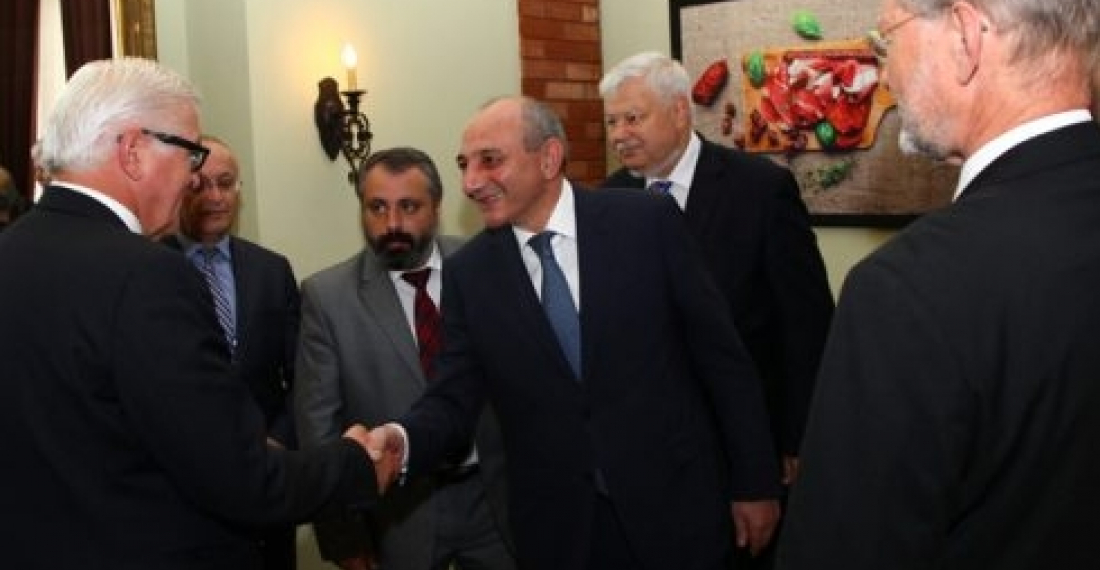
The Chairman-in-Office of the OSCE, German Foreign Minister Frank-Walter Steinmeier, is concurrently in the region where he has already met the key stakeholders in Armenia and Azerbaijan, including the Presidents and the Foreign Ministers in the two countries. In Yerevan on Thursday, Steinmeier  also met with the leadership of the self-declared Nagorno-Karabakh Republic, led by its President Bako Sahakyan. In Baku Steimeier met representatives of the Azerbaijani community displaced from Nagorno-Karabakh as a result of the conflict. 

Commonspace.eu political editor said in a comment that "the international community is trying to maintain the initiative and push the sides to take the negotiations to the next phase. There is cautious optimism that the relative calm on the line of contact that has been observed over the last days can be sustained throughout the usually difficult summer months, and that this will help the negotiations. However there is also recognition that in case progress is not registered in the negotiations more violence is to be expected. Whilst trying to navigate the complicated waters of Caucasus politics, diplomats also have to manage the different agendas of the international powers, who whilst all claiming to support the common efforts to resolve the Karabakh conflict, each have a different nuance as to how this can be achieved."

source: commonspace.eu with agencies.

photo: German Foreign Minister Frank-Walter Steinmeier on Thursday (30 June) met in Yerevan with the President of the self-declared Nagorno-Karabakh Republic Bako Sahakyan (picture courtesy of Armenian Public Radio).
Related articles

Editor's choice
News
Council of Europe launches new International Claims Commission for Ukraine

Council of Europe launches new International Claims Commission for Ukraine

Thirty-four countries and the European Union have signed a new convention establishing an International Claims Commission for Ukraine at a diplomatic conference co-hosted by the 46-nation Council of Europe and the Netherlands in the Hague. The diplomatic conference was attended by leaders and high-level representatives from over 50 states, including the President of Ukraine, Volodymyr Zelenskyy, the President of the Republic of Moldova, Maia Sandu, and the Prime Minister of the Netherlands, Dick Schoof.  “Today marks a major step forward in ensuring accountability for Ukraine. The International Claims Commission represents justice and hope for tens of thousands of victims—our determination that those who have suffered will not be forgotten. I call for quick ratifications so we can get the commission rapidly up and running for the people of Ukraine,” said Council of Europe Secretary General Alain Berset. Ukrainian President Volodymyr Zelenskyy said: “We expect that every mechanism for compensation from the Register of Damage and Claims Commission to the actual payments – will start working and receive strong and sufficient international support, so that people can truly feel that any kind of damage caused by the war can be compensated. This war, and Russia’s responsibility for it, MUST become a clear example – so that others learn not to choose aggression.” “Accountability is about creating the conditions for peace that endures. And therefore, accountability is a condition of security – today and for the future. But accountability is not only about Ukraine. And it is not only about one aggressor and one victim. Accountability is about Europe. About every country in Europe. It is about whether Europe, as a whole, is willing to defend its peace,” said Maia Sandu, President of the Republic of Moldova, which currently holds the Presidency of the Council of Europe’s Committee of Ministers. The Prime Minister of the Netherlands, Dick Schoof, said: “Every day Russia is deliberately bombarding homes, destroying businesses and damaging infrastructure in Ukraine. Russia must compensate Ukraine for the damage caused. That is why we have launched the International Claims Commission for Ukraine and we are honoured to host it.” The International Claims Commission will be the second part of a comprehensive compensation mechanism related to Russia’s war of aggression, building on the existing Register of Damage for Ukraine. The claims commission will be established within the framework of the Council of Europe and will also be open to other countries. The Register of Damage for Ukraine, created in 2023, collects and records compensation claims submitted by individuals, organisations and public bodies in Ukraine. Forty-four states and the European Union have so far joined the Register, which has already received 86,000 claims. The International Claims Commission will review, assess and decide upon claims submitted to the Register of Damage for Ukraine and determine the amount of compensation, if any, which is due in each case. The convention establishing the commission will enter into force once it has been ratified by 25 signatories, as long as sufficient funds have been secured to support its initial work.

Popular

Editor's choice
News
Council of Europe launches new International Claims Commission for Ukraine

Council of Europe launches new International Claims Commission for Ukraine

Thirty-four countries and the European Union have signed a new convention establishing an International Claims Commission for Ukraine at a diplomatic conference co-hosted by the 46-nation Council of Europe and the Netherlands in the Hague. The diplomatic conference was attended by leaders and high-level representatives from over 50 states, including the President of Ukraine, Volodymyr Zelenskyy, the President of the Republic of Moldova, Maia Sandu, and the Prime Minister of the Netherlands, Dick Schoof.  “Today marks a major step forward in ensuring accountability for Ukraine. The International Claims Commission represents justice and hope for tens of thousands of victims—our determination that those who have suffered will not be forgotten. I call for quick ratifications so we can get the commission rapidly up and running for the people of Ukraine,” said Council of Europe Secretary General Alain Berset. Ukrainian President Volodymyr Zelenskyy said: “We expect that every mechanism for compensation from the Register of Damage and Claims Commission to the actual payments – will start working and receive strong and sufficient international support, so that people can truly feel that any kind of damage caused by the war can be compensated. This war, and Russia’s responsibility for it, MUST become a clear example – so that others learn not to choose aggression.” “Accountability is about creating the conditions for peace that endures. And therefore, accountability is a condition of security – today and for the future. But accountability is not only about Ukraine. And it is not only about one aggressor and one victim. Accountability is about Europe. About every country in Europe. It is about whether Europe, as a whole, is willing to defend its peace,” said Maia Sandu, President of the Republic of Moldova, which currently holds the Presidency of the Council of Europe’s Committee of Ministers. The Prime Minister of the Netherlands, Dick Schoof, said: “Every day Russia is deliberately bombarding homes, destroying businesses and damaging infrastructure in Ukraine. Russia must compensate Ukraine for the damage caused. That is why we have launched the International Claims Commission for Ukraine and we are honoured to host it.” The International Claims Commission will be the second part of a comprehensive compensation mechanism related to Russia’s war of aggression, building on the existing Register of Damage for Ukraine. The claims commission will be established within the framework of the Council of Europe and will also be open to other countries. The Register of Damage for Ukraine, created in 2023, collects and records compensation claims submitted by individuals, organisations and public bodies in Ukraine. Forty-four states and the European Union have so far joined the Register, which has already received 86,000 claims. The International Claims Commission will review, assess and decide upon claims submitted to the Register of Damage for Ukraine and determine the amount of compensation, if any, which is due in each case. The convention establishing the commission will enter into force once it has been ratified by 25 signatories, as long as sufficient funds have been secured to support its initial work.

