EU must up its game in Karabakh, say experts in Brussels

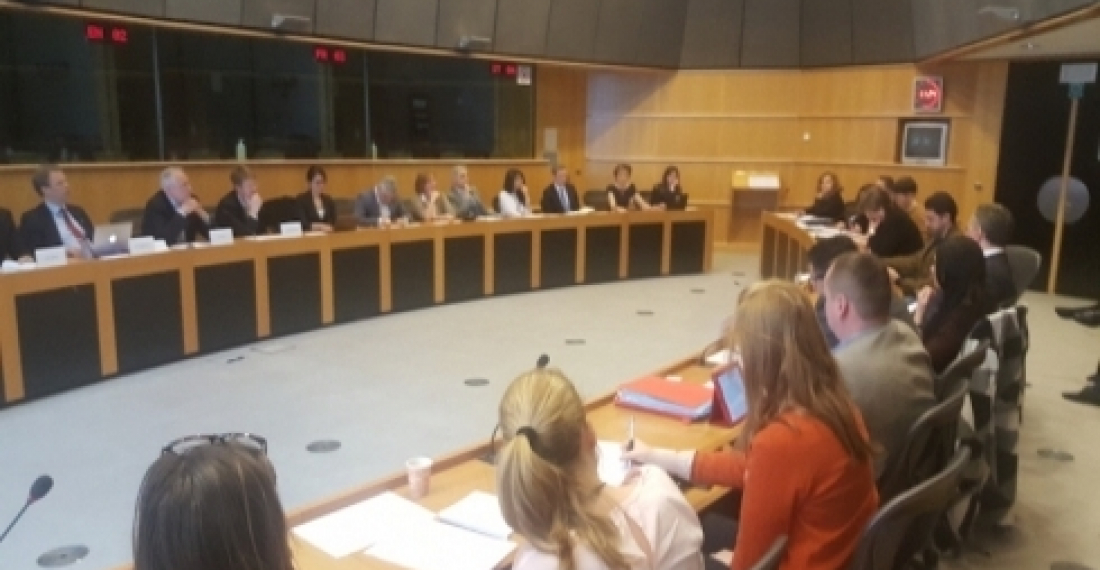
Following heavy fighting in Nagorno-Karbakh earlier this month, policy experts and MEPs, debated what the EU can do to help at a meeting in the European Parliament on Thursday.

Fighting between Armenia and Azerbaijan, the worst violence for two decades, began on April 2. It left dozens dead and many more wounded. A ceasefire was brokered on April 5, but since then, both sides have claimed numerous violations by the other side. 

The European Union must take a more active role, said Amanda Paul of the European Policy Centre (EPC) and Dennis Sammut of LINKS, who recently co-authored a policy paper together on the topic.

The discussion in Brussels was chaired by Ivo Vajgl MEP, a former foreign minister of Slovenia. Finding a solution in Nagorno-Karabakh is critical because a bigger outbreak of violence could lead to a humanitarian crisis, he said.

Panellists expressed their support for the European Partnership for the Peaceful Settlement of the Conflict over Nagorno-Karabakh (EPNK), a civil society initiative.

Armenian and Azerbaijani representatives were also present, as were EU officials. Razvan Rab, the European External Action Service’s political officer for relations with Armenia, emphasized EU support for the Minsk process peace plan under the so-called ‘Madrid principles’.

His comments were echoed by Lawrence Meredith, director of the EU’s “Neighbourhood East,” noting the positive recent precedent of talks between Kosovo and Serbia.

RUSSIA’S ROLE

“If you have a security vacuum, Russia wants to fill it”, said Paul, who described the situation in Nagorno-Karabakh as the most volatile and dangerous it has been for years. More died in a few days than did in several years before April 2, she said, adding that the status quo is “gone forever”.

While Russia was quick on the scene, with foreign minister Lavrov and prime minister Medvedev visiting Yerevan and Baku, the EU acted like a “rabbit trapped in the headlights,” she said, with the situation as it stands remaining extremely dangerous. 

“Both sides have procured very high level weaponry, on the ground and in the air,” said Paul. Russia sells arms to both Armenia and Azerbaijan, though as Russia\'s ally in the Collective Treaty Security Organisation, Armenia buys arms at discounted rates. 

Both Paul and Sammut said the EU should not expend undue energy debating who was responsible for starting specific incidents, because both sides have committed violations and both sides are responsible for killing. Rather than getting bogged down in historical details it is best to look forward, said Sammut, who also emphasized the importance of person-to-person contacts.

“Civil society over the last few weeks has been under a lot of pressure from nationalistic sources that have accused people who engage and work for cross-community dialogue as being traitors,” he said. As the biggest player in the region overall, the EU is the best partner for civil society in Armenia and Azerbaijan, so EU engagement is vital, Sammut added. 

Although the two policy analysts were unwilling to get drawn on who started the latest clashes, Paul did say the status quo clearly favours Armenia more than Azerbaijan.

UNSOLVED CONFLICTS

As a result of this imbalance, Azerbaijan wanted to score a morale boost by winning back territory, which it successfully did to a small extent for the first time since the 1994 ceasefire, said Paul.

MEPs also played an active part in the discussion. Norica Nicolai, from Romania, disputed the role as both “peacemaker and warmonger” played by Russia. “The territory [of Nagorno-Karabakh] belongs to Azerbaijan,” she said.

A spokeswoman for Buglarian MEP Angel Dzhambazki, condemnded the role being played by Turkey, Azerbaijan’s close ally. Eldar Mamedov, a political advisor to the Socialists and Democreats group, also criticized Turkey’s role, accusing panelists of overstating the role of Russia at the expense of Turkey, noting that unlike Russia, Turkey did not call for an immediate ceasefire at the beginning of April.

However, according to the two panellists, focusing on Russia is important because, as has been shown in Crimea, South Ossetia, Abkhazia and Syria, the country plays a very active role in the region’s unsolved conflicts. (Paul, like others on Thursday, criticized the term “frozen conflicts” as inappropriate when there have been so many deaths are still routine.)

This makes is all the more important for the EU to up its game, Paul and Sammut said.

“At the international level there is no other player that can play a counterpart to Russia in this region, because the United States is clearly not interested in engaging in another conflict on the European continent in an effective way,” said Sammut, arguing EU involvement is not just important, but absolutely essential. “Unless the EU engages with the resolution of the conflict, it’s very difficult to see how a change can happen,” he said.

An Azerbaijani policy analyst, Vugar Saidov, stressed the importance of choosing words carefully when discussing Nagorno-Karabakh, noting that the word “enclave” is not accepted by the Azerbaijani side. Armenian representatives firmly countered some of the points made by Saidov and other speakers.

THE EU’S ROLE

While the two governments do indeed share much of the blame for the status quo, realistically speaking, there will be no solution without two external factors, according to Sammut: a change in the international context, and a change in the way society engages with these issues in the two countries. 

“The EU must start with what it has already,” he said, praising the work done by Herbert Salber, the EU’s Special Representative for the South Caucasus, though adding the EU does not have sufficient resources to tackle such a huge and deeply rooted conflict.

In their paper published two weeks ago, Sammut and Paul also said the EU should be represented in the wider Minsk Group, such as through the EU member state holding the rotating EU presidency, a suggestion repeated at the Brussels round table.

They also expressed their support for inter-parliamentary initiatives between the EU and Armenia and Azerbaijan, such as Euronest.

In their paper, Sammut and Paul also suggested appointing EU military liaison officers in Baku and Yerevan, ensuring member state positions on Karabakh are better synchronised, and bringing the Karabakh conflict into closer focus, both in the EU’s dealings with Armenia and Azerbaijan, and in dealing with other stakeholders such as Russia, Turkey and Iran.

SOURCE: commonspace.eu

PHOTO: commonspace.eu
 

Related articles

Editor's choice
News
Council of Europe launches new International Claims Commission for Ukraine

Council of Europe launches new International Claims Commission for Ukraine

Thirty-four countries and the European Union have signed a new convention establishing an International Claims Commission for Ukraine at a diplomatic conference co-hosted by the 46-nation Council of Europe and the Netherlands in the Hague. The diplomatic conference was attended by leaders and high-level representatives from over 50 states, including the President of Ukraine, Volodymyr Zelenskyy, the President of the Republic of Moldova, Maia Sandu, and the Prime Minister of the Netherlands, Dick Schoof.  “Today marks a major step forward in ensuring accountability for Ukraine. The International Claims Commission represents justice and hope for tens of thousands of victims—our determination that those who have suffered will not be forgotten. I call for quick ratifications so we can get the commission rapidly up and running for the people of Ukraine,” said Council of Europe Secretary General Alain Berset. Ukrainian President Volodymyr Zelenskyy said: “We expect that every mechanism for compensation from the Register of Damage and Claims Commission to the actual payments – will start working and receive strong and sufficient international support, so that people can truly feel that any kind of damage caused by the war can be compensated. This war, and Russia’s responsibility for it, MUST become a clear example – so that others learn not to choose aggression.” “Accountability is about creating the conditions for peace that endures. And therefore, accountability is a condition of security – today and for the future. But accountability is not only about Ukraine. And it is not only about one aggressor and one victim. Accountability is about Europe. About every country in Europe. It is about whether Europe, as a whole, is willing to defend its peace,” said Maia Sandu, President of the Republic of Moldova, which currently holds the Presidency of the Council of Europe’s Committee of Ministers. The Prime Minister of the Netherlands, Dick Schoof, said: “Every day Russia is deliberately bombarding homes, destroying businesses and damaging infrastructure in Ukraine. Russia must compensate Ukraine for the damage caused. That is why we have launched the International Claims Commission for Ukraine and we are honoured to host it.” The International Claims Commission will be the second part of a comprehensive compensation mechanism related to Russia’s war of aggression, building on the existing Register of Damage for Ukraine. The claims commission will be established within the framework of the Council of Europe and will also be open to other countries. The Register of Damage for Ukraine, created in 2023, collects and records compensation claims submitted by individuals, organisations and public bodies in Ukraine. Forty-four states and the European Union have so far joined the Register, which has already received 86,000 claims. The International Claims Commission will review, assess and decide upon claims submitted to the Register of Damage for Ukraine and determine the amount of compensation, if any, which is due in each case. The convention establishing the commission will enter into force once it has been ratified by 25 signatories, as long as sufficient funds have been secured to support its initial work.

Popular

Editor's choice
News
Council of Europe launches new International Claims Commission for Ukraine

Council of Europe launches new International Claims Commission for Ukraine

Thirty-four countries and the European Union have signed a new convention establishing an International Claims Commission for Ukraine at a diplomatic conference co-hosted by the 46-nation Council of Europe and the Netherlands in the Hague. The diplomatic conference was attended by leaders and high-level representatives from over 50 states, including the President of Ukraine, Volodymyr Zelenskyy, the President of the Republic of Moldova, Maia Sandu, and the Prime Minister of the Netherlands, Dick Schoof.  “Today marks a major step forward in ensuring accountability for Ukraine. The International Claims Commission represents justice and hope for tens of thousands of victims—our determination that those who have suffered will not be forgotten. I call for quick ratifications so we can get the commission rapidly up and running for the people of Ukraine,” said Council of Europe Secretary General Alain Berset. Ukrainian President Volodymyr Zelenskyy said: “We expect that every mechanism for compensation from the Register of Damage and Claims Commission to the actual payments – will start working and receive strong and sufficient international support, so that people can truly feel that any kind of damage caused by the war can be compensated. This war, and Russia’s responsibility for it, MUST become a clear example – so that others learn not to choose aggression.” “Accountability is about creating the conditions for peace that endures. And therefore, accountability is a condition of security – today and for the future. But accountability is not only about Ukraine. And it is not only about one aggressor and one victim. Accountability is about Europe. About every country in Europe. It is about whether Europe, as a whole, is willing to defend its peace,” said Maia Sandu, President of the Republic of Moldova, which currently holds the Presidency of the Council of Europe’s Committee of Ministers. The Prime Minister of the Netherlands, Dick Schoof, said: “Every day Russia is deliberately bombarding homes, destroying businesses and damaging infrastructure in Ukraine. Russia must compensate Ukraine for the damage caused. That is why we have launched the International Claims Commission for Ukraine and we are honoured to host it.” The International Claims Commission will be the second part of a comprehensive compensation mechanism related to Russia’s war of aggression, building on the existing Register of Damage for Ukraine. The claims commission will be established within the framework of the Council of Europe and will also be open to other countries. The Register of Damage for Ukraine, created in 2023, collects and records compensation claims submitted by individuals, organisations and public bodies in Ukraine. Forty-four states and the European Union have so far joined the Register, which has already received 86,000 claims. The International Claims Commission will review, assess and decide upon claims submitted to the Register of Damage for Ukraine and determine the amount of compensation, if any, which is due in each case. The convention establishing the commission will enter into force once it has been ratified by 25 signatories, as long as sufficient funds have been secured to support its initial work.