


EU calls for an investigation in helicopter downing incident in Karabakh

The European Union has called for an investigation in  an incident in which an Armenian military helicopter, belonging to the armed forces of the self-declared Nagorno-Karabakh Republic, was shot down by Azerbaijan. A statement issued by the European External Action Service (EEAS) said "it is essential that all sides show restraint and avoid any actions or statements which could escalate the situation. Furthermore, we call for an investigation into this incident."

In its' statement the European Union reiterated its full support to the efforts of the OSCE Minsk Group and the three Co-Chairs. It said both sides have to strictly respect the ceasefire, to refrain from the use of force or any threat thereof, and to resume efforts towards a peaceful resolution of the Nagorno-Karabakh conflict."

On their part, the three co-Chairman of the OSCE Minsk Process also issued a statement following the incident. Ambassadors Igor Popov of the Russian Federation, James Warlick of the United States, and Pierre Andrieu of France expressed their very serious concern about the downing of a helicopter near the Line of Contact and the recent violence. "We regret the loss of life and express our condolences to the families", they said in their statement

The Co-Chairs are deeply worried by the events that prompted this drastic incident, the first of its kind since the ceasefire agreement was reached. Their statement added, "We strongly appeal to the sides to avoid steps that would escalate tension along the Line of Contact and Armenia-Azerbaijan border. The region cannot afford another round of violence like we witnessed this summer. Today's events remind us of the volatility of the Nagorno-Karabakh conflict and the urgency to intensify efforts to find a lasting settlement. We remain resolved to assist the sides in any way possible. We remind the Presidents of Armenia and Azerbaijan of their responsibilities to respect the ceasefire and honour the commitments they made in Sochi, Newport, and Paris to find a peaceful resolution to the conflict. We also encourage them to adopt confidence-building measures now that would increase transparency along the Line of Contact and the Armenia-Azerbaijan border, and reduce the likelihood of events like today's incident."

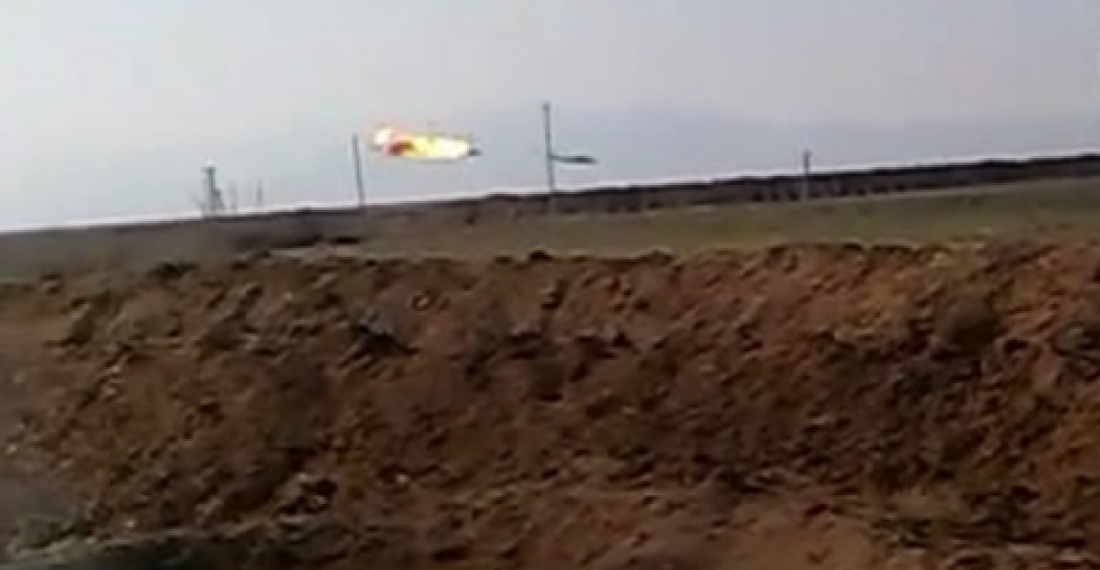
According to media reports two Armenian helicopters approached the Azerbaijani side of the line of contact whilst participating in military manoevres that have been going on for the last days. One of the helicopters was shot down and the other escaped. Azerbaijan has confirmed it shot down the Armenian helicopter 1700 meters north-east of Kangarli village (Aghdam region). This is the first time that an aircraft has been shot down in the Karabakh conflict zone since the cease fire came into force twenty years ago. A statement by the Azerbaijani Foreign Ministry said that the Azerbaijani forces shot down the helicopter whilst responding to its fire. The Azerbaijani Defence Minister in the meantime has said that the soldier who shot down the helicopter has been given a medal.

According to Armenian sources "The helicopter was shot down on Wednesday at around 1:45pm, and as a result of ceasefire violation by the Azerbaijani armed forces. The helicopter was shot during a training flight in the airspace of the eastern sector of the Karabakh-Azerbaijan border. The location where the helicopter was shot at is very close to the Line of Contact."

Armenian Defense Minister press secretary, Artsrun Hovhannisyan, told Armenian News-NEWS.am that "the Azerbaijani accusations that the Armenian helicopters had launched an attack on Azerbaijani positions are mindless, since an examination of the pieces of the helicopter's debris will confirm that it was not armed".

source: commonspace.eu

photo: An Armenian helicopter is seen ablaze after being hit by Azerbaijani fire near the line of contact in the Nagorno-Karabakh conflict zone. A second Armenian helicopter is seen moving away from the incident. (Photo is one of a series released by the Ministry of Defence of Azerbaijan).



 

Related articles

Editor's choice
News
10th anniversary of a failed coup that redefined Turkiye

10th anniversary of a failed coup that redefined Turkiye

Ten years ago, parts of the Turkish military attempted to overthrow the government of President Recep Tayyip Erdogan. The consequences of the failed coup continue to shape Turkiye to this day.  It was the evening of July 15, 2016. A warm summer day was coming to an end. Many people were spending their Friday evening with friends or family, looking forward to the weekend. There was nothing to suggest that Turkiye was about to be fundamentally transformed. Then, just a few hours later, tanks were rolling through the streets. Fighter jets flying over Ankara and Istanbul. Soldiers blocking the Bosphorus Bridge, the link between Europe and Asia. The parliament in Ankara came under fire. Turkish President Recep Tayip Erdogan called on the public via a video call broadcast to take to the streets and stop the coup. The coup attempt failed that very night, but its political consequences continue to impact the country The Turkish government blamed the Gulen movement for the coup attempt. Its founder, the Muslim cleric Fetullah Gulen was based in the United States. The government accused Gulen of having infiltrated the judiciary, police, military, and other state institutions with followers over decades in an effort to undermine the state. Gulen and his followers denied any involvement in the coup. Many high-ranking military officials with alleged ties to Gulen were arrested.. Gulen died in the US aged 83 in the US in 2024. In Turkey, July 15 is now a national holiday. The former Bosphorus Bridge was renamed the "Bridge of the Martyrs of July 15." It commemorates the people who lost their lives that night. According to official figures, 253 people died, most of them civilians. Many streets, squares and schools also bear the name "July 15". However, the anniversary is not just about commemorating the victims. It also marks a profound political turning point. The Gulen movement was designated a terrorist organization, and its alleged supporters were largely extracted from the state apparatus. Six days after the coup, parliament approved a state of emergency. It was initially limited to three months but did not end until July 19, 2018. During those two years, the president governed largely by emergency decrees, issuing 32 decrees in total. The consequences of these political purges have been enormous. More than 125,000 members of the civil service and the armed forces were dismissed. According to official figures, approximately 390,000 people had been detained or arrested between 2016 and 2025 on suspicion of ties to Gulen.

Popular

Editor's choice
Interview
Thursday Interview: Murad Muradov

Thursday Interview: Murad Muradov

Today, commonspace.eu starts a new regular weekly series. THURSDAY INTERVIEW, conducted by Lauri Nikulainen, will host  persons who are thinkers, opinion shapers, and implementors in their countries and spheres. We start the series with an interview with Murad Muradov, a leading person in Azerbaijan's think tank community. He is also the first co-chair of the Action Committee for a new Armenian-Azerbaijani Dialogue. Last September he made history by being the first Azerbaijani civil society activist to visit Armenia after the 44 day war, and the start of the peace process. Speaking about this visit Murad Muradov said: "My experience was largely positive. My negative expectations luckily didn’t play out. The discussions were respectful, the panel format bringing together experts from Armenia, Azerbaijan, and Turkey was particularly valuable during the NATO Rose-Roth Seminar in Yerevan, and media coverage, while varied in tone, remained largely constructive. Some media outlets though attempted to represent me as more of a government mouthpiece than an independent expert, which was totally misleading.  Overall, I see these initiatives as important steps in rebuilding trust and normalising professional engagement. The fact that soon a larger Azerbaijani civil society visits to Armenia followed, reinforces the sense that this process is moving in the right direction." (click the image to read the interview in full)