


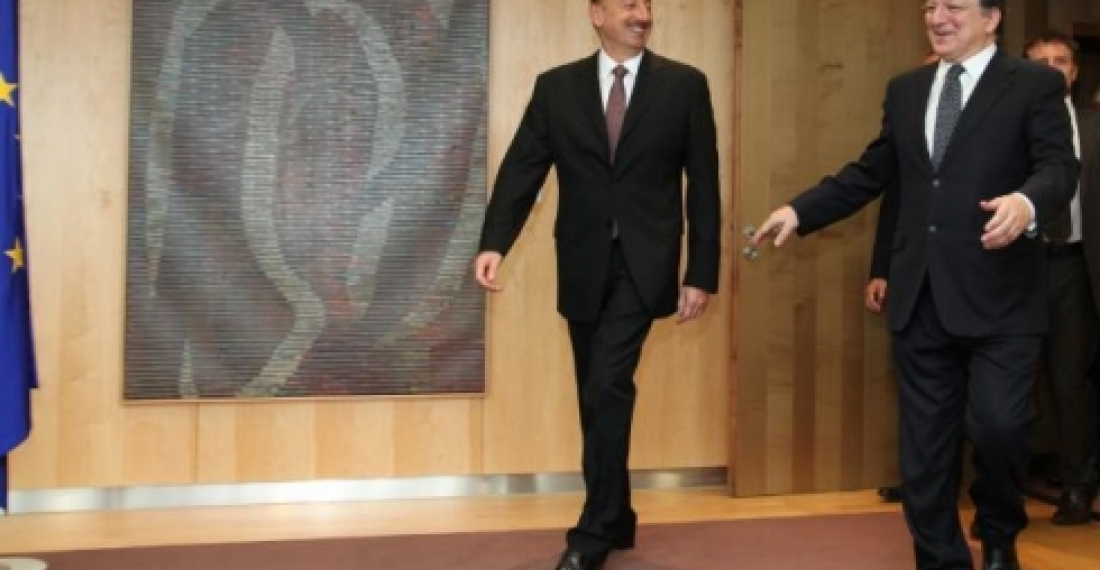
EU-Azerbaijan Relations are good. Now it is time to make them better. Oil, gas, pipelines and human rights discussed during Aliev's visit to EU.

President Ilham Aliev of Azerbaijan yesterday visited the European institutions in Brussels. He met the President of the European Council, Herman van Rompuy and the President of the European Commission Jose Manuel Barroso. Discussions focused on the future of Azerbaijan's relations with the European Union, issues of tangible cooperation particularly connected with energy, and questions of democratisation and human rights.


Speaking after his meeting with the Azerbaijani leader, President Herman van Rompuy said


"EU-Azerbaijan relations are good. Our long term committment is to strenghtening our relations even further by working towards concluding negotiations on the Association Agreement. With an Association Agreement our relationship can achieve its full potential". Van Rompuy said that he had reminded President Aliev "of the European Union's very firm ambition to achieve a long term association with Azerbaijan, with democracy and shared values at its core, in particular human rights and fundamental freedoms."


The theme was later echoed by the President of the European Commission, Jose Manuel Barroso. who told President Aliev that "2013 is indeed a year of great opportunity for EU-Azerbaijan relations. I stand for broader and deeper relations with your nation, a country which we very much respect, with energy as an excellent starting point and with shared values at the core."


Energy dominated the discussions in the meetings between President Aliev and EU leaders. As President Barroso said at the conclusion of the visit, the stakes are quite high. Referring to the new gas pipeline project that will connect Azerbaijan to European energy markets Barroso said:  "The Southern Gas Corridor is not a theoretical project on the drawing board. It is about to be realized, to the benefit of all involved. It will bring initially 10 billion cubic meters to Europe by 2019, but we will not stop here. The Corridor could in the medium term cover more than 10% of our annual needs in Europe and thus contribute to our energy security, price stability, growth and jobs. This is our common vision as President Aliyev and I agreed in 2011. This is what we will keep working for, to enhance our mutual security of supply. We believe this is in the best interest of Europe and Azerbaijan."


On his part President Aliev also highlighted the importance of relations with the EU for Azerbaijan. He said “Azerbaijan wants to be close to Europe as much as possible.” Aliev reiterated that Azerbaijan and the EU are continuing cooperating within the framework of the Eastern Partnership program. Ilham Aliyev expressed his thanks to the European institutions for supporting Azerbaijan’s development, including in the area of human rights. “This support helps Azerbaijan carry out reforms in line with the high world standards,” he said.


Commonspace.eu political editor said in a comment:


"The visit of President Aliev to the European institutions in Brussels came at a very decisive moment in EU-Azerbaijan relations. The two sides understand that this is a defining moment for these relations and that they now need either to deepen their relationship or distant themselves from each other. It seems from the tone and the atmosphere during the Brussels meetings that the two sides have decided to take the relationship forward. This requires balancing the economic side of the co-operation, particularly in the energy sector, with a sound political basis, particularly related to issues of governance and human rights. Both sides now recognise that these processes cannot be separated. The next few weeks will show if words can now be translated into deeds. The decision on the Southern Energy Corridor is due in the next days. President Barroso has hinted that in the long term both options that are currently being considered may be implemented, but for the moment a clear choice will set the process of construction in motion. In the political sphere Azerbaijan will hold Presidential elections in October. It is clear that much depends on how these elections are conducted and on the ability of the Azerbaijani leadership to conduct elections that are not only technically well organised, but that are held in an atmosphere that will allow the Azerbaijani people to elect their leader in a free and fair environment. The message coming out from the Brussels meetings are clear. EU-Azerbaijan relations are good. Now is the time to make them better."


source: commonspace.eu with the Press Service of the European Union and agencies.


picture: President Barroso and President Aliev in Brussels on 21 June 2013. (Picture courtesy of the Press and Audio Visual Serviuce of the European Union."

Related articles

Editor's choice
News
Council of Europe launches new International Claims Commission for Ukraine

Council of Europe launches new International Claims Commission for Ukraine

Thirty-four countries and the European Union have signed a new convention establishing an International Claims Commission for Ukraine at a diplomatic conference co-hosted by the 46-nation Council of Europe and the Netherlands in the Hague. The diplomatic conference was attended by leaders and high-level representatives from over 50 states, including the President of Ukraine, Volodymyr Zelenskyy, the President of the Republic of Moldova, Maia Sandu, and the Prime Minister of the Netherlands, Dick Schoof.  “Today marks a major step forward in ensuring accountability for Ukraine. The International Claims Commission represents justice and hope for tens of thousands of victims—our determination that those who have suffered will not be forgotten. I call for quick ratifications so we can get the commission rapidly up and running for the people of Ukraine,” said Council of Europe Secretary General Alain Berset. Ukrainian President Volodymyr Zelenskyy said: “We expect that every mechanism for compensation from the Register of Damage and Claims Commission to the actual payments – will start working and receive strong and sufficient international support, so that people can truly feel that any kind of damage caused by the war can be compensated. This war, and Russia’s responsibility for it, MUST become a clear example – so that others learn not to choose aggression.” “Accountability is about creating the conditions for peace that endures. And therefore, accountability is a condition of security – today and for the future. But accountability is not only about Ukraine. And it is not only about one aggressor and one victim. Accountability is about Europe. About every country in Europe. It is about whether Europe, as a whole, is willing to defend its peace,” said Maia Sandu, President of the Republic of Moldova, which currently holds the Presidency of the Council of Europe’s Committee of Ministers. The Prime Minister of the Netherlands, Dick Schoof, said: “Every day Russia is deliberately bombarding homes, destroying businesses and damaging infrastructure in Ukraine. Russia must compensate Ukraine for the damage caused. That is why we have launched the International Claims Commission for Ukraine and we are honoured to host it.” The International Claims Commission will be the second part of a comprehensive compensation mechanism related to Russia’s war of aggression, building on the existing Register of Damage for Ukraine. The claims commission will be established within the framework of the Council of Europe and will also be open to other countries. The Register of Damage for Ukraine, created in 2023, collects and records compensation claims submitted by individuals, organisations and public bodies in Ukraine. Forty-four states and the European Union have so far joined the Register, which has already received 86,000 claims. The International Claims Commission will review, assess and decide upon claims submitted to the Register of Damage for Ukraine and determine the amount of compensation, if any, which is due in each case. The convention establishing the commission will enter into force once it has been ratified by 25 signatories, as long as sufficient funds have been secured to support its initial work.

Popular

Editor's choice
News
Council of Europe launches new International Claims Commission for Ukraine

Council of Europe launches new International Claims Commission for Ukraine

Thirty-four countries and the European Union have signed a new convention establishing an International Claims Commission for Ukraine at a diplomatic conference co-hosted by the 46-nation Council of Europe and the Netherlands in the Hague. The diplomatic conference was attended by leaders and high-level representatives from over 50 states, including the President of Ukraine, Volodymyr Zelenskyy, the President of the Republic of Moldova, Maia Sandu, and the Prime Minister of the Netherlands, Dick Schoof.  “Today marks a major step forward in ensuring accountability for Ukraine. The International Claims Commission represents justice and hope for tens of thousands of victims—our determination that those who have suffered will not be forgotten. I call for quick ratifications so we can get the commission rapidly up and running for the people of Ukraine,” said Council of Europe Secretary General Alain Berset. Ukrainian President Volodymyr Zelenskyy said: “We expect that every mechanism for compensation from the Register of Damage and Claims Commission to the actual payments – will start working and receive strong and sufficient international support, so that people can truly feel that any kind of damage caused by the war can be compensated. This war, and Russia’s responsibility for it, MUST become a clear example – so that others learn not to choose aggression.” “Accountability is about creating the conditions for peace that endures. And therefore, accountability is a condition of security – today and for the future. But accountability is not only about Ukraine. And it is not only about one aggressor and one victim. Accountability is about Europe. About every country in Europe. It is about whether Europe, as a whole, is willing to defend its peace,” said Maia Sandu, President of the Republic of Moldova, which currently holds the Presidency of the Council of Europe’s Committee of Ministers. The Prime Minister of the Netherlands, Dick Schoof, said: “Every day Russia is deliberately bombarding homes, destroying businesses and damaging infrastructure in Ukraine. Russia must compensate Ukraine for the damage caused. That is why we have launched the International Claims Commission for Ukraine and we are honoured to host it.” The International Claims Commission will be the second part of a comprehensive compensation mechanism related to Russia’s war of aggression, building on the existing Register of Damage for Ukraine. The claims commission will be established within the framework of the Council of Europe and will also be open to other countries. The Register of Damage for Ukraine, created in 2023, collects and records compensation claims submitted by individuals, organisations and public bodies in Ukraine. Forty-four states and the European Union have so far joined the Register, which has already received 86,000 claims. The International Claims Commission will review, assess and decide upon claims submitted to the Register of Damage for Ukraine and determine the amount of compensation, if any, which is due in each case. The convention establishing the commission will enter into force once it has been ratified by 25 signatories, as long as sufficient funds have been secured to support its initial work.

