Leaders of many countries gathered in Gallipoli on Friday morning to honour those who fell during the bloody battles that started with allied landings on the Peninsula one hundred years ago.
Turkey says that in hosting world leaders, including those of its former enemies, it is sending a message of peace. and reconciliation.
Tens of thousands lost their lives on both sides in the nine month battle between the German-backed Ottoman forces and Allies including Australian, British and New Zealand troops trying to break through to take Istanbul and defeat the Ottoman Empire. The battle is often described as a defining moment not only for the emergence of Turkey as a modern state out of the ashes of the ottoman Empire, but also of British Commonwealth nations such as Australia and New Zealand.
Cemetries for the fallen troops from both sides are to be found in close proximity to each other on the Peninsula
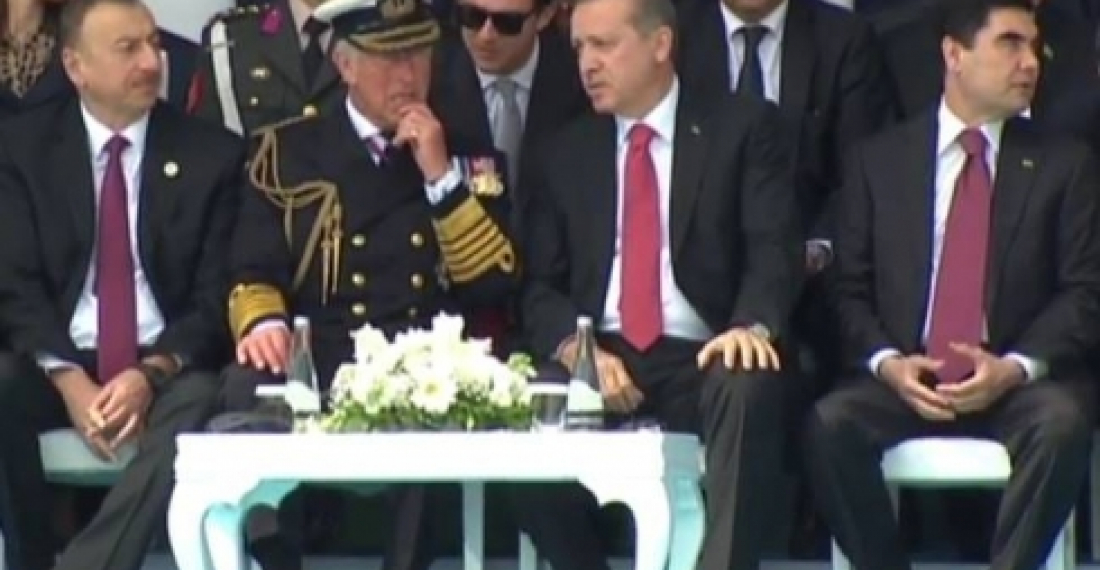
17 Presidents and 5 Prime Ministers, including Prime Minister Tony Abbott of Australia, New Zealand Premier John Key, as well as the heir to the British throne Prince Charles and his son Harry are among those attending the ceremonies.
Turkish President, Recip Tayip Erdoğan said in a message ahead of the ceremonies, "We paid a high price for the Gallipoli victory. Yet we should not forget that we owe our current independent state to that spirit and perseverance that we showed."
Source: commonspace.eu with agencies.
Photot: The Heir to the British throne, Prine Charles flanked by President Aliev of Azerbaijan and President Erdogan of Turkey at ceremonies marking the centenary of the Gallipoli landings in 2015. (Picture photo grab from TRT Television.)