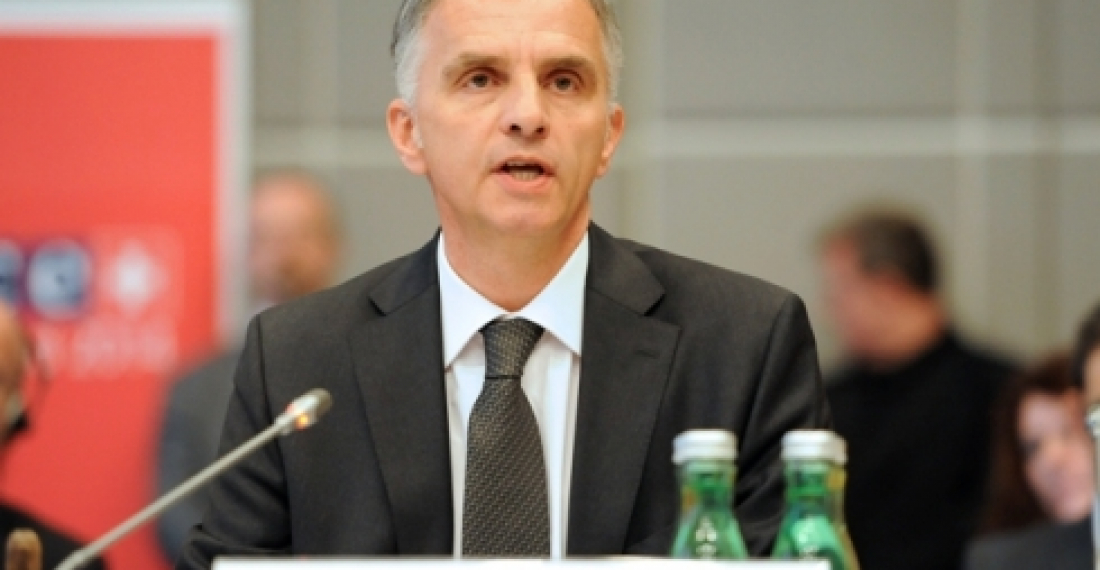
The Head of the Swiss Federal Department for Foreign Affairs and current Chairman in Office of the Organisation for Security and Co-operation in Europe, Didier Burkhalter, this morning addressed the Permanent Council of the organisation in Vienna, outlining a vision for "seizing opportunities to create a security community for the benefit of everyone". In the wide-ranging speech the Head of Swiss diplomacy said,
"The Swiss Chairmanship will focus on incremental progress rather than any new grand designs. Our ambition is to reinforce positive dynamics in the OSCE that allow participating States to gradually increase their level of security and their mutual understanding. The OSCE provides opportunities for all of us. As Chairperson- in-Office, I call upon you to seize these opportunities."
Speaking about the conflicts in the South Caucasus, Burkhalter said that the strategy of the Swiss Chairmanship will focus on dialogue and confidence-building. He said:
"As for the protracted conflicts, it is the view of the Swiss Chairmanship that we all have a collective responsibility to contribute to their fair and sustainable settlement. We are well aware that progress may not come overnight, and that no settlement will be feasible unless the parties are committed to it. However, we firmly believe that it is not an option to simply wait and see in these conflicts. We will work hard to move forward, proceeding step by step.
In the South Caucasus, there have been some encouraging signs concerning the Nagorno-Karabakh conflict in recent weeks. High-level contacts have intensified since the meeting of the presidents of Armenia and Azerbaijan on 19 November in Vienna. Incidents at the Line of Contact do, however, remain a matter of great concern. And we all are under no illusion that the road to peace remains long and winding.
The Swiss Chairmanship will support the efforts of the co-chairs of the Minsk Group through Ambassador Kasprzyk, my Personal Representative for this conflict. We will also encourage contacts between the civil societies of Armenia and Azerbaijan and between experts.
Regarding the conflict in Georgia, the Geneva International Discussions mark a unique platform which should be strengthened to lay the ground for a conflict settlement. Ambassador Gnädinger, my Special Representative for the South Caucasus, will co-chair the Geneva Discussions, together with the representatives of the EU and the UN.
We will encourage the participants of the Geneva Discussions to seek status-neutral solutions for a range of conflict-related problems. The Incident Prevention and Response Mechanism will remain a crucial element to stabilize the security situation on the ground.
The Swiss Chairmanship is also ready to re-launch a discussion on the OSCE presence in Georgia, provided that the stakeholders show flexibility and creativity regarding the institutional setup of the OSCE presence."
You may read the full text of the speech of the Swiss Chairman-In-Office of the OSCE to the Permanent Council in Vienna on 16 January 2014 here
source:commonspace.eu with the Swiss Chairmanship of the OSCE
photo: Didier Burkhalter, the Chairman-in-Office of the OSCE for 2014. (picture courtesy of OSCE)