The OSCE Monitoring Mission in Ukraine remains focused, despite criticism.

by Joseph d'Urso, reporting from Kiev for commonspace.eu.

The chief spokesman of the OSCE Special Monitoring Mission in Ukraine today spoke of “more calm” in the east of the country, two weeks after a ceasefire agreement was agreed in Minsk. He also denied the organisation has lost public trust.

The OSCE’s Special Monitoring Mission (SMM) in Ukraine is mandated to gather information and report facts on the ground. There has been a lull in fighting over the past 24 hours, with no combat fatalities reported on Wednesday. Speaking to journalists in Kiev, spokesman Michael Bociurkiw defended his organisation’s work against accusations it does not sufficiently attribute blame for ceasefire violations, saying the OSCE is “not in the business of naming names and pointing fingers”.

MORE THAN A MILLION DISPLACED

Bociurkiw spoke of the devastation which OSCE monitors observed yesterday in Debaltseve, the town from which Ukrainian troops withdrew on February 18th . “None of the buildings that we saw were untouched by shelling,” he said. “Many villages have been almost totally emptied of the civilian population.” Bociurkiw also referenced a UN report which states “more than a million people have been displaced within Ukraine”.

The OSCE reported seeing a range of ceasefire violations yesterday, including some artillery fire sporadic small arms fire near the city of Mariupol, which is seen as the next potential flashpoint in eastern Ukraine. The OSCE also observed the movement of military equipment. The next challenge is to oversee the withdrawal of heavy weaponry, as specified by the agreement reached in Minsk on 12 February. The places to where heavy weaponry is withdrawn “may need to be visited again and again by the mission for obvious reasons – for credible verification,” Bociurkiw said. “It is not enough to be invited to follow a removal process, it has to be complete. Like the Minsk agreements it is not a shopping list, you can’t pick and choose.”

A MANDATE TO MONITOR

Many in the Ukrainian capital are distrustful of the OSCE. A sticking point is that Russian monitors take part in OSCE patrols, because the Russian Federation is not an official party to the conflict, whereas Ukrainians do not A prime time broadcast of political programme ‘the X­Files’ on Ukrainian cable channel 1+1, which accused the OSCE of Russian bias, has compounded this problem, according to Iryna Ivashko of the International Centre for Policy Studies in Kiev. An incident in September in which two separatist fighters got into an SMM vehicle has been used as evidence of supposed pro­Russian bias.

The OSCE admitted to and apologised for this incident. Bociurkiw said “I don’t know I’d agree there is widespread cynicism and distrust,” describing ‘dialogue facilitation’ as one of the Mission’s most important background roles. “We’ll soon have been almost a year in Ukraine, and the contribution of the mission is widely known and appreciated,” he said, adding that the OSCE has an active presence active in Kharkiv and Lviv as well as the capital and war­torn eastern regions.

SWIFT AND DECISIVE

Within the international community there has been increased scepticism of the durability of the Minsk agreements. Ilkka Kanerva, president of the OSCE Parliamentary Assembly, said in Copenhagen yesterday "I am profoundly disturbed by the illegal separatists' continuing refusal to grant unlimited, safe access to OSCE monitors on the ground in Ukraine and their violations of the Minsk Package of Measures.  “By extension, I am also disturbed by Russia's apparent unwillingness to publicly insist that the rebels immediately allow the monitors access, stop all ceasefire violations and withdraw all heavy weapons. Any attempts by the rebels to threaten the city of Mariupol must be met with a swift and decisive response by the international community.”

It remains to be seen whether the current lull in fighting is temporary, or a lasting ceasefire under the Minsk protocols can be reached. General Philip Breedlove, NATO's top commander, said on February 20. "it is a ceasefire in name only".

source: Joseph d'Urso filed this report from Kiev for commonspace.eu

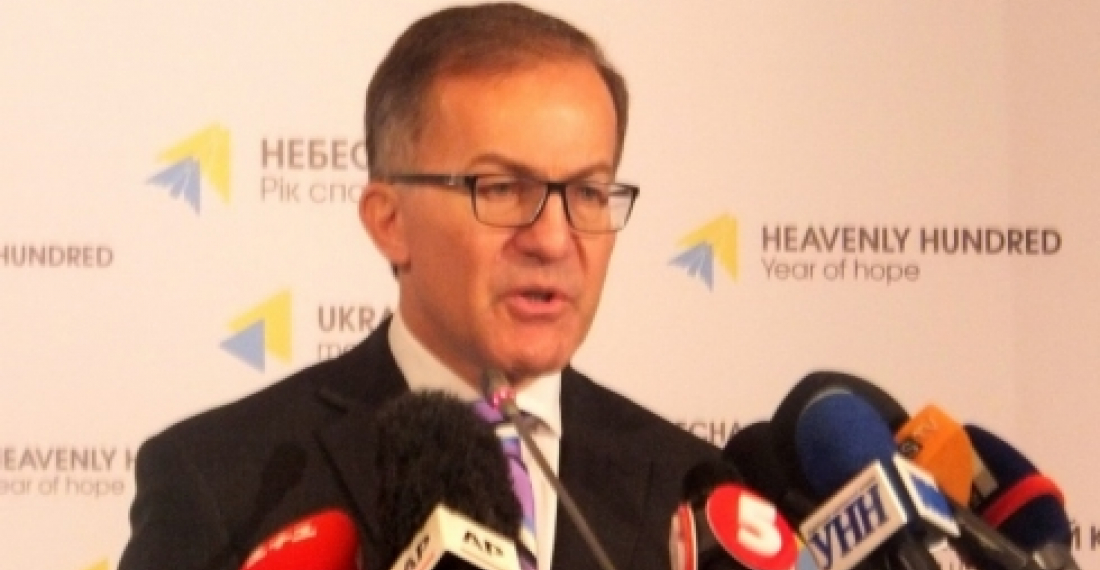
photo: The Spokesperson of the OSCE Special Monitoring Mission to Ukraine,  Michael Bociurkiw at a brieifng in Kiev on Thursday, 26 February 2015.
Related articles

Editor's choice
News
Borrell tells the European Parliament that the situation in Afghanistan was critical, but the EU will remain engaged

Borrell tells the European Parliament that the situation in Afghanistan was critical, but the EU will remain engaged

Borrell underlined that the European Union will make every effort to support the peace process and to remain a committed partner to the Afghan people. "Of course, we will have to take into account the evolving situation, but disengagement is not an option.  We are clear on that: there is no alternative to a negotiated political settlement, through inclusive peace talks.
Editor's choice
News
NATO Chief says war is on Europe's doorstep, and warns against complacency

NATO Chief says war is on Europe's doorstep, and warns against complacency

Russia could attack a Nato country within the next five years, the Secretary General of NATO, Mark Rutte, said in a stark new warning. "Nato's own defences can hold for now," Rutte warned in Berlin, but conflict was "next door" to Europe and he feared "too many are quietly complacent, and too many don't feel the urgency, too many believe that time is on our side. "Russia is already escalating its covert campaign against our societies," Rutte said in a speech in Germany. "We must be prepared for the scale of war our grandparents or great-grandparents endured." Earlier this month, Russia's President Vladimir Putin said his country was not planning to go to war with Europe, but it was ready "right now" if Europe wanted to - or started a war. But similar reassurances were given by Moscow in 2022, just before 200,000 Russian troops crossed the border and invaded Ukraine. Putin has accused European countries of hindering US efforts to bring peace in Ukraine - a reference to the role Ukraine's European allies have recently played in trying to change a US peace plan to end the war, whose initial draft was seen as favouring Russia. But Putin was not sincere, Nato's secretary-general said in the German capital, Berlin. Supporting Ukraine, he added, was a guarantee for European security. "Just imagine if Putin got his way; Ukraine under the boot of Russian occupation, his forces pressing against a longer border with Nato, and the significantly increased risk of an armed attack against us." Russia's economy has been on a war footing for more than three years now - its factories churn out ever more supplies of drones, missiles and artillery shells. According to a recent report by the Kiel Institute for the World Economy, Russia has been producing each month around 150 tanks, 550 infantry fighting vehicles, 120 Lancet drones and more than 50 artillery pieces. The UK, and most of its Western allies, are simply not anywhere near this point. Analysts say it would take years for Western Europe's factories to come close to matching Russia's mass-production of weapons. "Allied defence spending and production must rise rapidly, our armed forces must have what they need to keep us safe," the Nato chief said.

Popular

Editor's choice
News
NATO Chief says war is on Europe's doorstep, and warns against complacency

NATO Chief says war is on Europe's doorstep, and warns against complacency

Russia could attack a Nato country within the next five years, the Secretary General of NATO, Mark Rutte, said in a stark new warning. "Nato's own defences can hold for now," Rutte warned in Berlin, but conflict was "next door" to Europe and he feared "too many are quietly complacent, and too many don't feel the urgency, too many believe that time is on our side. "Russia is already escalating its covert campaign against our societies," Rutte said in a speech in Germany. "We must be prepared for the scale of war our grandparents or great-grandparents endured." Earlier this month, Russia's President Vladimir Putin said his country was not planning to go to war with Europe, but it was ready "right now" if Europe wanted to - or started a war. But similar reassurances were given by Moscow in 2022, just before 200,000 Russian troops crossed the border and invaded Ukraine. Putin has accused European countries of hindering US efforts to bring peace in Ukraine - a reference to the role Ukraine's European allies have recently played in trying to change a US peace plan to end the war, whose initial draft was seen as favouring Russia. But Putin was not sincere, Nato's secretary-general said in the German capital, Berlin. Supporting Ukraine, he added, was a guarantee for European security. "Just imagine if Putin got his way; Ukraine under the boot of Russian occupation, his forces pressing against a longer border with Nato, and the significantly increased risk of an armed attack against us." Russia's economy has been on a war footing for more than three years now - its factories churn out ever more supplies of drones, missiles and artillery shells. According to a recent report by the Kiel Institute for the World Economy, Russia has been producing each month around 150 tanks, 550 infantry fighting vehicles, 120 Lancet drones and more than 50 artillery pieces. The UK, and most of its Western allies, are simply not anywhere near this point. Analysts say it would take years for Western Europe's factories to come close to matching Russia's mass-production of weapons. "Allied defence spending and production must rise rapidly, our armed forces must have what they need to keep us safe," the Nato chief said.