


In the second in a series of three commentaries on the consequences of the recent military clashes on the Armenia-Azerbaijan border, Azerbaijani political analyst Ahmad Alili says that recent events have changed a lot of things for Baku and will have far-reaching effects on the diplomatic mediation efforts also. Secret diplomacy has failed and is causing more damage than it is creating constructive outcomes. It is time to think of alternative approaches, he argues.
Related content on commonspace.eu: The Current framework of negotiations has exhausted itself
On 12 July 2020, Armenian and Azerbaijani Armed Forces faced each other at their international border. For Azerbaijan, the news, broken by Armenia Ministry of Defence sources, came as a surprise. Azerbaijan's military is concentrated in the Nagorno-Karabakh conflict zone, south to where the recent incidents occurred. During the first months of Prime Minister Pashinyan's tenure as the head of Armenia, Azerbaijan believed that the new Armenian Prime Minister had the vision to resolve the Nagorno-Karabakh conflict, and wanted to show goodwill. Baku redeployed its heavily equipped Armed Forces from the international border and replaced them with the relatively lightly equipped Border Service forces. It also agreed to a hot line between the military of the two sides. Both were meant to signal that Baku was not interested in increasing tension on the international border.
The recent outburst of violence was the biggest since the April 2016 escalation, even if it had a relatively smaller number of casualties: only 16 in total as far as is known at present, but the political and social consequences are extensive. The military escalation at the international border has changed a lot of things for Baku. These changes will shape the foreign policy of the Azerbaijani government in the coming years.
For Baku, the most significant result of the escalation was that it exposed that Moscow is not favouring Armenia (or at least an Armenia ruled by Prime Minister Pashinyan) in the conflict with Azerbaijan. Azerbaijan considers this hugely significant. Since the early 1990s, Yerevan was using its ties with Moscow to brand itself "Protected by Russia." All the rationale of Armenian foreign policy since the mid-1990s was to have Russian backing in case of an attack from Azerbaijan. It was natural that the Armenians were assuming that in case of an escalation on the international border with Azerbaijan, the Collective Security Treaty Organisation (CSTO) will have to step in on the Armenian side. It did not work. For the last ten years, Azerbaijan was actively purchasing weapons from Russia, hence buying Russian loyalty at the expense of its traditional strategic partner in the South Caucasus - Armenia. Besides, Baku was actively working to build strategic links with Belarus and Kazakhstan, also members of CSTO. It paid off. The CSTO called an urgent meeting on the escalation at the Armenia and Azerbaijan international border, but that was suddenly and unexpectedly postponed. There were other signals which the think-tank community in Baku interpreted as the Kremlin signalling its positive attitude towards Azerbaijan. For example, some Russian media outlets with links with high-ranking officials in the Kremlin published results of opinion polls, according to which Russian respondents wanted their country to support Azerbaijan over Armenia in twice the number (32% and 16%, respectively). Despite questions about the credibility of the report, it was clear that the Kremlin was signalling positive messages to Azerbaijan. The Russian Ministry of Defence also quickly denied that the military drills that started in the Northern Caucasus had something to do with the escalation at the border with Azerbaijan. For many, this answered the question of whether Russia would stay neutral if the fighting continued.
The developments also demonstrated that Azerbaijan has the backing of Ukraine. Kiev publicly supported the resolution of the conflict based on the UN Security Council resolutions as favoured by Baku. It also showed that Azerbaijan's renewed efforts within GUAM, and bilateral relations with Ukraine, are paying off. In previous years, Baku had also supported the territorial integrity of Ukraine in various international platforms and during the UN General Assembly sessions. A new alliance in the Eastern Partnership countries is thus becoming a reality: the former-Soviet Union countries who have seen an invasion by foreign powers are uniting, and this has the potential to open up new perspectives for Azerbaijan's foreign policy.
Of immense immediate significance is the public awakening and mass-rallies in support of Azerbaijan's military activity in Nagorno-Karabakh. It was proof that the importance of the Nagorno-Karabakh conflict for the domestic audience in Azerbaijan should not be underestimated. It is still not clear what exactly triggered people to rush to the street, but local observers and analysts unanimously say that these public manifestations were spontaneous and authentic. A day before the mass-rally event, there was another, smaller one in the suburbs of Baku. Residents of "Gobu-Park," a neighbourhood built for the IDPs, around 20 minutes driving distance from Baku city centre, decided to march towards the city and to demand military activities for the liberation of Nagorno-Karabakh. The event, which was live-streamed on social networks, called on the rest of the population to "get brave and fight for the motherland," and was watched by many, even if those demonstrating were stopped by the police from reaching the city centre. The next day, when the Azerbaijani army lost its charismatic Major-General Polad Hashimov and Colonel Ilgar Mirzayev in unclear circumstances, the crowd gathered around their homes and initiated the rally, which lasted until 4.00 am. The rally, and the mood around it, has strengthened President Aliyev's hand if he opts to start a military campaign in Nagorno-Karabakh. However, it also demonstrates the potential public cost if the government decides not to. Such a mass rally is the first seen in Baku for many years, and it has enormous significance.
There were other consequences too. One of the most significant was the replacement of the Foreign Minister. Regardless of the reasons, coming at a moment of high-intensity diplomatic and military activity, the timing was unexpected. Elmar Mammadyarov was one of the longest-serving ministers in the Azerbaijani government, and he was the chief-negotiator in the OSCE Minsk Group peace process format since 2004. There are only few people who can be as experienced as Mammadyarov. It is not clear if the new Foreign Minister, Jeyhun Bayramov, will also be the chief-negotiator or if he will be replaced by someone else in this position. There is a possibility that, in order to demonstrate its frustration with the recent decisions of the mediators, Baku might want to signal that the format of the negotiations is no longer interesting for Azerbaijan. Hence, the new Azerbaijani foreign minister might be absent from the negotiation table for a long time, due to the objective reason that he has to familiarise himself with the background of the negotiations process. Also, Baku might decide to downgrade the talks by appointing a deputy-minister as the chief-negotiator, going back to a previous format. As a result, the effectiveness of the peace-negotiations at Track1 level might be much lower in the upcoming months. As President Aliyev said in one of his recent statements, "Azerbaijan is not going to have negotiations for the sake of negotiations." The last time when President Aliyev made similar statements was in the aftermath of the failed Kazan meeting in June 2011. In the following years, three significant escalations occurred: in August of 2014, November 2014, and April of 2016.
In 2018 there were expectations in Baku that Nikol Pashinyan's coming to power may open a new chapter in the conflict settlement process. Instead, Pashinyan's statement, "Karabakh is Armenia. Full stop" marked the demise of the peaceful settlement of the Nagorno-Karabakh conflict. The lack of an adequate reaction from the OSCE Minsk Group co-chairs to the statement caused significant frustration in Azerbaijani society.
Instead, we are witnessing fatigue among the local peacebuilders in Armenia and Azerbaijan, among diplomatic circles and the donor organisations funding peacebuilding projects in the region. The consequences of the incidents in Tovuz (Azerbaijan) - Tavush (Armenia) border region this July is going to have far-reaching effects in the diplomatic mediation efforts also.
Given this, the way forward in the immediate future should be direct Armenian-Azerbaijani negotiations. There should also be more significant involvement of experts working at the Track-2 level in the formal Track-1 peacebuilding process. Secret diplomacy has failed and is causing more damage than it is creating constructive outcomes. It is time to think of alternative approaches.
source: Ahmad Alili is Chairman of the Caucasus Policy Analysis Centre of Azerbaijan.
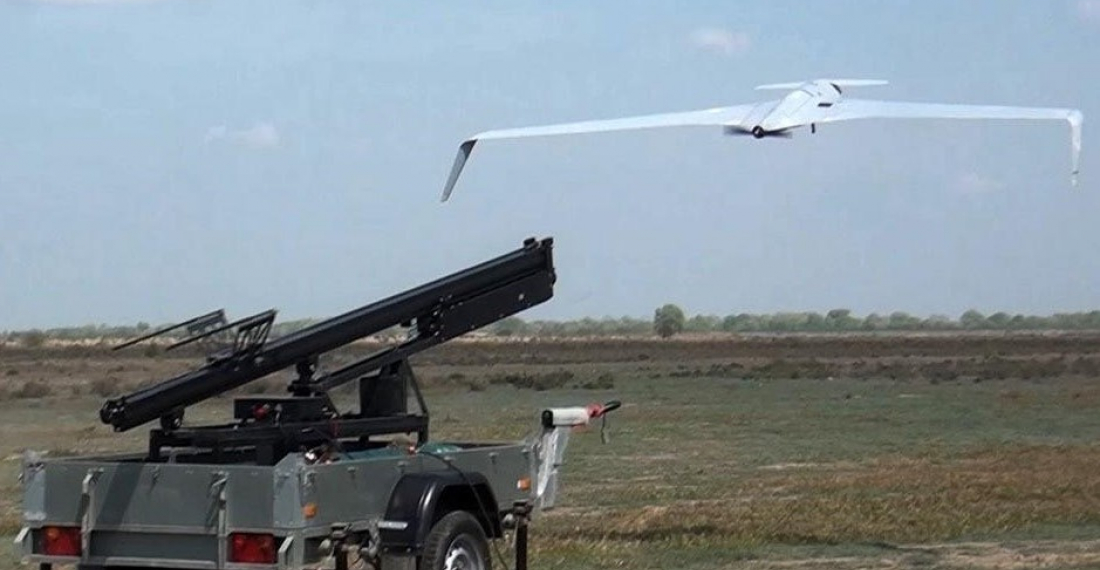
photo: An Azerbaijani Unmanned Aeriel Vehicle (UAV) similar to the ones used in recent fighting on the Armenian-Azerbaijani border (picture courtesy of the Azerbaijan Ministry of Defence)
The views expressed in opinion pieces and commentaries do not necessarily reflect the position of commonspace.eu or its partners



