The public debate between the leaders of Armenia and Azerbaijan in Munich on Saturday was not there to be won or lost, but was itself a confidence-building measure, argues Dennis Sammut in this week's Monday Commentary
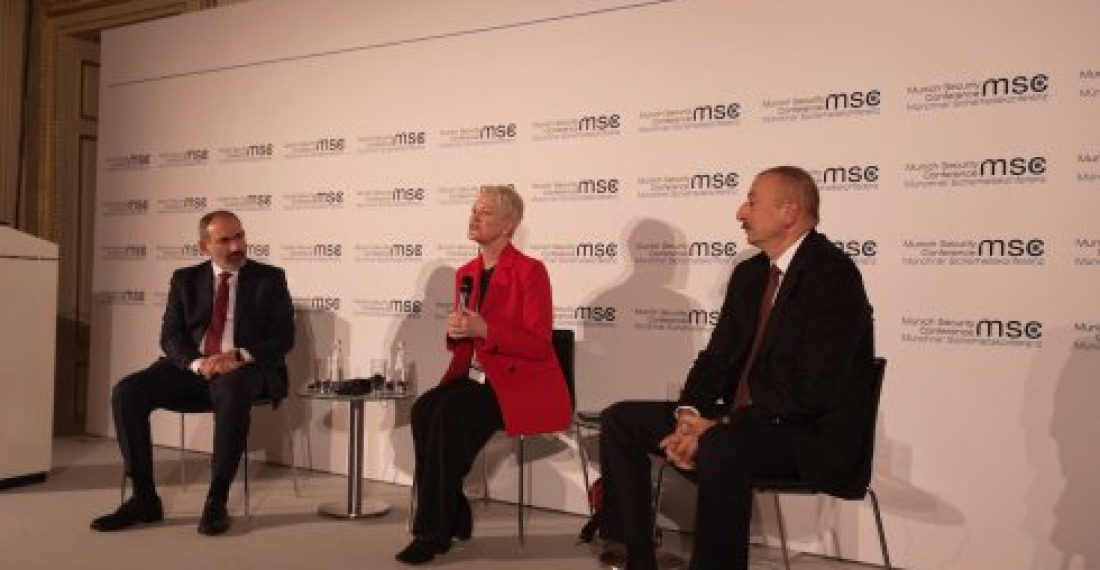
On Saturday (15 February), president Ilham Aliyev of Azerbaijan and prime minister Nikol Pashinyan of Armenia sat down in a meeting room in a hotel in Munich and debated publicly the Nagorno-Karabakh conflict and conflict settlement. The debate was one of the events in the framework of the Munich Security Conference, an annual event which attracts the world's movers and shakers. The debate lasted forty five minutes, was conducted in English, and was streamlined live.
Historic
There is no other word to describe this event other than historic. There have been many meetings between Armenian and Azerbaijani leaders on the Karabakh issue over the last thirty years, but these have always been private, with very little emerging of what was discussed. In Munich Aliyev and Pashinyan met privately too, but the fact that they felt confident enough to engage also in a public debate is hugely significant. For the audiences back home this was a very unusual sight. The mood of the discussion was tough but overall well natured, with both sides wanting to score points, yet both avoiding unnecessary unpleasantness. The organisers of the Munich Security Conference should be congratulated for being able to hold this event, but the warmest congratulations should go to Aliyev and Pashinyan for putting aside all the complexes of the past, and engaging in this very public discussion.
Historical
The historic meeting was also historical - indeed as much as two-thirds of the time was spent discussing the history of Nagorno-Karabakh, and of Armenia and Azerbaijan, as both leaders tried to justify why Nagorno-Karabakh is part of their nation. This frustrated many of the listeners and viewers, especially those not familiar with the conflict. For the more seasoned, this was inevitable. I have set in many meetings with Armenians and Azerbaijanis and the historical prelude always appears to be necessary since it provides the foundation for all subsequent arguments. It is also counter-productive and often constrains the sides from moving forward. Usually however, once the positions have been stated, it becomes possible later in the meeting, or in the next one, for history to be put aside and issues related to the present and the future to be discussed. It would be good if Saturday's Aliyev-Pashinyan public performance can have a sequel, where they both agree that the history part now done, they focus more on the present and the future.
Disappointing
The over-emphasis on history left many of those listening and viewing somewhat disappointed. People wanted to hear how the leaders proposed to resolve the conflict, and there was not much of that. There was a repetition of previously stated positions - Pashinyan insisting on a solution that is acceptable "to the people of Azerbaijan, Armenia and Nagorno-Karabakh" and a renunciation of the use of force as a solution, and Aliyev insisting on a solution based on a step by step approach and for the international community to put pressure on Armenia and push it to get in line with UN Security Council resolutions. It's a pity that the moderator appeared to struggle when she opened the discussion for questions from the floor. A good audience would have had plenty of pertinent questions to ask the two leaders, and this could have made them have to address issues which they otherwise avoided.
Promising
This notwithstanding this meeting was promising in many ways. The very fact that it took place was already a step in the right direction. Prime Minister Pashinyan argument that the two leaders had a responsibility to resolve the problem for the sake of their countries and also of regional peace showed a good and positive mind-set. President Aliyev's indication that at some point Azerbaijan may also be willing to accept international arbitration was interesting. It is recognised that international arbitration may be necessary in the future on some aspects of a peace agreement, but having the whole issue referred to an international court is not something often discussed. Both Aliyev and Pashinyan stated their committment to the negotiation process. Pashinyan spoke about what he called "mini revolutions", including his appeal for those Armenians and Azerbaijanis writing on social media to be more constructive and stop insulting each other.
Unfortunately a lot of the media coverage of the Munich meeting in Armenia and Azerbaijan over the weekend focused on who won and who lost. Despite the adversarial nature of Armenian-Azerbaijani relations, this was not meant to be a competition with winners and losers, rather an opportunity for the leaders to present their points of view. Both could have done more to reach out to the audience on the other side.
Despite this, the public debate between prime minister Pashinyan and president Aliyev was in itself a confidence-building measure. Only hours before it happened there were casualties in the conflict zone, and this could easily have derailed the event. But it appears that Aliyev and Pashinyan are focused on trying to achieve progress in the negotiations on the resolution of the Karabakh conflict. In this they deserve the support of their nations, and of the international community.
source: Monday Commentary is prepared by Dennis Sammut, Director of LINKS Europe and a member of the editorial board of commonspace.eu
photo: Prime Minister Nikol Pashinyan of Armenia and president Ilham Aliyev of Azerbaijan participated in a public discussion on the Karabakh conflict in the framework of the Munich Security Conference on Saturday, 15 February 2020.
The views expressed in opinion pieces and commentaries do not necessarily reflect the position of commonspace.eu or its partners