


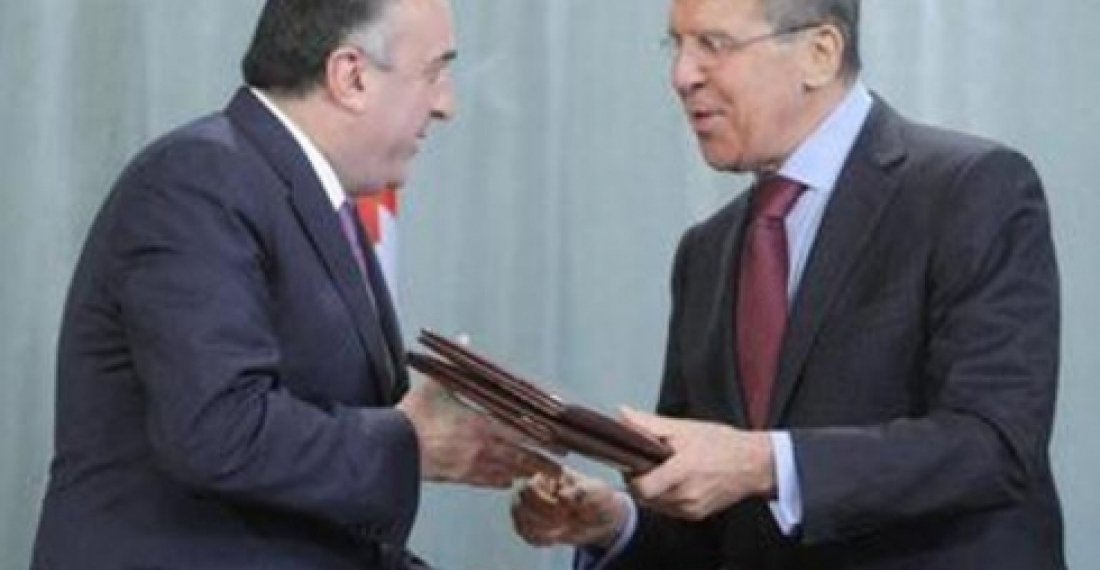
It was all smiles during Lavrov's visit to Baku, but Russia remains concerned that Azerbaijan does not follow Georgia's way.

The Russian Foreign Minister Sergei Lavrov has been on a charm offensive in the South Caucasus, visiting Armenia and Azerbaijan to mark the 20th anniversary of the establishment of diplomatic relations between Russia and the two countries.

The region, once part of the Tsarist empire, and later of the Soviet Union, has since 1991 splintered into three countries, with a further three entities seceding from these soon after.

A lot of Russia's efforts in the region in the last decade has been spent on ensuring that Azerbaijan does not follow in the way of Georgia and become a hostile neighbour to Russia. This has not been easy given Russia's special relations with Armenia. This Russian concern could be felt from Lavrov's speeches in Baku yesterday. Lavrov praised the way the two countries had been able to work together. "Over recent years we have shown that we are able to develop mutually beneficial dialogue and to resolve the most complex problems, including delimitation of the state border. Russia is ready to continue developing partnership with Azerbaijan."

The major sticking point remains Karabakh, where the Azerbaijanis have decided that Russians are the key to pushing the Armenians into handing its territories back. The Azerbaijani Foreign Minister Elmar Mammadyarov expressed gratitude to Russian President Dmitriy Medvedev for his initiatives to settle the Armenian-Azerbaijani conflict over Nagorno-Karabakh. "Unfortunately we have not achieved it yet, but I hope we will achieve the settlement of the problem and move the situation from the point of status quo," the minister told a news briefing after meeting his Russian counterpart.

Sergey Lavrov said that Russia was interested in a settlement of the problem as soon as possible: "The decision must be acceptable to all sides. Russia is continuing its mediation mission to settle the conflict."

The two ministers said that they had discussed the extension of Russia's lease of the Gabala radar station in Azerbaijan, but gave nothing away about the details of the talks. Sergey Lavrov said that the negotiations were being handled by the two countries' defence ministries. Mammadyarov recalled that Azerbaijan had set up a special commission to deal with the issue: "Now the commission is considering Russia's proposals on extending the lease of Gabala radar station." Russia is desperate to keep the Gabala facility and the Azerbaijanis are not in principle against, but they are making the Russian's sweat a little bit before they say yes.

A more serious issue is the Caspian Sea. The Russians are furious at the European Union's plan to sign a Treaty with Turkmenistan and Azerbaijan on the transit of Turkmen Gas through the Caspian.

The Iranian news agency IRNA reported that whilst addressing Yerevan State University students, during his visit to Armenia, Lavrov said the European Union’s decision to exploit the Caspian Sea and transfer Turkmenistan gas to Europe without taking into account the stance of Caspian littoral states is unacceptable. Lavrov said that the Caspian Sea legal regime had been agreed in 1921 and 1940 by the then Soviet Union and Iran, and after the collapse of the USSR negotiations on a new regime had started.


On the legal status of the Caspian Sea, Sergey Lavrov said: "The use of the Caspian Sea water area must be solved with the participation of all five Caspian littoral countries." "Foreign actors, especially the European Union, will respect the decision of the five Caspian countries."

In Baku Lavrov said that speeding up work on a Convention on the Legal Status of the Caspian Sea was especially important. Exactly what he said in private on this subject to his Azerbaijani counterpart is not clear.

Lavrov is not visiting Georgia on this trip. The two countries currently do not have diplomatic relations after Georgia cut off relations following the Russian recognition of the secessionist territories of Abkhazia and South Ossetia.

source: commonspace.eu with APA, News.az and IRNA

photo: Sergei Lavrov and Eldar Mammadyarov exchange bound collections of documents signed by Azerbaijan and Russia between 1992 and 2012 after their meeting in Baku yesterday (picture courtesy of APA)
Related articles

Editor's choice
News
Borrell tells the European Parliament that the situation in Afghanistan was critical, but the EU will remain engaged

Borrell tells the European Parliament that the situation in Afghanistan was critical, but the EU will remain engaged

Borrell underlined that the European Union will make every effort to support the peace process and to remain a committed partner to the Afghan people. "Of course, we will have to take into account the evolving situation, but disengagement is not an option.  We are clear on that: there is no alternative to a negotiated political settlement, through inclusive peace talks.
Editor's choice
News
NATO Chief says war is on Europe's doorstep, and warns against complacency

NATO Chief says war is on Europe's doorstep, and warns against complacency

Russia could attack a Nato country within the next five years, the Secretary General of NATO, Mark Rutte, said in a stark new warning. "Nato's own defences can hold for now," Rutte warned in Berlin, but conflict was "next door" to Europe and he feared "too many are quietly complacent, and too many don't feel the urgency, too many believe that time is on our side. "Russia is already escalating its covert campaign against our societies," Rutte said in a speech in Germany. "We must be prepared for the scale of war our grandparents or great-grandparents endured." Earlier this month, Russia's President Vladimir Putin said his country was not planning to go to war with Europe, but it was ready "right now" if Europe wanted to - or started a war. But similar reassurances were given by Moscow in 2022, just before 200,000 Russian troops crossed the border and invaded Ukraine. Putin has accused European countries of hindering US efforts to bring peace in Ukraine - a reference to the role Ukraine's European allies have recently played in trying to change a US peace plan to end the war, whose initial draft was seen as favouring Russia. But Putin was not sincere, Nato's secretary-general said in the German capital, Berlin. Supporting Ukraine, he added, was a guarantee for European security. "Just imagine if Putin got his way; Ukraine under the boot of Russian occupation, his forces pressing against a longer border with Nato, and the significantly increased risk of an armed attack against us." Russia's economy has been on a war footing for more than three years now - its factories churn out ever more supplies of drones, missiles and artillery shells. According to a recent report by the Kiel Institute for the World Economy, Russia has been producing each month around 150 tanks, 550 infantry fighting vehicles, 120 Lancet drones and more than 50 artillery pieces. The UK, and most of its Western allies, are simply not anywhere near this point. Analysts say it would take years for Western Europe's factories to come close to matching Russia's mass-production of weapons. "Allied defence spending and production must rise rapidly, our armed forces must have what they need to keep us safe," the Nato chief said.

Popular

Editor's choice
News
NATO Chief says war is on Europe's doorstep, and warns against complacency

NATO Chief says war is on Europe's doorstep, and warns against complacency

Russia could attack a Nato country within the next five years, the Secretary General of NATO, Mark Rutte, said in a stark new warning. "Nato's own defences can hold for now," Rutte warned in Berlin, but conflict was "next door" to Europe and he feared "too many are quietly complacent, and too many don't feel the urgency, too many believe that time is on our side. "Russia is already escalating its covert campaign against our societies," Rutte said in a speech in Germany. "We must be prepared for the scale of war our grandparents or great-grandparents endured." Earlier this month, Russia's President Vladimir Putin said his country was not planning to go to war with Europe, but it was ready "right now" if Europe wanted to - or started a war. But similar reassurances were given by Moscow in 2022, just before 200,000 Russian troops crossed the border and invaded Ukraine. Putin has accused European countries of hindering US efforts to bring peace in Ukraine - a reference to the role Ukraine's European allies have recently played in trying to change a US peace plan to end the war, whose initial draft was seen as favouring Russia. But Putin was not sincere, Nato's secretary-general said in the German capital, Berlin. Supporting Ukraine, he added, was a guarantee for European security. "Just imagine if Putin got his way; Ukraine under the boot of Russian occupation, his forces pressing against a longer border with Nato, and the significantly increased risk of an armed attack against us." Russia's economy has been on a war footing for more than three years now - its factories churn out ever more supplies of drones, missiles and artillery shells. According to a recent report by the Kiel Institute for the World Economy, Russia has been producing each month around 150 tanks, 550 infantry fighting vehicles, 120 Lancet drones and more than 50 artillery pieces. The UK, and most of its Western allies, are simply not anywhere near this point. Analysts say it would take years for Western Europe's factories to come close to matching Russia's mass-production of weapons. "Allied defence spending and production must rise rapidly, our armed forces must have what they need to keep us safe," the Nato chief said.

