


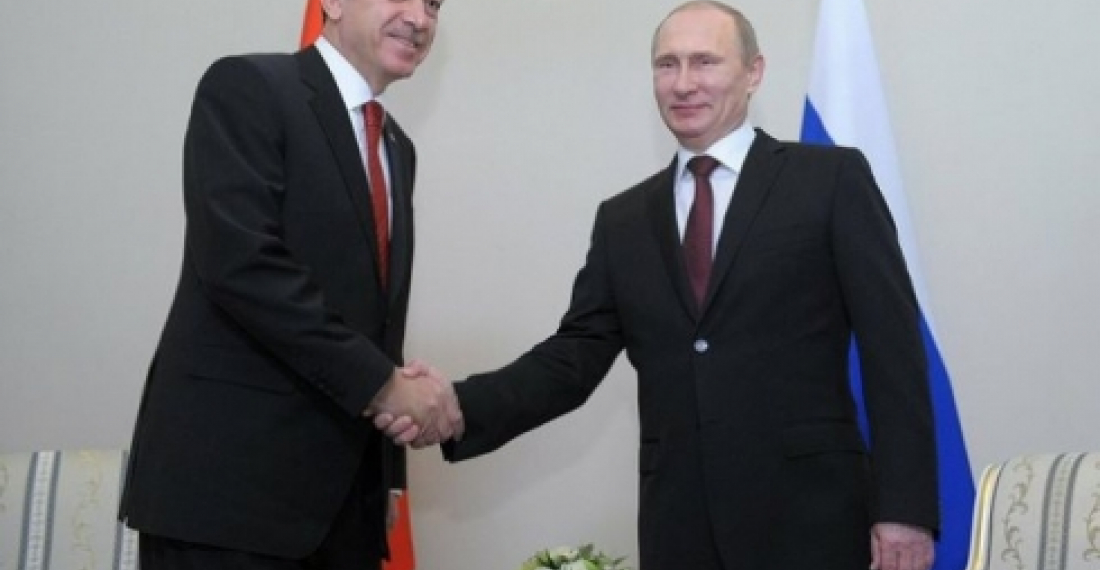
Erdogan: "Russia and Turkey have obligations in the region". Putin and Erdogan discussed Karabakh, Syria and Iraq at their meeting Friday.

"Russia and Turkey have obligations in the region from the standpoint of Azerbaijan-Armenia conflict, situation in Syria and development of the situation in Iraq," Turkish Prime Minister, Recip Tayip Erdogan said after meeting with Russian President Vladimir Putin in St Petersburg on Friday morning.

"There are basic steps that we must take, and the talks that we held on these topics allowed us to create a platform and a base for resolving the issues," added the Turkish leader.

Erdogan and Pution later participated in a session of the High Level Russian Turkish Co-operation Council.

Welcoming Erdogan to St Petersburg President Putin said:

"We have not met for quite a while, but even without our personal direct involvement, relations between Russia and Turkey continue their successful development. I think that you and I will certainly do nothing to hinder this development at our meeting today. On the contrary, it is our intention to help it even further, and I am sure that we can achieve this. We have good cooperation plans.

I want to thank you for accepting our invitation to come here for these consultations."

On his part Prime Minister Erdogan stated:

"I place great importance on today's talks, during which we will discuss current bilateral and international issues. I think that there are steps we can take and projects that we should undertake together. I am sure that we will discuss today the future possible joint steps we can take and outline plans for their implementation."

Turkey has for some time been trying to have an understanding with Russia on both the Caucasus as well as the Levant, but the Russian leadership has proved very elusive - willing to talk but hardly to co-ordinate positions. There is nothing to suggest that things are different this time round, though Turkish leaders hope for a minimum of common ground that may help break the impasse on some of the issues simmering on Turkey's borders.

source: commonspace.eu

photot: Prime Minister Erdogan of Turkey and President Putin of Russia after their meeting in St Petersburg on 22 November 2013 (picture courtesy of the Press Service of the President of Russia).




Related articles

Editor's choice
News
European leaders set out their plan for Ukraine

European leaders set out their plan for Ukraine

The leaders of Germany, Denmark, Finland, France, Italy, Netherlands, Norway, Poland, Sweden, and United Kingdom, together with the President of the European Council, and the President of the European Commission, o  Monday (15 December) issued a statement, outlining their plan for Ukraine. In their statement, Chancellor Merz, Prime Minister Frederiksen, President Stubb, President Macron, Prime Minister Meloni, Prime Minister Schoof, Prime Minister Støre, Prime Minister Tusk, Prime Minister Kristersson, Prime Minister Starmer, as well as President Costa and President von der Leyen spoke about "Peace for Ukraine". The Leaders welcomed significant progress on President Trump’s efforts to secure a just and lasting peace in Ukraine. They also welcomed the close work between President Zelenskyy’s and President Trump’s teams as well as European teams over the recent days and weeks. They agreed to work together with President Trump and President Zelenskyy to get to a lasting peace which preserves Ukrainian sovereignty and European security. Leaders appreciated the strong convergence between the United States, Ukraine and Europe. Leaders agreed that ensuring the security, sovereignty, and prosperity of Ukraine was integral for wider Euro-Atlantic security. They were clear that Ukraine and its people deserved a prosperous, independent, and sovereign future, free from fear of future Russian aggression. Both the US and European leaders committed to work together to provide robust security guarantees and economic recovery support measures for Ukraine in the context of an agreement on ending the war. This would include commitments to: Provide sustained and significant support to Ukraine to build its armed forces, which should remain at a peacetime level of 800,000 to be able to deter conflict and defend Ukraine’s territory. A European-led ‘multinational force Ukraine’ made up from contributions from willing nations within the framework of the Coalition of the Willing and supported by the US. It will assist in the regeneration of Ukraine’s forces, in securing Ukraine’s skies, and in supporting safer seas, including through operating inside Ukraine. (Click the image to read the statement in full).

Popular
