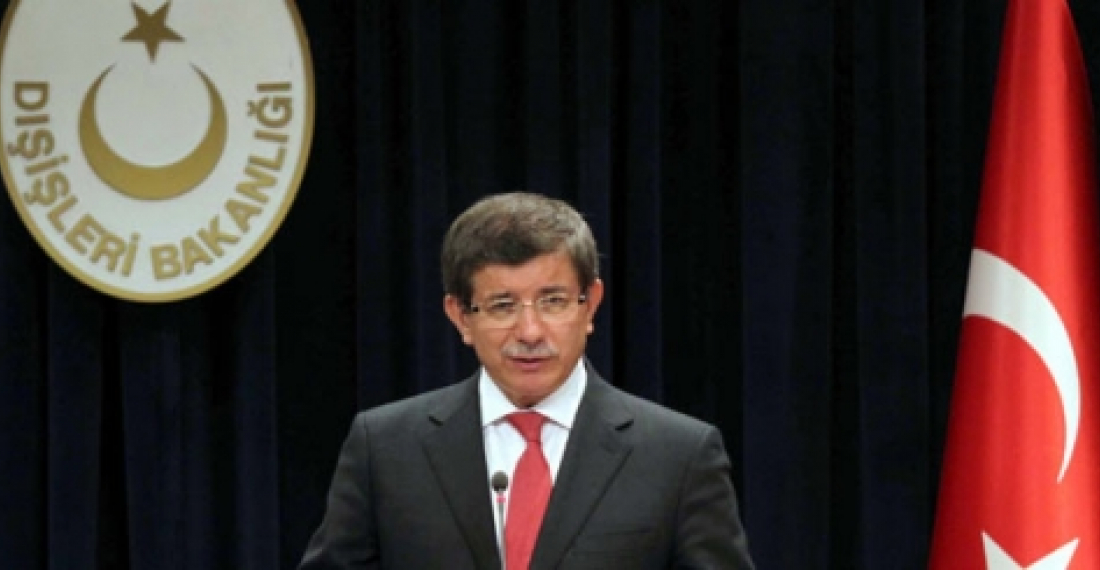
Turkish Foreign Minister Ahmet Davutoğlu said on Tuesday in Ankara the 21st century will be the century of Turkic-speaking countries as Turkey signed an agreement with the Cooperation Council of Turkic Speaking States to be the council's host country during the fourth-annual Conference of Turkish Ambassadors. Davutoğlu said the council, which was formed in 2010, aimed to boost economic and diplomatic cooperation between Turkic states and will be enlarged by the inclusion of other Turkic states. It currently has only four members: Kazakhstan, Azerbaijan, Kyrgyzstan and Turkey, the largest member.
The council's main objectives are to boost economic cooperation between member states, improve mutual cooperation in culture and tourism and preserve the cultural and historic assets of the Turkic world.
Davutoğlu pointed out that the Turkic states [in Central Asia] are now self-reliant and have made remarkable progress in economic and political fields in the 20 years following their independence after the disintegration of the Soviet Union.
"I hope the 21st century will be the century of Turkic-speaking countries," Davutoğlu said.
Noting that the headquarters of the Cooperation Council of Turkic Speaking States would be located in Istanbul under the agreement, Davutoğlu said they want to make İstanbul the center of international organizations. Turkey wants to cast İstanbul as a global diplomatic center, a UN city, the minister noted.
On Tuesday, the Ministry of Foreign Affairs signed an agreement with the İstanbul Metropolitan Municipality for close cooperation as İstanbul appears to be a new center of economic and diplomatic relations in the global scene.
İstanbul will be a financial center, positioning it as the main station for the global economic network and transportation routes, Davutoğlu said. Another major goal is to make İstanbul a center of cultural and intellectual activity as the city has had an astonishing history, he added.
By signing the agreement for close cooperation with the municipality, he noted that the ministry aims to bulk up its presence with various diplomatic activities in the city. He said municipality officials will receive diplomatic training as millions of tourists annually visit the historic city, which also hosts hundreds of international conferences on diplomatic or economic affairs.
In return, diplomats will take courses on city culture and the history of İstanbul from historians who work as experts and advisors at the municipality.
Speaking at the fourth-annual Ambassadors Conference, Deputy Prime Minister Ali Babacan strenuously dismissed the populist criticism of the EU in Turkey by saying that the EU criteria on the political system, institutions and judicial system is still significant although relations sometimes deteriorated due to political disputes in some areas.
Making a presentation to ambassadors titled "The Economic Crisis in the EU, Its Possible Political Implications and Turkey," he said the EU accession process would not be taken hostage by populism in Turkey, pointing to the significance of the union for consolidation of democracy in the country.
According to Babacan, the recent legislation in France which makes the denial of an alleged Armenian genocide a crime punishable by a one-year prison sentence and a fine of 45,000 euros was a fatal blow to freedom of expression, which is seen as one of the fundamental principles of the EU.
source: commonspace.eu with Todays' Zaman and agencies