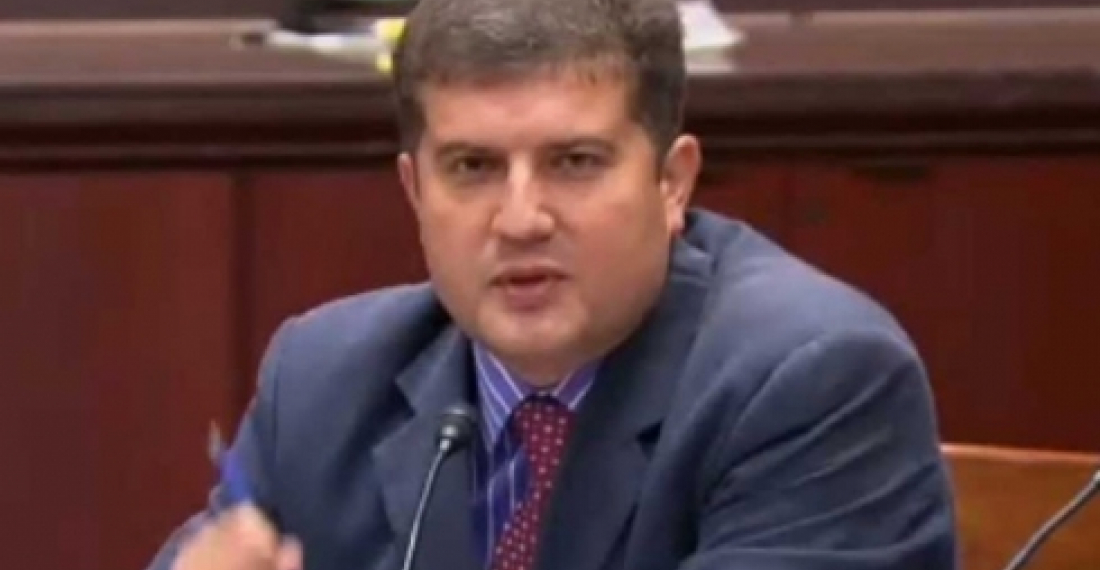
"The Government of Azerbaijan needs to move quickly, after the forthcoming Presidential election next month, with introducing constitutional reforms that would create conditions for proper parliamentary elections in 2015. These reforms should include the creation of an upper house of parliament." This view was expressed by Erkin Gadirli, Vice Chairman of the opposition REAL Movement in Azerbaijan, during a presentation at Chatham House in London. Gadirli said that the constitutional changes were necessary since it was clear that the ruling elite in Azerbaijan was not ready to release its current hold on power, and the creation of a second chamber in Parliament, that would act as a counter-balance to the first, was the only way in which the current Azerbaijani authorities would tolerate the presence of their political opponents in Parliament.
Gadirli lambasted the Azerbaijani authorities for refusing to register REAL's Chairman, Ilgar Mammedov, who is currently in prison awaiting trail, as a candidate in the October 9th election. He said that the Movement will exhaust the remaining legal remedies to try to have his candidature re-installed, but that if this did not happen they would then have no other choice but to ask their members to support the other opposition candidate Camil Hassanli, who has been nominated by a coalition of opposition parties grouped together in the "National Council". Gadirlli said that REAL had serious ideological differences with the "National Council" platform, which is why it did not join it, but that Hassanli was a respected national figure who now was the only credible option for those rejecting the candidature of the current President Ilham Aliev. Gadirli insisted that Aliev's election for a third term was anti-constitutional since the constitutional changes in 2009 could not be retroactive.
During his presentation, and an intensive question and answer session that followed, Gadirli spoke about changes in Azerbaijani society. Young people, he said, were much less dependent on the government than previous generations had been. They were also now the main source of information in the family, changing the old patriarchal ways in which politics was traditionally conducted. The internet had offered young people an opportunity to break out of the controls imposed by the tight hold on the media by the current government. Gadirli said that the government had lost the battle for the information space on the internet, despite its many efforts.
Asked about the improvements in the quality of life of the Azerbaijani people over the last ten years Gadirli said that he accepted that many things had changed for the better, but the government was still far from satisfying people's expectations. These expectations were not only material. People demanded from their government rule of law, respect, and the ability to express themselves freely. Gadirli highlighted the plight of several dozen young activists who were currently imprisoned on trumped up charges because they had dared to challenge the government.
Gadirli said that the government of Azerbaijan had been a reliable partner to the west in a number of spheres, including energy projects and the fight against terrorism. But the Government had disappointed western partners on the democracy agenda. He called on European institutions in the future to focus on property rights since he said that this will need to be the cornerstone on which the future could be build.
During his presentation Gadirli announced that REAL will transform itself into a political party soon after the Presidential elections, and that it would concentrate on the emerging middle class for its core support but that it also had plans to expand its work to all the regions of Azerbaijan.
source: commonspace.eu