


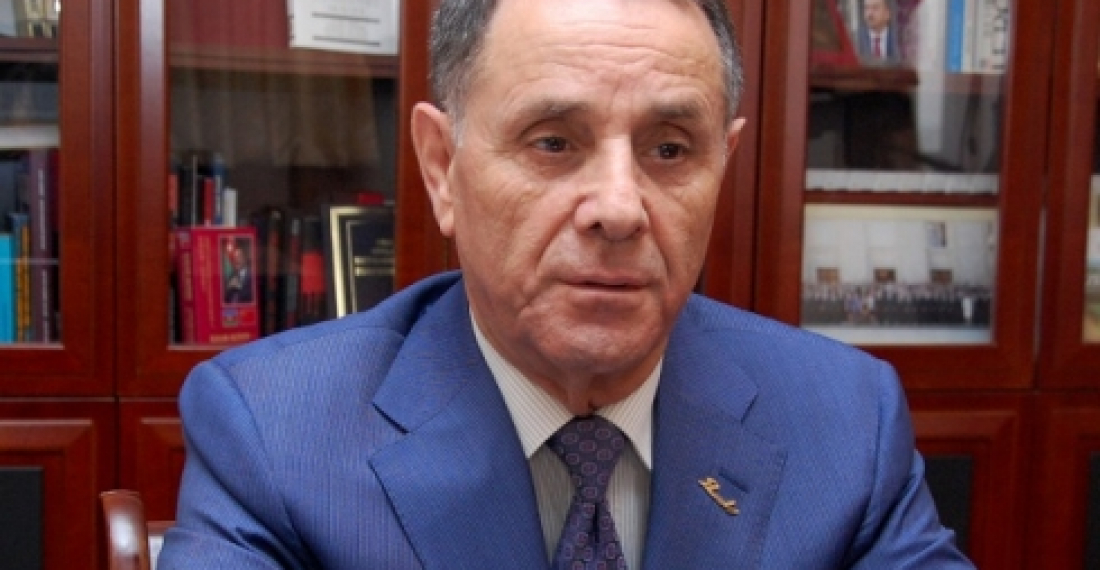
A senior Azerbaijani Government official has articulated the country's position on a number of key foreign policy issues when speaking to journalists on Friday (20 November). Novruz Mammedov, Deputy Head of the Presidential Administration and a key person in President Aliev's foreign policy team, said that a meeting between the presidents of Armenia and Azerbaijan on the resolution of the Karabakh conflict may still happen before the end of the year, but this was not yet confirmed. He reiterated Azerbaijan's demand for Armenia to withdraw from all Azerbaijani territory, and said this was long overdue. On relations with the European Union Mammedov said that Azerbaijan had refused to sign an Association Agreement with the EU since the document did not refer to the territorial integrity of Azerbaijan, but that discussions with the EU on co-operation within a strategic framework were ongoing, and Azerbaijan was willing to move its relations with the EU forward, as long as these were based on the principles of equality and mutual respect.
Novruz Mammedov started by highlighting the importance of Azerbaijan's participation in the G20 Summit in Antalya earlier in the week, where it attended as a special guest of the Turkish presidency of the G20. Mammedov noted that the terrorist attacks in Paris on the eve of the G20 summit, put a spotlight on the event and that the summit had discussed issues that will have global implications for many years to come.
Turning to the Karabakh conflict, Novruz Mammedov said that the time to return Azerbaijani lands occupied by Armenia is long due. Answering a question about the talks heldby the Russian Foreign Minister Sergey Lavrov in Yerevan and Armenian media speculation that Russia is trying to persuade Armenia to liberate the occupied Azerbaijani districts in exchange for Azerbaijan's consent to join the Eurasian Union Mammadov said that the Armenian side has not realized yet that the more it delays the in resolving the conflict, the worse it is for it.
"The Armenian leadership, namely, the foreign minister and president, often first agree on one issue and then suddenly change their position during the negotiations," Mammadov was quoted as saying. "The situation changes and previous words and statements then appear to have no significance."
Mammadov said that the essence of all negotiations on Karabakh conflict is that at least 3-5 occupied districts of Azerbaijan must be liberated at first. "According to the Madrid principles, at first, five districts must be released," he said. "These districts must be cleared from mines. Refugees must return there."
The second stage is for determining the format of the Lachin corridor and the issue of liberating two more Azerbaijani districts, Mammadov said.
At the same time, in parallel, earlier or later, a question of placing peacekeeping troops in Nagorno-Karabakh [will be decided], he said. "That is what they want - ensuring safety", Mammadov said.
"The third stage includes the return of refugees to Nagorno-Karabakh, and after a certain time - holding of a referendum as part of the Azerbaijani legislation," he added.
Mammadov also said that Azerbaijan has not seen a fair position on the part of Western countries concerning the Nagorno-Karabakh conflict settlement - in accordance with UN resolutions norms and principles of international law - for a long time. "This complicates the situation," Mammadov said.
Referring to reports that the presidents of Armenia and Azerbaijan will meet to negotiate on a Karabakh conflict settlement before the end of the year, Mammedov said that a decision has not been made yet. "President Ilham Aliyev's position is that Baku does not avoid such meetings, and is ready for them," he said.
Mammadov said however, that it was necessary to be confident beforehand that conditions to advance the settlement of the Nagorno-Karabakh conflict exist. "The OSCE Minsk Group co-chairmen are trying to organize such a meeting in 2015," he said. "If such a meeting is to take place, we will try to provide information on that a few days in advance. Today, I can't comment on anything."
The deputy head of the Azerbaijani presidential Administration also addressed issues related to relations with the European Union. Azerbaijan expects these relations to be conducted on the basis of equality and mutual respect, he said. He pointed out that Azerbaijan is one of the countries closely cooperating with the EU.
"Azerbaijan didn't accept the text of the Association Agreement that was proposed to us earlier", he said. "They propose us such an agreement, but unlike similar agreements, for example with Moldova, they do not mention recognition of [Azerbaijan's] territorial integrity."
Novruz Mammedov said that Azerbaijan wants to sign a document on strategic partnership with the European Union. "Azerbaijan has already signed a document on strategic partnership with eight important European countries," he added. If the European Union shows that it is ready for a relationship based on equality and mutual respect, and if the proposed document reflects Azerbaijan's territorial integrity, the country will sign this document.
Taking a swipe at recent controversies in Azerbaijan's relations with western countries Mammedov said that Europe can learn from Azerbaijan's experience in resolving the problems of refugees
"Some 700,000-800,000 refugees who have arrived in Europe with a 400 million population, caused great problems," he said. "The US is now considering not to accept refugees from Syria and Iraq."
Mammadov reminded that in 1990 when Azerbaijan gained independence, it was able to cope with the refugee problem. "During this period, at a time of political instability and weak economy in the country, more than one million refugees and internally displaced people arrived in Azerbaijan. The country's population was just 5-6 million people. However, Azerbaijan coped with this problem," he said.
"Azerbaijan cooperates with the European Union in the framework of the European Neighborhood Policy, Eastern Partnership," he said. "But they do not stress the work done by Azerbaijan to solve the problems of refugees and internally displaced people. Some organizations of these countries can make statements on various issues related to Azerbaijan several times a year. But they do not talk about the violation of the rights of refugees and internally displaced people."
He said that when such an attitude is shown, and such statements are made, good relations are difficult. "This is the result of the West's errors, and its unfair attitude to these issues," Mammadov said.
Commonspace.eu political editor said in a comment that "Novruz Mammedov is a key person in Azerbaijan's Foreign Policy establishment, and although he often speaks to the media, his comments on Friday were more comprehensive and far reaching than usual, and were meant to address criticism that Azerbaijan had become intransigent both in the negotiations on the Karabakh issue in the context of the Minsk Process, and in its negotiations on future relations with the European Union. "The message from Novruz Mammedov was clear: Azerbaijan is willing to engage on both issues, but that its engagement was not unconditional and the framework had to be acceptable.
Over the last year we have seen a serious deterioration in relations between Azerbaijan and the European Union and the United States. In his comments Novruz Mammedov could not resist criticising western countries for their attitude, including on Karabakh and on the issue of the displaced persons from the conflict. He did not explain how this western attitude differs from that of Russia, which he hardly mentioned at all. This notwithstanding Azerbaijan's willingness to remain constructively engaged in both the Karabakh peace negotiations, as well as in negotiations on its contractual arrangements with the European Union, is welcomed. The welfare of Azerbaijan, and of its people, is of significant importance for peace and stability in the Caucasus and in wider Europe and Eurasia. All concerned must now engage with good will and in haste so that progress can be achieved, both on securing lasting peace in Karabakh, as well as on properly institutionalising Azerbaijan's place within the European family of nations."
source: Commonspace.eu with TREND News Agency (Baku) and APA News Agency (Baku)
Photo: Deputy Head of the Presidential Administration, and Head of the Foreign Relations Department of the Presidential Administration of Azerbaijan, Novruz Mammedov.



