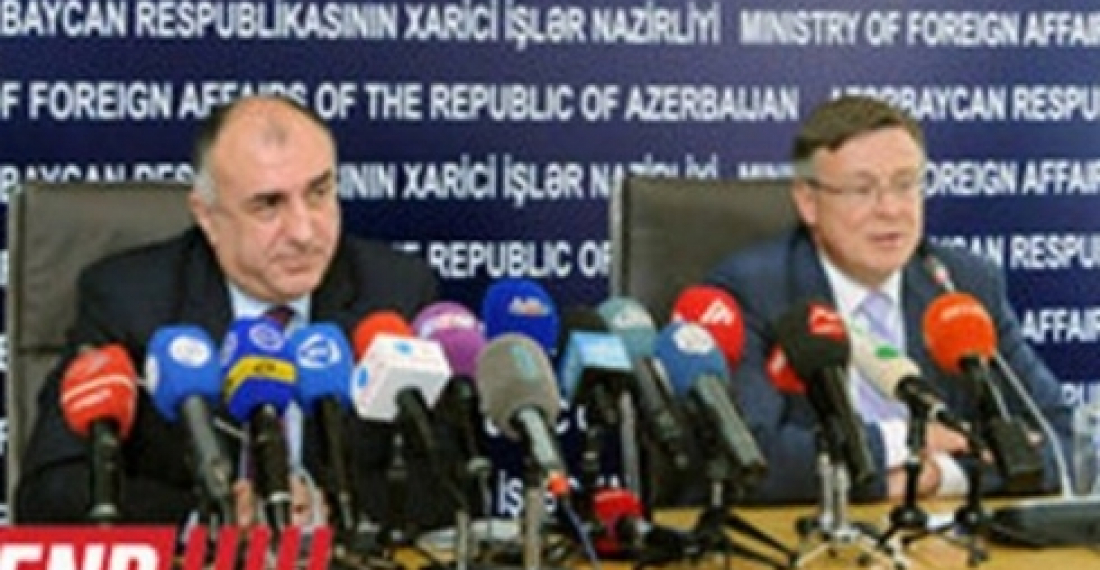
The Chairman-in-Office of the Organisation for Security and Co-operation in Europe (OSCE), Ukrainian Foreign Minister Leonid Kozhara has started a visit to the South Caucasus. This morning he met the Azerbaijani Foreign Minister, Elmar Mammadyarov, after which both Ministers spoke to the media about the importance of "intensifying" the work of the Minsk Process, mandated to facilitate negotiations between Armenia and Azerbaijan on the Nagorno-Karabakh conflict.
Mammadyarov also told journalists that he will shortly have another meeting with the diplomats from France, Russia and the United States, who constitute the co-Chair of the Minsk Process. The Azerbaijani News Agency APA quoted Minister Mammadyarov as saying that "We intend to move forward basing on the principles prepared by the OSCE co-chairs and approved by the heads of OSCE Minsk Group co-chair countries at the G8 summit." APA said that the Foreign Minister urged the Minsk Group to intensify its activity during his meeting with the OSCE Chairman-in-Office. He said that the meetings of the Minsk Group should be held more frequently: "I asked Ukraine to hold such meetings more frequently in Vienna, as the OSCE chairing country."
Mammadyarov left some ambiguity with regards to the format of future meeting: "This may be a meeting with co-chairs, or intermediaries may arrange a meeting of ministers." The Minister said that Azerbaijan's position remains unchanged: "We are ready to work on a comprehensive peace agreement. However, Armenia still considers it inexpedient to start work on the aforementioned agreement."
Commonspace.eu political editor said in a comment:
"For several years now, Azerbaijan has been trying to break out of the straightjacket that it considers it has been put in by the current format of the OSCE Minsk Process which has been monopolised by the three co-Chair countries, France, Russia and the US. Azerbaijan points to the lack of results from years of negotiations in that format as justification for its insistence that the format be changed. On the other hand Azerbaijan understands the value of having the US and Russia, and to a lesser extent France, involved in the mediation process and still hopes that they can put pressure to bear on Armenia, even if so far there has not been any sign of that happening.
This latest attempt to get the Ukrainian Chairmanship involved is unlikely to yield much results since Ukraine is in no position to influence the three co-chair countries. However Ukraine can insist on more reporting by the Minsk Group co-Chair to the OSCE Permanent Council in Vienna, and this may, and it is a big may, lead to more accountability by the co-Chair countries to the rest of the international community on the matter of the Karabakh peace process."
Press reports say that Mammadyaroiv and Kozhara also discussed the Helsinki Plus 40 process, an attempt launched at the last OSCE Ministerial Meeting to renew the work of the OSCE forty years after the signing of the 1975 Helsinki Final Act. The future of the OSCE Office in Baku has also been discussed during the meeting. Azerbaijan earlier this year had requested that the office be downgraded to a project office, a development which would seriously curtain the mission's ability to monitor issues related to governance and human rights. Ukraine which has its own human rights problems, is likely to be sympathetic to Azerbaijan on this issue.
source: commonspace.eu with APA, Trend and other news agencies.
Photo: The Azerbaijani and Ukrainian Foreign Ministers addressing a press conference in Baku on 8 July 2013 at the start of the visit of the OSCE Chairman-in-Office to the South Caucasus. (picture courtesy of Trend News Agency).