Armenian parliament to debate bill on recognising Nagorno-Karabakh independence

The Armenian government gave its approval on Thursday to debate a bill that would recognize the self-declared Nagorno-Karabakh Republic as independent. Similar bills have been proposed before, but were blocked by the government for fear they will interfere with the delicate peace process.

The development comes two days after Shavarsh Kocharyan, Armenia’s deputy foreign minister, said recognition is a possibility. “If Azerbaijan unleashes new military aggression, the recognition of Nagorno-Karabakh will be included in the agenda,” Kocharyan told journalists.

Current peace talks take place under the auspices of the OSCE Minsk Group, chaired by Russia, France and the United States. Russian foreign minister Sergei Lavrov said on Wednesday it was important not to "sound alarm and panic" about the prospect of Nagorno-Karabakh's independence being recognised.

"When I was in Yerevan last time and then, when I talked with my Armenian colleague on the phone, and later, when he was in Moscow after the escalation on the line of contact in Karabakh in early April, the official Yerevan reconfirmed its commitment to a peaceful settlement," said Lavrov in an interview with the RIA Novosti TV channel.

"This means that the status of Karabakh will be determined in the context of an overall agreement and not unilaterally," he said in response to deputy foreign minister Kocharyan's comments. 

The United States said on Friday it does not recognise Nagorno-Karabakh as independent. "We urge the sides to come to the negotiating table in good faith in order to reach a settlement that achieves [a comprehensive settlement]," said State Department spokesman Mark Toner.

The proposed Minsk Group settlement is set out by the “Madrid Principles”, which suggest giving an interim status to Nagorno-Karabakh, and linking it by land to Armenia. Independence for Nagorno-Karabakh would not be acceptable to Azerbaijan.

Earlier this week, Novruz Mammadov, deputy head of the Azerbaijan presidential administration, called the move by Armenian parliamentarians a "provocation".

"Their main goal was to use this as a pretext to spoil the negotiation process and perpetuate the status-quo," he said. "The Armenian side has once again proved that international law, UN Security Council resolutions and the negotiation process are of no value to them."

The bill was submitted by opposition lawmakers Zarui Postanjan and Grant Bagratyan. The government’s decision to debate it was “conditioned by discussions between Armenia and Karabakh, taking external and internal factors into account,” Kocharyan said on Thursday.

On April 2 fierce fighting broke out, the worst in two decades, with many soldiers and civilians killed on both sides. A verbal ceasefire agreement, brokered by Russia, was reached on April 5. However sporadic fighting has continued every night since then, with several casualties.

SOURCE: commonspace.eu and agencies

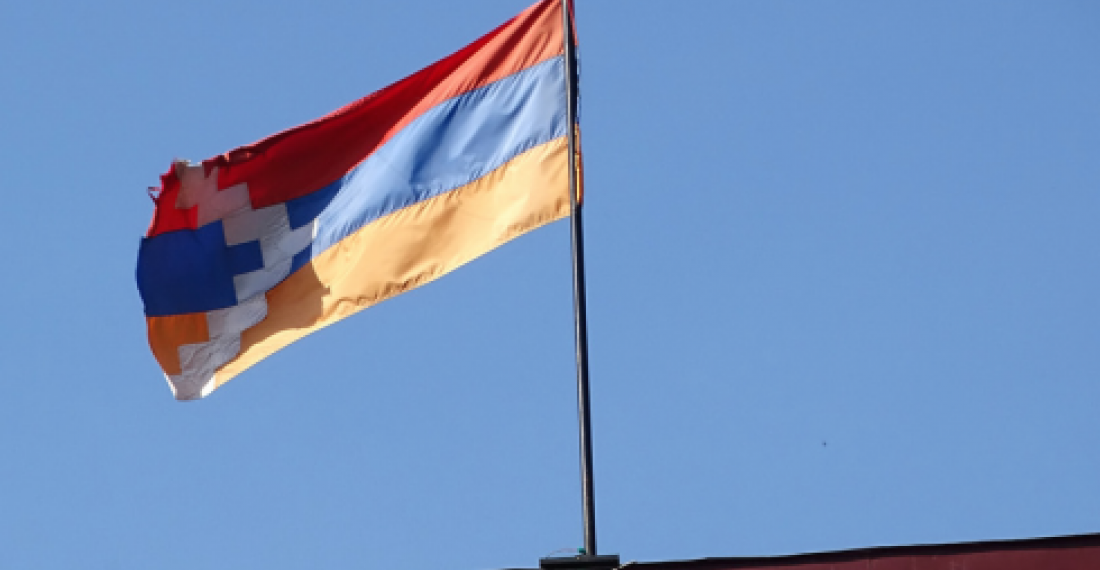
PHOTO: Karabakh flag
Related articles

Editor's choice
News
Council of Europe launches new International Claims Commission for Ukraine

Council of Europe launches new International Claims Commission for Ukraine

Thirty-four countries and the European Union have signed a new convention establishing an International Claims Commission for Ukraine at a diplomatic conference co-hosted by the 46-nation Council of Europe and the Netherlands in the Hague. The diplomatic conference was attended by leaders and high-level representatives from over 50 states, including the President of Ukraine, Volodymyr Zelenskyy, the President of the Republic of Moldova, Maia Sandu, and the Prime Minister of the Netherlands, Dick Schoof.  “Today marks a major step forward in ensuring accountability for Ukraine. The International Claims Commission represents justice and hope for tens of thousands of victims—our determination that those who have suffered will not be forgotten. I call for quick ratifications so we can get the commission rapidly up and running for the people of Ukraine,” said Council of Europe Secretary General Alain Berset. Ukrainian President Volodymyr Zelenskyy said: “We expect that every mechanism for compensation from the Register of Damage and Claims Commission to the actual payments – will start working and receive strong and sufficient international support, so that people can truly feel that any kind of damage caused by the war can be compensated. This war, and Russia’s responsibility for it, MUST become a clear example – so that others learn not to choose aggression.” “Accountability is about creating the conditions for peace that endures. And therefore, accountability is a condition of security – today and for the future. But accountability is not only about Ukraine. And it is not only about one aggressor and one victim. Accountability is about Europe. About every country in Europe. It is about whether Europe, as a whole, is willing to defend its peace,” said Maia Sandu, President of the Republic of Moldova, which currently holds the Presidency of the Council of Europe’s Committee of Ministers. The Prime Minister of the Netherlands, Dick Schoof, said: “Every day Russia is deliberately bombarding homes, destroying businesses and damaging infrastructure in Ukraine. Russia must compensate Ukraine for the damage caused. That is why we have launched the International Claims Commission for Ukraine and we are honoured to host it.” The International Claims Commission will be the second part of a comprehensive compensation mechanism related to Russia’s war of aggression, building on the existing Register of Damage for Ukraine. The claims commission will be established within the framework of the Council of Europe and will also be open to other countries. The Register of Damage for Ukraine, created in 2023, collects and records compensation claims submitted by individuals, organisations and public bodies in Ukraine. Forty-four states and the European Union have so far joined the Register, which has already received 86,000 claims. The International Claims Commission will review, assess and decide upon claims submitted to the Register of Damage for Ukraine and determine the amount of compensation, if any, which is due in each case. The convention establishing the commission will enter into force once it has been ratified by 25 signatories, as long as sufficient funds have been secured to support its initial work.

Popular

Editor's choice
News
Council of Europe launches new International Claims Commission for Ukraine

Council of Europe launches new International Claims Commission for Ukraine

Thirty-four countries and the European Union have signed a new convention establishing an International Claims Commission for Ukraine at a diplomatic conference co-hosted by the 46-nation Council of Europe and the Netherlands in the Hague. The diplomatic conference was attended by leaders and high-level representatives from over 50 states, including the President of Ukraine, Volodymyr Zelenskyy, the President of the Republic of Moldova, Maia Sandu, and the Prime Minister of the Netherlands, Dick Schoof.  “Today marks a major step forward in ensuring accountability for Ukraine. The International Claims Commission represents justice and hope for tens of thousands of victims—our determination that those who have suffered will not be forgotten. I call for quick ratifications so we can get the commission rapidly up and running for the people of Ukraine,” said Council of Europe Secretary General Alain Berset. Ukrainian President Volodymyr Zelenskyy said: “We expect that every mechanism for compensation from the Register of Damage and Claims Commission to the actual payments – will start working and receive strong and sufficient international support, so that people can truly feel that any kind of damage caused by the war can be compensated. This war, and Russia’s responsibility for it, MUST become a clear example – so that others learn not to choose aggression.” “Accountability is about creating the conditions for peace that endures. And therefore, accountability is a condition of security – today and for the future. But accountability is not only about Ukraine. And it is not only about one aggressor and one victim. Accountability is about Europe. About every country in Europe. It is about whether Europe, as a whole, is willing to defend its peace,” said Maia Sandu, President of the Republic of Moldova, which currently holds the Presidency of the Council of Europe’s Committee of Ministers. The Prime Minister of the Netherlands, Dick Schoof, said: “Every day Russia is deliberately bombarding homes, destroying businesses and damaging infrastructure in Ukraine. Russia must compensate Ukraine for the damage caused. That is why we have launched the International Claims Commission for Ukraine and we are honoured to host it.” The International Claims Commission will be the second part of a comprehensive compensation mechanism related to Russia’s war of aggression, building on the existing Register of Damage for Ukraine. The claims commission will be established within the framework of the Council of Europe and will also be open to other countries. The Register of Damage for Ukraine, created in 2023, collects and records compensation claims submitted by individuals, organisations and public bodies in Ukraine. Forty-four states and the European Union have so far joined the Register, which has already received 86,000 claims. The International Claims Commission will review, assess and decide upon claims submitted to the Register of Damage for Ukraine and determine the amount of compensation, if any, which is due in each case. The convention establishing the commission will enter into force once it has been ratified by 25 signatories, as long as sufficient funds have been secured to support its initial work.