Armenia talks tough as violence continues in Karabakh conflict zone.

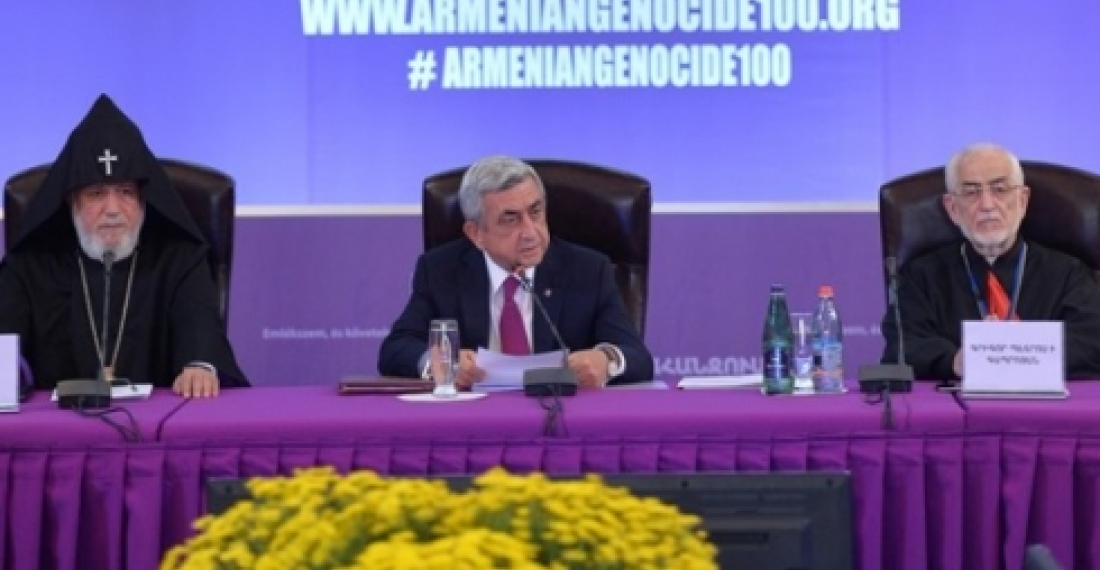
There has been tough talk in Yerevan following the latest incidents in the Karabakh conflict zone and on the international border between Armenia and Azerbaijan, in which at least seven Armenian soldiers and civilians were killed and many others injured. Armenian president Serzh Sargsyan referred to the incidents at the opening of the 6th session of the State Commission on Coordination of the Events for the Commemoration of the 100th Anniversary of the Armenian Genocide that took place at the Presidential Palace in Yerevan on Saturday (26 September).

Using sharp language, the Armenian leader lambasted the Azerbaijani leadership for its current stance. Serzh Sargsyan said:

"On the eve of the 70th Session of the UN General Assembly and amid the regular peacemaking efforts of the OSCE Minsk Group co-Chairs, before the eyes of the entire world, confident in is impunity, and inspired by the practice of numerous international players to put an equals sign between the conflicting sides’ actions, Azerbaijan again impenitently violated its very obligations to maintain the ceasefire. As a consequence of the ceasefire violation, we have suffered painful losses: 4 Armenian young soldiers, the guardians of their motherland’s tranquility, soldiers who were very far from the immediate danger zone and were engaged in their everyday activities 5 km away from the frontline, were killed. And one day ago, in their own house, in their own garden, in front of their beloved people were killed 3 women, a mother, a sister and a daughter, who would take care of their family with their peaceful work.

They were killed because an entire world can’t make Azerbaijan understand that the path of human losses, bloodsheds, sufferings and tortures, and of drowning out the voice of its own citizens does not lead to peace, does not lead to prosperity, and does not lead to stability and security.

As demonstrated by the modern history of human kind, the path chosen by Azerbaijani authorities, the path of crimes against humanity either results in an international punishment or leads to the scaffold put up by own people completely run out of patience.

By deviating from the path to the peaceful resolution of the conflict, Azerbaijan is also deviating, gradually and steadily, from the path of other norms of international law. Gradually and steadily, Azerbaijan’s criminal regime is further plunging into the swamp of crimes against humanity.

The law of the civilized world calls upon humanity to put an end to the impunity of crimes against humanity. The Republic of Armenia is committed to this position. We will consistently reveal, disclose and persecute each committer of such crimes, starting from the private solider executing an order to the commander issuing such an order. Lacking alternatives, we ourselves will be humanity’s retributive sword against committers of these crimes. We will do it on our own as long as the civilized world is not able to find a more effective mechanism.

These are not mere words when we say that we are afraid of war, but are not afraid to fight. Armenia and by Armenia I also mean Nagorno-Karabakh as its inseparable part, is one of the most militarized zones on the earth. As you know, our grandfathers would say that no pilaf is given out during a battle. And throughout more than 20 years of the imposed ceasefire, which has been impossible to transform into peace on account of Baku’s authorities, we have tried our best to avoid a new confrontation. We will continue in the same vein, and that also includes retributive actions so that the opponent does not think that his impertinent behavior is remained unpunished.

Without a doubt, we will certainly force Azerbaijan’s government to give an account to its people for causing them continued suffering. This much for now".

After two days of bloody exchanges on Thursday and Friday incidents on the front line continued also on Saturday (26 September). Azerbaijan accused Armenia of using mortar fire which killed one civilian in the Aghdam region.  APA News Agency reported that a resident of the Agdam region, forty year old Bahram Baghirov was wounded as a result of the mortar shelling, and died later in hospital.

In a statement on Saturday the OSCE Minsk Group co-Chair condemned the ongoing violence and the use of heavy weaponary in the conflict zone. They called on the sides "to accept an OSCE mechanism to investigate ceasefire violations". The co-Chair said that "Armenia has agreed to discuss the details of the mechanism" and , "urged Azerbaijan to do the same". You can read the full statement of the OSCE Minsk Group Co-Chair issued on 26 September 2015 here.
source: commonspace.eu with the press Service of the President of Armenia, APA news agency, osce.org and other agencies.
photo: President Serzh Sargsyan of Armenia speaking about the latest incidents in Karabakh at an event in Yerevan on Saturday, 26 September 2015. (Picture courtesy of the Press Service of the President of Armenia).

Related articles

Editor's choice
News
Council of Europe launches new International Claims Commission for Ukraine

Council of Europe launches new International Claims Commission for Ukraine

Thirty-four countries and the European Union have signed a new convention establishing an International Claims Commission for Ukraine at a diplomatic conference co-hosted by the 46-nation Council of Europe and the Netherlands in the Hague. The diplomatic conference was attended by leaders and high-level representatives from over 50 states, including the President of Ukraine, Volodymyr Zelenskyy, the President of the Republic of Moldova, Maia Sandu, and the Prime Minister of the Netherlands, Dick Schoof.  “Today marks a major step forward in ensuring accountability for Ukraine. The International Claims Commission represents justice and hope for tens of thousands of victims—our determination that those who have suffered will not be forgotten. I call for quick ratifications so we can get the commission rapidly up and running for the people of Ukraine,” said Council of Europe Secretary General Alain Berset. Ukrainian President Volodymyr Zelenskyy said: “We expect that every mechanism for compensation from the Register of Damage and Claims Commission to the actual payments – will start working and receive strong and sufficient international support, so that people can truly feel that any kind of damage caused by the war can be compensated. This war, and Russia’s responsibility for it, MUST become a clear example – so that others learn not to choose aggression.” “Accountability is about creating the conditions for peace that endures. And therefore, accountability is a condition of security – today and for the future. But accountability is not only about Ukraine. And it is not only about one aggressor and one victim. Accountability is about Europe. About every country in Europe. It is about whether Europe, as a whole, is willing to defend its peace,” said Maia Sandu, President of the Republic of Moldova, which currently holds the Presidency of the Council of Europe’s Committee of Ministers. The Prime Minister of the Netherlands, Dick Schoof, said: “Every day Russia is deliberately bombarding homes, destroying businesses and damaging infrastructure in Ukraine. Russia must compensate Ukraine for the damage caused. That is why we have launched the International Claims Commission for Ukraine and we are honoured to host it.” The International Claims Commission will be the second part of a comprehensive compensation mechanism related to Russia’s war of aggression, building on the existing Register of Damage for Ukraine. The claims commission will be established within the framework of the Council of Europe and will also be open to other countries. The Register of Damage for Ukraine, created in 2023, collects and records compensation claims submitted by individuals, organisations and public bodies in Ukraine. Forty-four states and the European Union have so far joined the Register, which has already received 86,000 claims. The International Claims Commission will review, assess and decide upon claims submitted to the Register of Damage for Ukraine and determine the amount of compensation, if any, which is due in each case. The convention establishing the commission will enter into force once it has been ratified by 25 signatories, as long as sufficient funds have been secured to support its initial work.

Popular

Editor's choice
News
Council of Europe launches new International Claims Commission for Ukraine

Council of Europe launches new International Claims Commission for Ukraine

Thirty-four countries and the European Union have signed a new convention establishing an International Claims Commission for Ukraine at a diplomatic conference co-hosted by the 46-nation Council of Europe and the Netherlands in the Hague. The diplomatic conference was attended by leaders and high-level representatives from over 50 states, including the President of Ukraine, Volodymyr Zelenskyy, the President of the Republic of Moldova, Maia Sandu, and the Prime Minister of the Netherlands, Dick Schoof.  “Today marks a major step forward in ensuring accountability for Ukraine. The International Claims Commission represents justice and hope for tens of thousands of victims—our determination that those who have suffered will not be forgotten. I call for quick ratifications so we can get the commission rapidly up and running for the people of Ukraine,” said Council of Europe Secretary General Alain Berset. Ukrainian President Volodymyr Zelenskyy said: “We expect that every mechanism for compensation from the Register of Damage and Claims Commission to the actual payments – will start working and receive strong and sufficient international support, so that people can truly feel that any kind of damage caused by the war can be compensated. This war, and Russia’s responsibility for it, MUST become a clear example – so that others learn not to choose aggression.” “Accountability is about creating the conditions for peace that endures. And therefore, accountability is a condition of security – today and for the future. But accountability is not only about Ukraine. And it is not only about one aggressor and one victim. Accountability is about Europe. About every country in Europe. It is about whether Europe, as a whole, is willing to defend its peace,” said Maia Sandu, President of the Republic of Moldova, which currently holds the Presidency of the Council of Europe’s Committee of Ministers. The Prime Minister of the Netherlands, Dick Schoof, said: “Every day Russia is deliberately bombarding homes, destroying businesses and damaging infrastructure in Ukraine. Russia must compensate Ukraine for the damage caused. That is why we have launched the International Claims Commission for Ukraine and we are honoured to host it.” The International Claims Commission will be the second part of a comprehensive compensation mechanism related to Russia’s war of aggression, building on the existing Register of Damage for Ukraine. The claims commission will be established within the framework of the Council of Europe and will also be open to other countries. The Register of Damage for Ukraine, created in 2023, collects and records compensation claims submitted by individuals, organisations and public bodies in Ukraine. Forty-four states and the European Union have so far joined the Register, which has already received 86,000 claims. The International Claims Commission will review, assess and decide upon claims submitted to the Register of Damage for Ukraine and determine the amount of compensation, if any, which is due in each case. The convention establishing the commission will enter into force once it has been ratified by 25 signatories, as long as sufficient funds have been secured to support its initial work.