


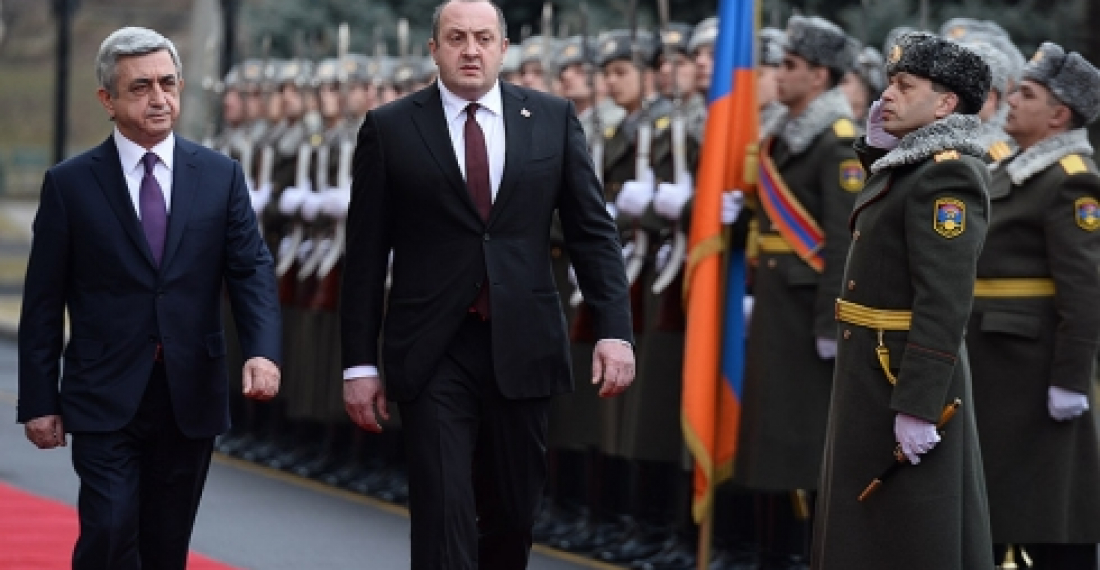
The President of Georgia, Giorgi Margvelashvili is in Armenia on an official visit at the invitation of his Armenian counterpart Serzh Sargsyan. After an official welcoming ceremony at the Presidential Palace, Serzh Sargsyan and Giorgi Margvelashvili held a private meeting which was followed by extended-format negotiations with the participation of the two countries' delegations.
"Serzh Sargsyan welcomed the President of Georgia and expressed hope that President Giorgi Margvelashvili's first official visit to Armenia will give a new impulse to the cooperation between the two countries, as well as the friendship and brotherhood of the Armenian and Georgian people. At the meeting, the President of Armenia took the opportunity once again congratulating Giorgi Margvelashvili on the occasion of his election as the President of Georgia and wished him successes", stated the website of the Armenian President. President Serzh Sargsyan noted that it is important to also listen to President Margvelashvili's position on the regional situation because the level of the bilateral relations, indeed, give an opportunity to constructively observe all the issues which are of interest for both Armenia and Georgia.
Commonspace.eu political editor commented on the visit:
Armenia and Georgia are linked by a shared history, geographic proximity and most importantly by the close relationship between their people. Yet between the two nations there is also a degree of unhealthy competition that sometimes complicates their relationship.
The modern, post Soviet states of Armenia and Georgia are also caught in a geo-political reality that creates awkward moments in the relationship between them. Armenia is closely aligned with Russia, is a member of the Russian backed CSTO and will soon be a member of the Russia led economic grouping the Customs Union, whilst Georgia sees Russia as occupying its territory and is on its way to closer relations with NATO and the EU. Georgia sees itself as the victim of agressive separatism in Abkhazia and South Ossetia, whilst Armenia is the promoter of separatism in Nagorno-Karabakh. Armenia is at war with Azerbaijan, whilst Georgia sees Azerbaijan as its strategic partner.
The new Georgian President, Giorgi Margvelashvili has prioritised relations with Georgia's immediate neighbours in the short time that he has been President. This is to his credit for Georgia needs to manage its immediate neighbourhood well if it is to succeed in its ambitious political and economic objectives. This visit is therefore timely and of the utmost importance. Armenian leaders have also traditionally paid a lot of attention to their relations with Georgia and have been extremely careful in dealing with Georgian sensitivities, including in difficult moments, such as the 2008 Georgia-Russia War. Both sides have practical reasons for doing so - Georgia has a very large and ethnically aware Armenian minority. Armenia on its part currently depends almost solely on Georgia for its overland connections with the outside world.
However the two countries need to move beyond this relationship built on expediency and construct together frameworks for future co-operation that are durable and of mutual benefit. With the two countries now anchoring themselves in separate military and economic blocks this will be more difficult in the future than it has been in the past. Both sides need to accept this, and plan around this eventuality. Both need to be sure that when negotiating their arrangements with their preferred international partners they keep in mind the need to maintain this important bilateral relationship on solid basis.
source: commonspace.eu
photo: President Sargsyan of Armenia and President Margvelashvili of Georgia reviewing a guard of honour at the Presidential Palace in Yerevan on Thursday, 27 February 2014 (Picture courtesy of the Press Service of the President of Armenia).



