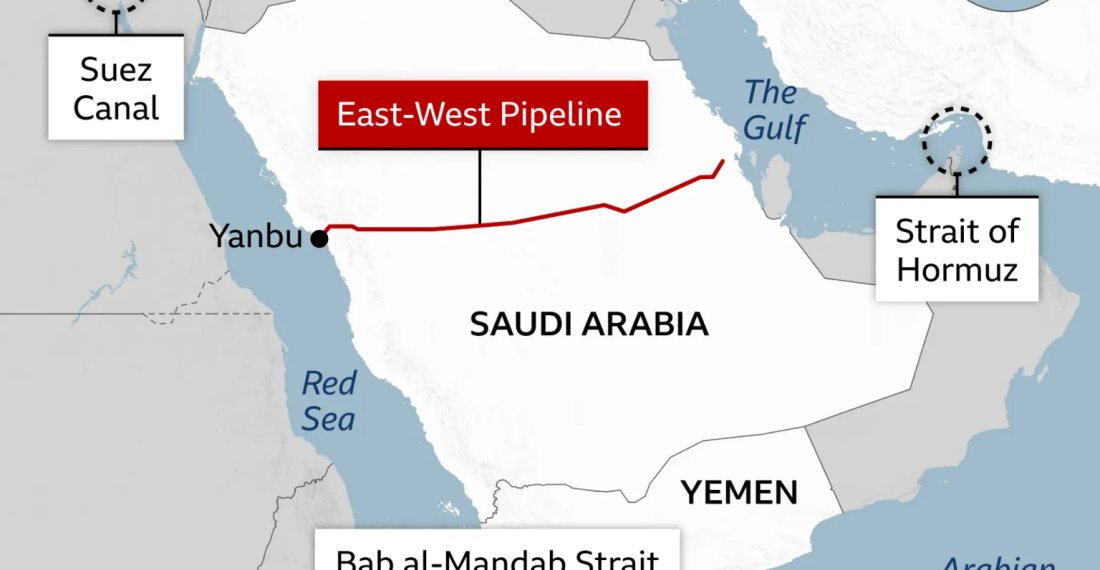
The crisis in the Gulf continues. The US bombed Iran for the twelfth consecutive night, but Tehran continues to assert control over the key Middle East maritime choke points - the Strait of Hormuz, and Bab el Mandeb.
Yemen's Houthis say they have attacked two Saudi oil tankers in the Red Sea as the US launched its 12th consecutive night of strikes on Iran.
Iranian state media said two people had been killed in the US strikes on Wednesday, and a tanker caught fire in an explosion in a mined route in the Strait of Hormuz.
Ahead of the latest round of strikes, US President Donald Trump had threatened to destroy an Iranian bridge or power plant if Iran attacked a ship in the strait and to "take care of" the Houthis if they blocked the Red Sea.
If confirmed, the Houthi attack would be the first since the Iran-backed group announced a "maritime embargo" against Saudi Arabia.
The Houthis named the tankers as the Encelia and the Layla, though neither their responsibility, nor the attack on the Layla has been confirmed.
The group's military spokesperson Yahya Saree said they had targeted the ships with drones and missiles for allegedly violating its naval blockade.
Saree added that the Houthis promised to continue their naval operations and would continue "enforcing the 'siege for a siege' equation".
UK Maritime Trade Operation (UKMTO) reported an "unknown projectile" struck a Saudi tanker about 130km from Al Shuqaiq in Saudi Arabia at 20:00 GMT. The attack caused a fire but no casualties, it said.
British maritime risk management group Vanguard also reported that the Saudi tanker Encelia had been hit.
The Iranian Revolutionary Guard (IRGC) said the Strait of Hormuz was "completely closed" after an explosion in the channel, Iranian state media reported.
The IRGC said it had stopped three oil tankers from passing through the strait.
One tanker caught fire and two others turned back after attempting to pass through a mined route south of the strait, according to Iranian state media.
At least seven oil tankers have made U-turns close to Yemen since the Iran-linked Houthi group announced a "maritime embargo" against Saudi Arabia on Monday, ship-tracking data shows.
All of the ships were travelling either to or from Saudi ports and made sharp changes of course after the embargo was announced.
Nearly 15% of global sea trade moves through the Red Sea, which connects the Mediterranean and Gulf of Aden through two choke points - the Suez Canal in Egypt and the Bab al-Mandab Strait between Yemen and the Horn of Africa.
The Red Sea has been a key route for exports of Saudi oil since the US-Israeli war with Iran led to the effective closure of the Strait of Hormuz, which has severely restricted the flow of oil and gas from the Gulf.
This has played a "major role in relieving pressure to global markets" and if the Houthis further restrict trade then "prices will go up", said Rosemary Kelanic from the US-based Defense Priorities think tank.
On Thursday morning (23 July), the price of Brent oil had reached US$95.
The day before the Houthis announced their blockade, 20 vessels entered the Red Sea and 22 exited via the Bab al-Mandeb strait, according to maritime intelligence firm Kpler.
Kelanic told BBC Verify that any Houthi attacks on vessels in the Red Sea or Gulf of Aden "will suppress all international traffic not just Saudi-bound vessels".
The EU's naval force in the region Aspides recommended on Wednesday that "merchant vessels linked to Israeli, US or Saudi interests avoid transiting the Red Sea and Gulf of Aden until the threat level decreases", according to an advisory seen by Reuters news agency.
On Wednesday (22 July) Iran said it struck two oil tankers in the Strait of Hormuz
Centcom, the US military command in the Middle East, insisted that commercial vessels were continuing to pass through the Strait of Hormuz.
Iran meanwhile said its forces struck two oil tankers as they attempted to transit through what it called the strait's "unsafe and hazardous southern route" and rescue teams were picking up their crews, according to state media.
The United Kingdom Maritime Trade Operations agency (UKMTO) said a tanker in the Strait of Hormuz had reported being struck by an unknown projectile, forcing its crew to abandon the vessel and board a lifeboat.
It was not clear whether the tanker reported by UKMTO was among those cited by Iran.
Six fuel tankers and cargo ships crossed the Strait of Hormuz on Monday, according to preliminary data from maritime intelligence firm Kpler. Two of these vessels had previously been sanctioned by the US for links with Iran.
This is down from eight vessels crossing on 19 July, the data shows. All but one of the crossings made on 20 July were via the northern route near Iran.
source: commonspace.eu with BBC (London) and agencies