Von Der Leyen's "State of the Union" speech was ambitious and visionary, but will the Brussels bureaucracy deliver?

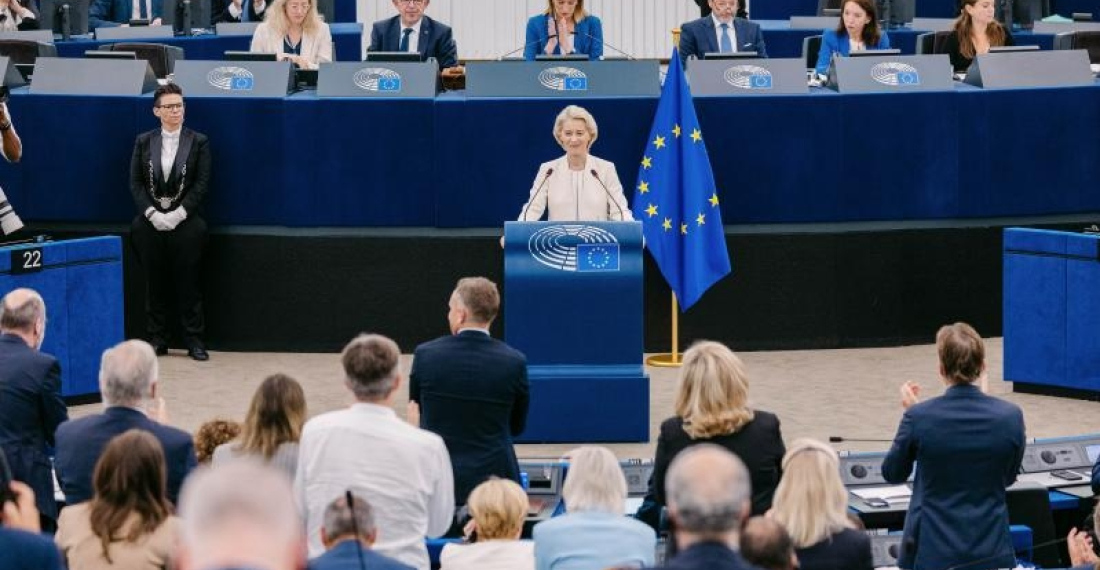
European Commission president, Ursula von der Leyen gave her annual "State of the Union" speech to the European Parliament on Thursday (17 September). The speech was visionary in its scope and ambitious in what it seeks to achieve. But many who are familiar with the Brussels bureaucracy do not think that the system that von der Leyen heads, has the stamina, flexibility or even the will to deliver.

Von der Leyen did not mince her words. Her opening statement laid out the vision and the ambition

It was the best of times, it was the worst of times.' This is how Charles Dickens describes Europe in the days of the French Revolution. And it is also a fair description of the world we live in. The speed of change is incredible. The challenges exceptional. So if I look at Europe today, my take is this: the state of our Union is the strongest it has ever been. The state of our Union can also feel as precarious as it has ever been.

These two statements may seem incompatible. But they are both true. And they reflect these exceptional times. This complex age of great possibilities and great perils, which all countries are seeking to navigate.

In this world, Europe has chosen to forge its own path. And a stronger, independent Europe is now emerging.

This is a Europe that is securing its prosperity. One that is breaking free from its toxic dependency on Russian fossil fuels. That has become the greatest trading power on the planet. That is transforming its industrial policy while upholding our unique social model.

This is a Europe better able to defend itself than ever before. One that has radically overhauled its approach to securing our homelands. That has increased defence spending by almost 80 % in the last five years alone.

This is a Europe that stands up for each other. As we are doing by standing with Ukraine as it fights for its future and for our freedom. Or when we stood up for Greenland when it was threatened. Or when drones, hybrid attacks or disinformation target our democracies.

All of this proves one thing. That Europe is there for Europeans. And that in the cold fragility of today's world, only Europe can provide true sovereignty to Europeans.

This is a Europe we can be so proud of.

At the same time, we all know the threats that we are facing. As old assumptions and relationships have frayed, we are now dealing with an openly hostile world. A territorial war of aggression is raging on our continent; others have erupted nearby. A fight for industrial capacities is shaping global competition. And a battle of narratives is seeking to weaken confidence in Europe; to paralyse our democracies.

But people's worries are not only linked to these big, global threats. The effects of the many crises are present for many European families, not least in the cost of living or housing. The dizzying speed of change and technology is impacting our jobs, our livelihoods and our society. And it is also having a profound effect on our democracy and our discourse.

We see this in the rise of the extreme, the decline of nuance – even in the way that we relate to each other.

These real concerns are being weaponised to drive a wedge between us. Sometimes from the outside – and too often from the inside. But our path is clear. Building an independent Europe that has the power to act. Nothing can divert us from this. Because in this world, the fate of Europe must remain in the hands of Europeans.

So our choice is clear. Do we want a strong and independent Europe that stands up for its values in this world? Or do we let divisions and dependencies hold us back? Do we want to rally around our European idea that together we can decide our own destiny? Or do we let our democracies be undermined by the proxies and puppets of authoritarians?

Whether it is the ultranationalists or the anti-Europeans, whether it is Russian interference or disinformation, the names may be different, but their goal is the same. They despise our values, and they want to shatter our European unity. So let's not only fight back against that, but also let's fight together for our European idea.

The European Commission president used her speech to make the case for a stronger, more independent Europe.

Present in person at the EP in Strasbourg was Canadian Prime Minister Mark Carney. The Commission president invited the country to work with Brussels on becoming “the first associate member of the European Union,” adding “we see the world through the same eyes.”

Von der Leyen also said she would propose a new security forum, A European Security Council, for EU and like-minded leaders in response to escalating Russian hybrid attacks and fraying transatlantic relations, with Canada, Ukraine, Norway, and the U.K. also invited to join.

Putting her point of view to the European Parliament, and being honest about the challenges ahead, was an important challenge. More difficult is the challenge that von der Leyen has: to convince the bureaucracy in the EU institutions in Brussels of the challenges ahead, and of the need to change and adapt to the new realities.

This bureaucracy has often failed to deliver. It's too caught in its own labyrinth and comfort zone; has a problem with engaging with both EU citizens and the wider world; lacks the readiness to learn from its own mistakes, partly because of a flawed institutional memory, and is too slow to adjust.

Von der Leyen has tried to fix some of these problems, but with limited success. She needs to try harder!

You can read Von der Leyen's speech in  full here
 

Related articles

Editor's choice
News
European Commission Disburses €1.24 Billion to Boost Ukraine’s Defence Industry

European Commission Disburses €1.24 Billion to Boost Ukraine’s Defence Industry

The European Commission disbursed €1.24 billion to Ukraine on Wednesday (October 7) under the defence component of the €90 billion Ukraine Support Loan, earmarked for drones, drone interceptors, ammunition, and missiles produced by Ukrainian entities. European Commission President Ursula von der Leyen said the payment would strengthen Ukraine’s defence industry and its ability to protect people and infrastructure. She described Russia’s ongoing attacks as a deliberate strategy intended to make daily life increasingly difficult for Ukrainians. The Ukraine Support Loan provides an indicative €60 billion for defence and €30 billion for budgetary assistance during 2026–2027. The European Commission plans to disburse €28.3 billion for Ukraine’s defence industrial capacity in 2026, with further payments under the defence component expected in the coming weeks. Funding decisions are based on Ukraine’s evolving requirements and remain subject to agreed conditions and monitoring. According to Ukrainian Prime Minister Serhiy Koretskyi, the latest payment brings Ukraine’s defence financing received through the programme to nearly €13 billion. He said the government would continue working with European partners to ensure the remaining planned funding is delivered on schedule and in full For the remainder of 2026, €32.5 billion in EU financial support remains available to Ukraine. This includes €28.1 billion under the Ukraine Support Loan – €15.4 billion for defence industrial capacity and €12.7 billion in budget support. A further €4.4 billion remains available through the Ukraine Facility, bringing the total budget support available for 2026 to more than €17 billion, subject to Ukraine meeting the relevant conditions. Since 2022, the EU and its member states have provided €228.7 billion in overall support to Ukraine, including €3.8 billion generated from immobilised Russian assets.
Editor's choice
News
In Ethiopia, government forces take rebel capital

In Ethiopia, government forces take rebel capital

Government forces in Ethiopia, have taken control of the town of Mekelle, capital of the Tigray region. Earlier, Ethiopia's federal military said it had recaptured the main airport in the capital of the northern Tigray region, dealing a major setback to an ​opposition alliance in its stronghold. Clashes pitting a rebel alliance led by Tigray's ruling party ‌against the government and its allied forces broke out in northern Ethiopia last week, in the most serious escalation of violence since a 2020-2022 civil war. The fighting has stoked fears that it could escalate into a wider regional conflict, potentially drawing in neighbouring ​countries in the Horn of Africa and the Gulf. In recent days Ethiopia and Eritrea broke off diplomatic relations amid mutual accusations. In Washington, State Department spokesman Tommy Pigott ​said the United States strongly urged Ethiopia and Eritrea to "exercise maximum restraint and return ⁠to dialogue and cooperation as agreed in their 2018 peace framework." "The Horn of Africa cannot sustain another ​military conflict and humanitarian crisis," Pigott said. "A conflict jeopardizes ongoing U.S. collaboration on shared interests with both countries." The ​federal government in Addis Ababa accused Eritrea of supporting the rebel alliance alongside Sudan and Egypt. The three countries deny this. Troops from the Ethiopian National Defence Forces had regained control of Alula Aba ​Nega Airport in Tigray's capital Mekelle,   A Mekelle resident who asked not to be named for security reasons, confirmed the ‌taking of ⁠the airport by government forces and added they could hear gunfire outside the city centre. This source said they had seen some Tigrayan Defence Force fighters abandoning their posts and heading home, and that there was looting of government facilities taking place in the city. Mekelle's airport, which ​is around 10 km (6 miles) from the centre of the city, was ​one of three ⁠airports in the region that were seized by the opposition forces at the start of the fighting on September 23. The taking of Mekelle by government forces would be a major setback for the opposition alliance, although analysts say ⁠it ​would be unlikely to end the conflict. In 2020, federal forces captured ​Mekelle within the first month of the two year war before the TPLF reclaimed it seven months later.

Popular

Editor's choice
Interview
Thursday Interview: Murad Muradov

Thursday Interview: Murad Muradov

Today, commonspace.eu starts a new regular weekly series. THURSDAY INTERVIEW, conducted by Lauri Nikulainen, will host  persons who are thinkers, opinion shapers, and implementors in their countries and spheres. We start the series with an interview with Murad Muradov, a leading person in Azerbaijan's think tank community. He is also the first co-chair of the Action Committee for a new Armenian-Azerbaijani Dialogue. Last September he made history by being the first Azerbaijani civil society activist to visit Armenia after the 44 day war, and the start of the peace process. Speaking about this visit Murad Muradov said: "My experience was largely positive. My negative expectations luckily didn’t play out. The discussions were respectful, the panel format bringing together experts from Armenia, Azerbaijan, and Turkey was particularly valuable during the NATO Rose-Roth Seminar in Yerevan, and media coverage, while varied in tone, remained largely constructive. Some media outlets though attempted to represent me as more of a government mouthpiece than an independent expert, which was totally misleading.  Overall, I see these initiatives as important steps in rebuilding trust and normalising professional engagement. The fact that soon a larger Azerbaijani civil society visits to Armenia followed, reinforces the sense that this process is moving in the right direction." (click the image to read the interview in full)