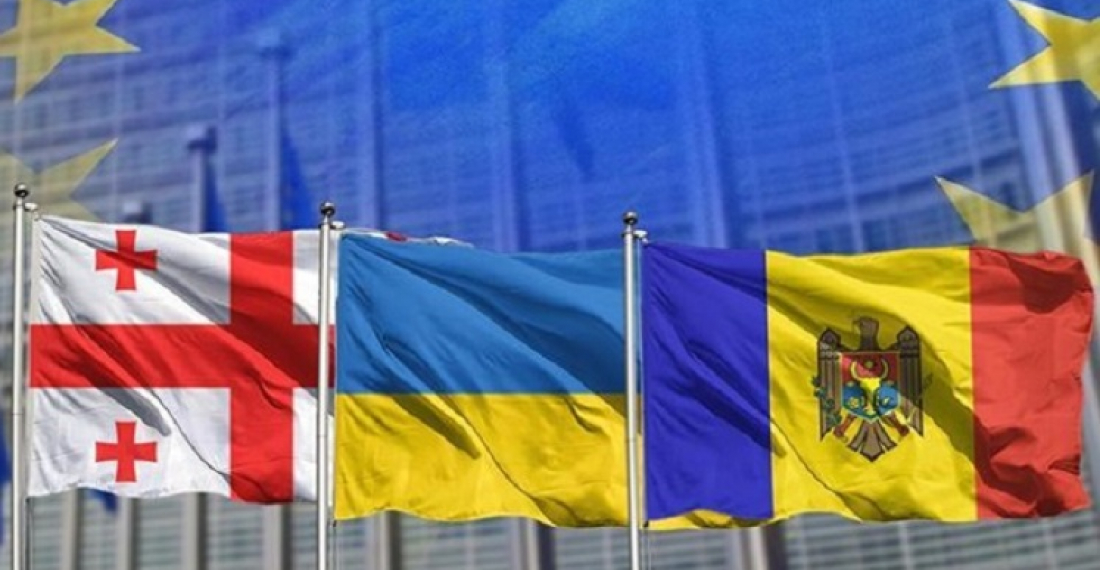
Editorial: Give Georgia, Moldova and Ukraine EU candidate status now!

In the next few days the European Commission will announce its opinion on the request of Georgia, Moldova and Ukraine for European Union candidate status. A decision will then be taken by the 27 member states in the European Council at the end of this month.

“Candidate Status” is the beginning of a journey for any country that wants to join the European Union. In the case of many successful candidates in the past, the process has often taken a decade or more. In the case of others, such as Turkey, the process does not appear to have an end in sight. In short candidate status is not an automatic ticket to EU membership, simply a political expression of the will of the applicant and of the EU to embark on the journey. This notwithstanding the EU has been increasingly hesitant to give a membership perspective to the trio. This is partly due to the so called “enlargement fatigue”, partly because there are those within the member states and the institutions who do not think Georgia, Moldova and Ukraine should be in the EU, period! These sceptics have been caught on the wrong foot by the war in Ukraine, the heroism of the Ukrainian resistance to the Russian invasion, and the decision of the trio to bring forward their request for candidate status and to ask that it be dealt with urgently.

Clearly, Georgia, Moldova and Ukraine are not ready for EU membership today, but that is not what is on the agenda now. The many challenges facing the tree countries should not be hidden under the carpet, and the political elites in Tbilisi, Chisinau and Kyiv must assume their responsibility to ensure political, economic and judicial reforms are implemented more comprehensively and more speedily. But for now, candidate status, especially in the present context, is primarily a political decision and a political statement. The EU needs to embrace these three countries and work diligently with them over the next years to prepare them for membership.

In doing so the EU will be repeating the process it had done so successfully in the 1970s and the 1980s when it welcomed the applications of Greece, Portugal and Spain, who had just emerged from the horror of fascist dictatorships and speedily opened to them the door of full membership. The EU consolidated their democracy, hugely improved the quality of life of their people and united them unequivocally in the European family. That is the sort of ambition that should prevail in dealing with Georgia, Moldova and Ukraine, and they therefore should be accorded candidate status now!
This is an editorial prepared by the editorial team of commenspace.eu

Related articles

Editor's choice
News
Borrell tells the European Parliament that the situation in Afghanistan was critical, but the EU will remain engaged

Borrell tells the European Parliament that the situation in Afghanistan was critical, but the EU will remain engaged

Borrell underlined that the European Union will make every effort to support the peace process and to remain a committed partner to the Afghan people. "Of course, we will have to take into account the evolving situation, but disengagement is not an option.  We are clear on that: there is no alternative to a negotiated political settlement, through inclusive peace talks.
Editor's choice
News
Germany accuses Russia of cyberattacks and disinformation campaign

Germany accuses Russia of cyberattacks and disinformation campaign

The German government holds Russia responsible for a cyberattack on German air traffic control, and for targeted disinformation campaigns before the last federal election. According to the German Foreign Office in Berlin, the incidents could be clearly attributed to the Russian military intelligence service, the GRU. In response, the Russian ambassador to Berlin was summoned to the Foreign Ministry. "We have been observing a massive increase in threatening hybrid activities by Russia for some time now," a spokesperson for the Foreign Ministry stated. These range from disinformation campaigns and espionage to cyberattacks and sabotage attempts. The aim is to divide society, sow distrust, and undermine confidence in democratic institutions. The spokesperson added that with these actions, Russia is "very concretely threatening our security, not only through its war of aggression against Ukraine, but also here in Germany."  The Foreign Ministry spokesperson explained that the cyberattack on air traffic control in August 2024 was clearly attributed to the hacker collective "APT28," known as "Fancy Bear," and to the responsibility of the Russian military intelligence service, the GRU. Furthermore, it could now be "conclusively stated" that Russia had attempted "to influence and destabilize both the last Federal election and the ongoing internal affairs of the Federal Republic of Germany." There was "absolutely irrefutable evidence" for this". The so-called "Storm 1516" campaign, which has been running since 2024, is allegedly backed by "reliable information" that the Moscow-based think tank "Center for Geopolitical Expertise" is behind it. The Center is also said to be supported by Russian military intelligence. Its primary aim is to influence democratic elections in the West. (Click the image to read more).

Popular

Editor's choice
News
Germany accuses Russia of cyberattacks and disinformation campaign

Germany accuses Russia of cyberattacks and disinformation campaign

The German government holds Russia responsible for a cyberattack on German air traffic control, and for targeted disinformation campaigns before the last federal election. According to the German Foreign Office in Berlin, the incidents could be clearly attributed to the Russian military intelligence service, the GRU. In response, the Russian ambassador to Berlin was summoned to the Foreign Ministry. "We have been observing a massive increase in threatening hybrid activities by Russia for some time now," a spokesperson for the Foreign Ministry stated. These range from disinformation campaigns and espionage to cyberattacks and sabotage attempts. The aim is to divide society, sow distrust, and undermine confidence in democratic institutions. The spokesperson added that with these actions, Russia is "very concretely threatening our security, not only through its war of aggression against Ukraine, but also here in Germany."  The Foreign Ministry spokesperson explained that the cyberattack on air traffic control in August 2024 was clearly attributed to the hacker collective "APT28," known as "Fancy Bear," and to the responsibility of the Russian military intelligence service, the GRU. Furthermore, it could now be "conclusively stated" that Russia had attempted "to influence and destabilize both the last Federal election and the ongoing internal affairs of the Federal Republic of Germany." There was "absolutely irrefutable evidence" for this". The so-called "Storm 1516" campaign, which has been running since 2024, is allegedly backed by "reliable information" that the Moscow-based think tank "Center for Geopolitical Expertise" is behind it. The Center is also said to be supported by Russian military intelligence. Its primary aim is to influence democratic elections in the West. (Click the image to read more).