


Davitoglu uses Armenia visit to outline vision of peace based on three pillars

Turkish Foreign Minister Ahmit Davitoglu on Thursday met Armenian Foreign Minister, Edward Nalbandian, in Yerevan on the margins of the meeting of the Black Sear Economic Co-operation Organisation, BSEC. Davitoglu's visit introduced a positive element to relations between the two countries. There have been no public high level contacts between Armenia and Turkey since 2009 when the two sides signed protocols that were aimed to normalise relations between them. Both sides, for different reasons, have so far failed to ratify the agreements.

The Turkish Foreign Minister took the opportunity of the Yerevan visit to outline Turksih current thinking on the situation in the South Caucasus. Davitoglu spoke about a "comprehensive peace" based on "three pillars".

"Our primary aim is not open only the Turkish-Armenian border but to form a foundation that will pave the way for a comprehensive peace," Davutoglu said. "It has three pillars. The first one is relations between Turkey and Armenia. The second one is Azerbaijani-Armenian relations. This also includes Georgian-Abkhaz ties. The third one is relations between Turks and Armenians," he said.

Whilst Armenia sees its bilateral relations with Turkey as a separate issue not connected with the Nagorno-Karabakh conflict, Davitoglu has different views.

"If one of the pillars is crippled, it will create distress. Let's say we opened the Armenian border gate. If a war breaks out between Armenia and Azerbaijan, then we would be forced to close it again. The hardest thing is to defrost the iceberg of the status quo.

You could start a war when you trying to defrost it," he said.

Commonspace.eu political editor made this comment:

"Davitoglu's three pillar policy is significant. It shows that Turkey is trying to break out of the straitjacket that it found itself in when it back-tracked over the 2009 protocols because of the sharp opposition of Azerbaijan to any deal with Armenia prior to a Karabakh settlement. Turkey needs a Caucasus policy that recognises both its immediate interests but also takes into account the fact that Turkey has historical baggage in the region and must therefore proceed prudently. The three pillars policy is based on the concept that the problems of the region need to be addressed comprehensively, and not by piecemeal methods, even if different tactics need to be used for different situations. Turkey is right to pursue this policy, as long as it also understands that it needs to bring in early other key international players, such as Russia, the EU and the US if such a policy is ever to have any chance of success. Turkey's proximity to the region, and its influence, which is not insignificant, does however allow Turkey to take a leading role in the process.

In Yerevan Davitoglu also touched on the issue of the events of 1915. The anniversary of the atrocities that are often characterised as genocide of the Armenian people in the last years of the Ottoman Empire may inflame passions on both sides, since there is certainly no agreement on how to read this unsavoury page of history. Yet it may also provide an opportunity for dialogue and reconciliation. Davitoglu told journalists in Yerevan that Turkish diplomats now have instructions to engage in dialogue with Armenian diaspora communities, many of whom are descendants of victims of the 1915 events. All this is positive. Turkey needs to be encouraged in its initiatives as long as it pursues them with good intentions and with the broad support of the international community."

source: commonspace.eu with Turkish media.

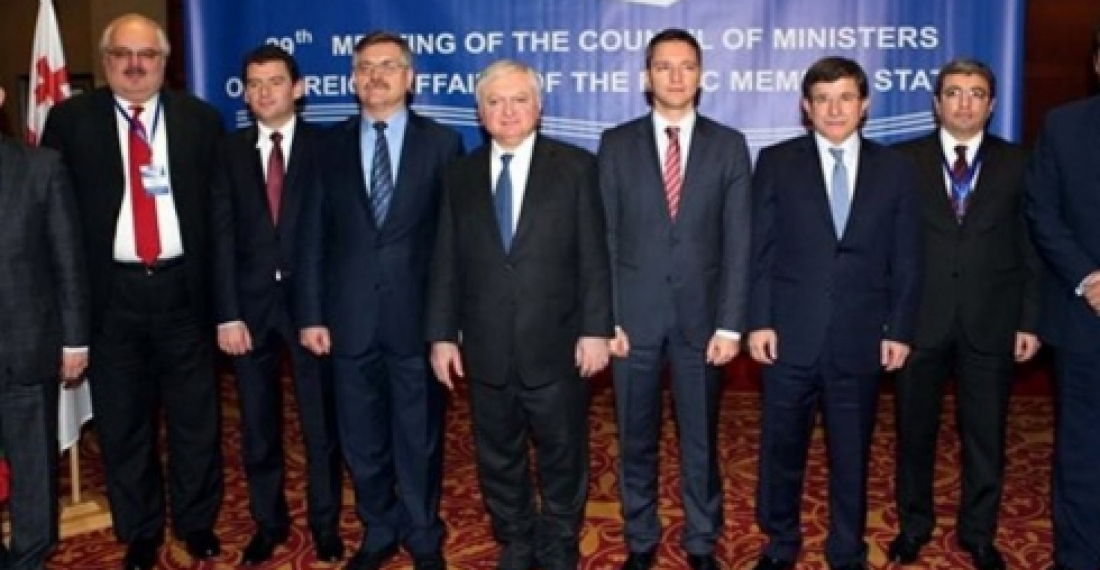
photo: Ministers from BSEC countries at their meeting in Yerevan on 12 December (picture courtesy of the Turkish Foreign Ministry).


Related articles

Editor's choice
News
Aden under curfew, as problem in Yemen's south deepens

Aden under curfew, as problem in Yemen's south deepens

The port city of Aden, in Yemen's south, has been put under curfew, as the rift in the country between  the Saudi led coalition which  backs Yemen's presidential governing council, and the southern forces led by the Southern Transitional Council (STC), deepens. Abdul Rahman al-Mahrami, a member of the Yemeni Presidential Governing Council and commander of the al-Amalik brigades, has ordered a curfew in the temporary capital, Aden, "to maintain security". "A curfew has been imposed throughout Aden Governorate from 9:00 p.m. to 6:00 a.m., in accordance with the instructions of Commander Abdul Rahman al-Mahrami, a member of the Presidential Management Council," the statement said. It states that only security and military personnel, as well as medical and technical teams with approved permits, will be allowed to move in the area during these hours. Yemen's presidential council, which is backed by Saudi Arabia and which already is in a struggle with the Houthi Movement in the north of the country who also occupy the capital Sanaa, two days ago issued an order for the arrest of the head of the Southern Transitional Council (STC),, Aidarous al Zubaidi. The STC have wide support among people in the South, and advocate that South Yemen restores its independence. The coalition warned of further escalation in Aden, long regarded as an STC stronghold, as the Presidential Leadership Council (PLC) chief accused STC leader Aidarous Al Zubaidi of “high treason” and announced the revocation of his membership in the governing body. The moves mark a sharp escalation in tensions within the anti-Houthi camp, despite National Shield Forces, rivals of the STC and former allies, having recently retaken control of Hadhramaut and Mahra from southern fighters. The STC’s takeover of the two regions last month angered Saudi Arabia and contributed to igniting the current internal conflict. (click the picture to read more)

Popular

Editor's choice
News
Aden under curfew, as problem in Yemen's south deepens

Aden under curfew, as problem in Yemen's south deepens

The port city of Aden, in Yemen's south, has been put under curfew, as the rift in the country between  the Saudi led coalition which  backs Yemen's presidential governing council, and the southern forces led by the Southern Transitional Council (STC), deepens. Abdul Rahman al-Mahrami, a member of the Yemeni Presidential Governing Council and commander of the al-Amalik brigades, has ordered a curfew in the temporary capital, Aden, "to maintain security". "A curfew has been imposed throughout Aden Governorate from 9:00 p.m. to 6:00 a.m., in accordance with the instructions of Commander Abdul Rahman al-Mahrami, a member of the Presidential Management Council," the statement said. It states that only security and military personnel, as well as medical and technical teams with approved permits, will be allowed to move in the area during these hours. Yemen's presidential council, which is backed by Saudi Arabia and which already is in a struggle with the Houthi Movement in the north of the country who also occupy the capital Sanaa, two days ago issued an order for the arrest of the head of the Southern Transitional Council (STC),, Aidarous al Zubaidi. The STC have wide support among people in the South, and advocate that South Yemen restores its independence. The coalition warned of further escalation in Aden, long regarded as an STC stronghold, as the Presidential Leadership Council (PLC) chief accused STC leader Aidarous Al Zubaidi of “high treason” and announced the revocation of his membership in the governing body. The moves mark a sharp escalation in tensions within the anti-Houthi camp, despite National Shield Forces, rivals of the STC and former allies, having recently retaken control of Hadhramaut and Mahra from southern fighters. The STC’s takeover of the two regions last month angered Saudi Arabia and contributed to igniting the current internal conflict. (click the picture to read more)

