In their "Baku Declaration" Parliamentarians condemn Russia's annexation of Crimea and call for its reversal. The declaration also expresses deep concern at the fate of victims of politicised court cases in Azerbaijan.
The OSCE Parliamentary Assembly meeting in Baku has adopted a resolution calling on Russia to reverse its annexation of Crimea and the port of Sebastopol. The resolution was part of the "Baku declaration" issued by the Assembly at the end of its session. The resolution was adopted with 97 voting in favour, one against and nine abstentions. Amongst the abstentions were the members of the Russian delegation. The day before the Political Commoittee of the Assembly had voted to include the resolution on Ukraine in the final Baku document. Parliamentarians voted by a margin of 92 in favor to 30 against with 27 abstentions on the item.
A press statement by the OSCE Parliamentary Assembly said that the Baku Declaration lent "political support to wide-ranging policy recommendations for the OSCE and its 57 participating States in the fields of political affairs and security, economics, the environment and human rights." The full text of the declaration is available here.
The crisis in Ukraine is among the document's central themes. Among its recommendations on political affairs and security, the Declaration "Express[es] grave concern about the situation in Ukraine and emphasiz[es] the role of the OSCE in engaging all parties in a constructive dialogue, monitoring and supporting the implementation of all OSCE principles and commitments on the ground, preventing further escalation of the crisis and promoting a diplomatic process towards a peaceful resolution to the crisis."
It also calls on Russia to "reverse the annexation of the Autonomous Republic of Crimea and the city of Sevastopol, Ukraine," and "condemns the clear, gross and uncorrected violation of the Helsinki principles by the Russian Federation with respect to Ukraine, including the particularly egregious violation of that country's sovereignty and territorial integrity."
The resolution, initiated by U.S. Senator Benjamin Cardin, the Deputy Head of the U.S. Delegation, was the focus of an at-times heated parliamentary debate on 1 July.
In its 140 clauses, the Baku Declaration encompasses the resolutions of the PA's three General Committees -- the Committee on Political Affairs and Security; the Committee on Economic Affairs, Science, Technology and Environment; and the Committee on Democracy, Human Rights and Humanitarian Questions.
The Declaration also offers a diverse set of recommendations and pronouncements in the democracy and human rights sphere -- from "deploring" hate crimes against migrant workers to calling for a redoubled fight against anti-Semitism to raising the cases of specific individuals in the OSCE region.
The Declaration "expresses concern at the misuse of administrative procedures and legislation to detain, imprison, intimidate or otherwise silence human rights defenders and critics in numerous OSCE participating States, including Azerbaijan, Belarus, Kazakhstan and the Russian Federation." It further "endorses the adoption by the Parliamentary Assembly of the Council of Europe of a resolution confirming the definition of ‘political prisoners.'"
It also calls upon Ukrainian authorities to fully investigate all recent fatalities during the crisis in the country, and particularly in Odessa.
The Declaration also asks the government of Turkmenistan to provide information on the status of persons who have disappeared in the country's prisons.
Several paragraphs focus on Azerbaijan, the host country for this year's OSCE PA Annual Session, including an expression of "deep concern at the situation of Mr. Anar Mammadli" and other "citizens who have been victims of politicized court cases."
See also Baku's Twilight zone: a commentary by commonspace.eu editorial team on the holding of the OSCE Parliamentary Assembly annual session in baku and its implications for Azerbaijan (read it here)
source: commonspace.eu with the OSCE PA Press Service.
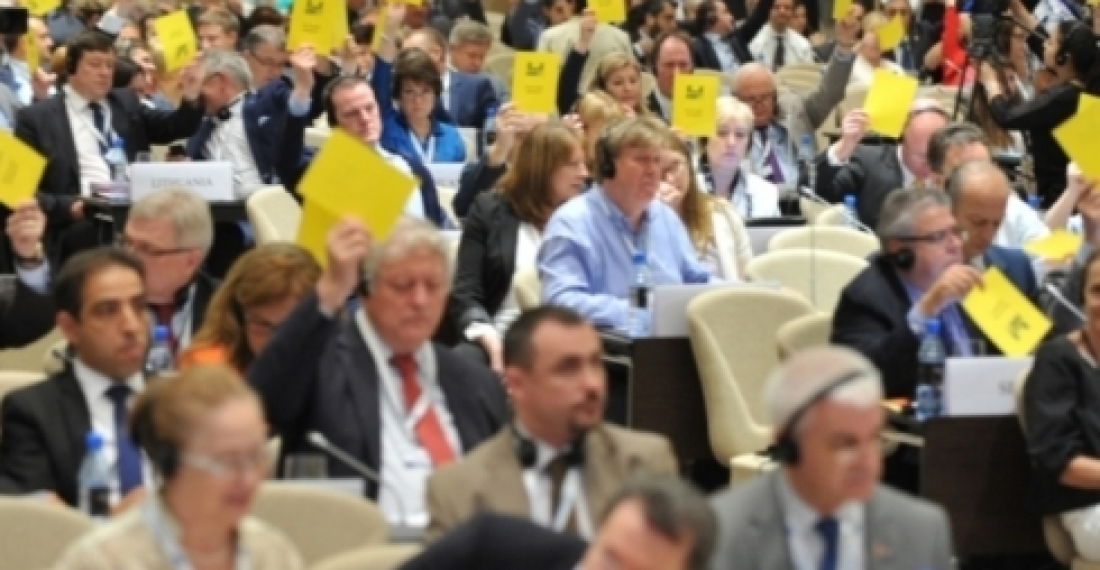
photo: Parliamentarians from the 57 member states of the OSCE voting for the Baku Declaration at the end of the annual session of their Parliamentary Assembly which ended in Baku on 2 July 2014. (picture courtesy of the OSCE PA).