Armenia and Russia have agreed on a number of measures to strengthen relations between them. The President of Armenia Serzh Sargsyan, met president Putin of Russia in Moscow yesterday to discuss relations and agree future steps.
Speaking at the end of the meeting President Putin said:
"I hope that the Intergovernmental Commission, which will start work very soon (with the Transport Minister [Maxim Sokolov] as co-chairman on the Russian side), will draft the cooperation programme for our economic relations through to 2020. This will be something like a roadmap for our trade and economic ties.
We place a lot of importance on developing interregional ties. In this respect, I note that more than 70 Russian regions are involved in such ties. Interregional cooperation is developing specific organisational forms now too: the first Interregional Forum took place in Yerevan in April 2011, and the second such forum is scheduled for November this year. I am sure you will agree with me that direct contacts between our regions are extremely important. They help to reduce red tape in economic relations and make them more vibrant, concrete and effective. We discussed today the prospects for increasing our cooperation within the CIS, CSTO and other international organisations. We spoke more broadly about the integration projects underway in the post-Soviet area and reflected on what we need to do to make use of the latest integration agreements. We agreed to establish a joint commission to look at how we can make use of the latest Customs Union cooperation agreements between Russia, Kazakhstan and Belarus with regard to Armenia and its specific situation. Armenia does not have any common borders with us after all, but we can reflect on ways to use some of the instruments the three countries have agreed on.
Of course, we also devoted considerable attention to the Nagorno Karabakh issue and exchanged our views on the situation with negotiations. I stress in this respect Russia's continued commitment to playing an active part as a mediator through its role as co-chair of the OSCE's Minsk Group. I am happy with the meeting's results."
In his reply, Armenian President Serzh Sargsyan said,
"I am happy to see that the Armenian-Russian strategic partnership, based on the time-tested friendship between our peoples, continues its steady growth. Our countries have reached a complete mutual understanding on foreign and domestic policy matters. The regular political dialogue at all levels and active contacts between our parliaments and at the regional level play a big part in strengthening our partnership. We looked at how to strengthen the institutions underpinning our bilateral cooperation today and discussed the need for more frequent exchanges and consultations at every level, including at the higher levels.
Armenia has always strived for peace and stability in the Caucasus. This is the goal of our policy to reach a peaceful and lasting settlement of the Nagorno Karabakh conflict. We think that Russia plays a key part in security issues in the South Caucasus. This applies too, to Russia's constructive efforts to settle the Nagorno Karabakh issue, which are extremely important for Armenia. Mr President, we thank you for Russia's constant attention and effective efforts in this area. We seek to continue our effective cooperation, based on mutual consideration for each other's interests, within international and regional organisations. We will continue our efforts to make our foreign policy coordination in international forums more effective.
Armenia is a strong supporter of reinforcing the CSTO and we will continue to make the necessary efforts to develop this organisation. Armenia will host the CSTO Rapid Reaction Force's military exercises in September. Our military and military technical cooperation continue to develop well. We discussed today new possibilities for expanding our cooperation in the defence industry and in training for military personnel. We extended the lease of the Russian military base in Armenia in 2010. Our position is that having the military base on our soil is in the interests of our country's security. The protocol that we signed also expands possibilities for using the base in the event of a threat to Armenia's security.
Russia's economic presence in Armenia is in the strategic interests of both countries. Russia is Armenia's main trade partner and accounts for more than half of all foreign investment in our country. The joint implementation of a number of big projects such as construction of new units at the Metsamor Nuclear Power Plant and possible Russian participation in infrastructure projects in Armenia are evidence of our long-term economic ties. Of course, we also discussed today the important matter of prices for natural gas supplies to Armenia. I think that we have reached a common understanding on the price: it will be based on the real market price multiplied or divided (as you wish) by Armenia's natural gas supply needs at costs comparable to regional prices and that can ensure the Armenian economy remains effective. Mr Putin confirmed that Russia wants to see a strong, competitive and developed Armenia. This is the approach of a true ally.
I thank the Russian President for his clear position on all of the issues on our agenda. I took the opportunity to invite President Putin to make a state visit to Armenia at any convenient time for him."
source: commonspace.eu with the Press Service of the president of Russia
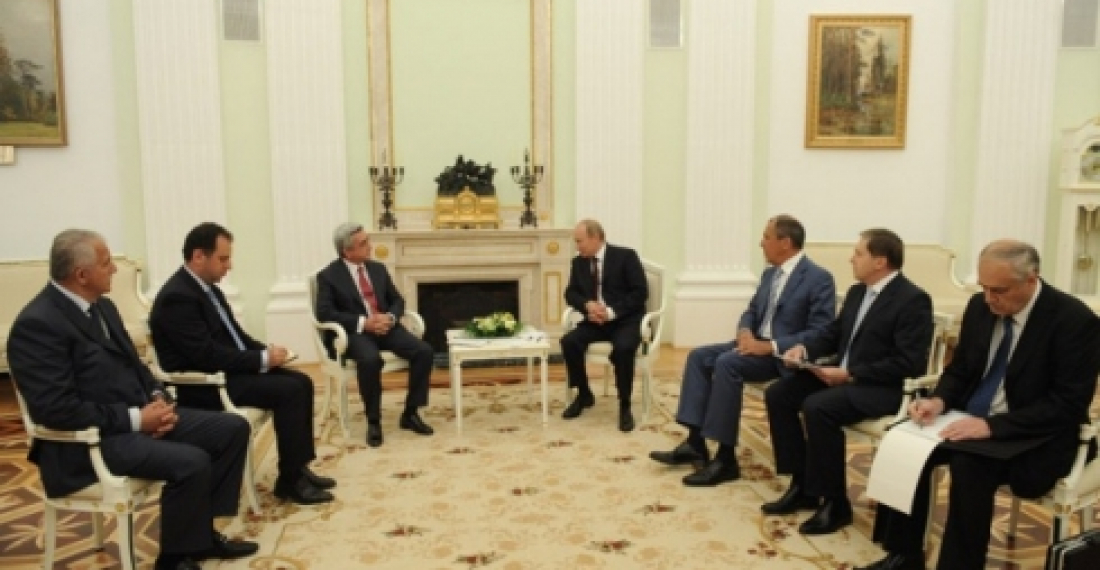
photo: President Sargsyan and President Putin at their meeting in Moscow on 8 August 2012 (picture courtesy of the Press Serrvice of the president of Armenia)