MONDAY COMMENTARY
The meeting in Krakow between the foreign ministers of Armenia and Azerbaijan did not lead to a breakthrough, and none was expected. But there appears to be a change of gear in the negotiations, says Dennis Sammut in this week's Monday Commentary
Another meeting of the Foreign Ministers of Armenia and Azerbaijan took place on Friday (18 January) in the Polish city of Krakow. This was the umpteenth meeting of these two men in the last decade, as part of a process to try to resolve the Nagorno-Karabakh conflict - a process facilitated by the international community represented by diplomats from France, Russia and the United States who go under the name of the "Co-Chair of the OSCE Minsk Group Process"
Elmar Mammadyarov and Eduard Nalbandian have sat down together in dozens of European cities, sometimes enthusiastically, often reluctantly, and in a perverse kind of way their encounters have been considered as a soothing re-assurance that one of the nastiest unresolved conflicts in contemporary Europe is not about to boil over. On one or two occasions there were hopes that they may be close to a deal, but harsh reality soon dampened the optimism. Yet those in the know tended to be more worried when the two Ministers were not meeting, then when they were meeting and disagreeing. Expectations from Thursday's meeting were close to non-existent, and even the most ardent aficionados of diplomacy failed to be excited by the prospect of what could emerge from it.
Prima facie they were not disappointed. The usual terse statement by the international mediators immediately after the meeting did not exactly hail a historic breakthrough. Yet something has changed. It is certainly not a change in the position of the sides: these keep being re-affirmed on a daily basis by the leadership of the two countries; nor is it a change in the format of the negotiations: it remains the same: two negotiating countries, three mediators and one supporting act; it looks however that there has been a change of gear.
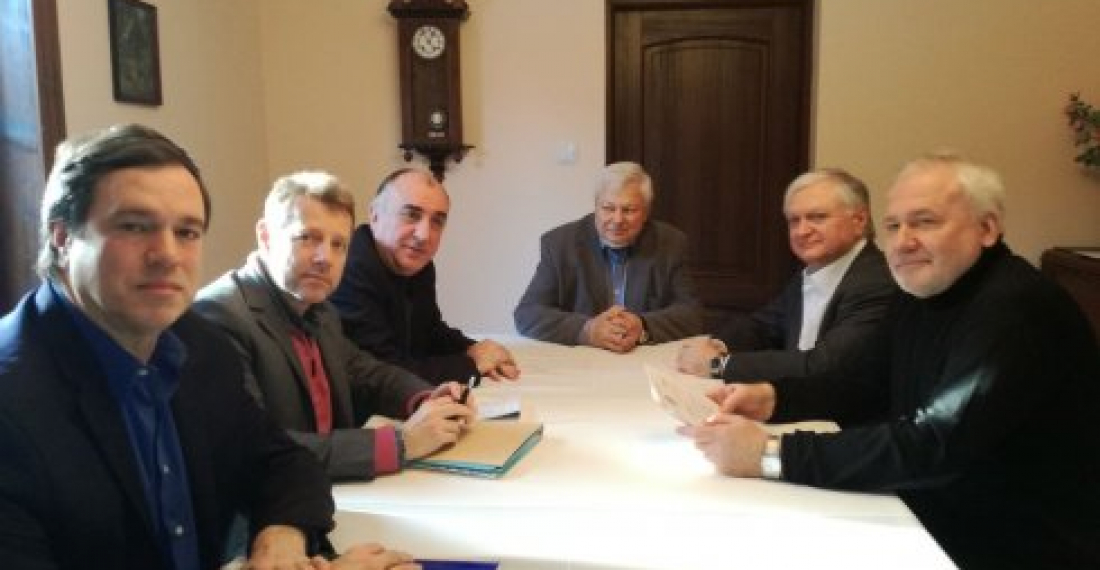
One could notice this first from the picture of the meeting tweeted as the proceedings started. Six men in suits, but with an open collar, sitting around a homily table - no ties, no flags, no army of journalists. Was this a signal that the long-standing posturing was coming to an end, and that the two sides have finally sat down to deal with the nitty gritty tasks of actually bringing this conflict to some kind of resolution?
One would have been tempted to dismiss the informality to perhaps the central heating in Krakow being too high, forcing participants to take of their ties, had it not been for the fact that on closer scrutiny the statement issued by the mediators after the meeting was also unlike many of the others issued earlier. Over many years statements by the OSCE Minsk Group co-chair tended to take the form "we came, we met, we left", leaving us none the more knowledgeable about the state of play. This latest statement whilst not revealing much, gave us a clue or two.
You may read the statement on the OSCE website here
It had five points:
First, it dealt with issues that one or the other sides say was agreed in meetings between the Armenian and Azerbaijani presidents on 2016. This has been a sticking point particularly for the Armenians who made it a condition for returning to the negotiating table. One issue is related to more international presence in the conflict zone. "The Foreign Ministers agreed in principle to the Co-Chairs' revised concept paper for implementing the expansion of the Office of the Personal Representative of the OSCE Chairperson-in-Office with a view toward finalizing it as soon as possible", the statement said, indicating that we are closer (though not quite there yet) to seeing a small increase in the number of international monitors.
Second, the statement says that "the parties and Co-Chairs exchanged views on core sensitive issues contained in the working proposals currently on the table". So, the sides are back to discussing substance, something the Azerbaijanis have been insisting upon.
Third, "The Co-Chairs also called for pursuing trust-building measures as an important contribution to the negotiation process". It seems the sides are not ready for this yet, but there is hope. To make it more palatable the mediators are now calling confidence-building measures (CBMs), "trust building measures", hoping that those who rejected CBMs in the past may take to the new name.
Fourth, "The Ministers and the Co-Chairs acknowledged the relative calm on the Line of Contact, and the Co-Chairs urged the parties to reinforce this positive trend." This is a star for good behaviour. Often the co-chair countries have had to express concern about incidents on the line of contact separating the thousands of soldiers of the two sides in the Karabakh conflict zone. Incidents have been much fewer and less serious in the last three months, and this needed to be said.
Fifth, "the Co-Chairs indicated to the Ministers their interest in further discussing the possibility of conducting a follow up to the 2010 assessment mission to the territories affected by the conflict". This idea has been floated for some time. The fact that it is now being mentioned in a formal statement indicates there is a basis to hope it would be possible to have such a mission, possibly in the autumn. It also enables the possibility of a public debate on the composition of the mission and what it can achieve ahead of its deployment.
For those, if they existed, hoping for a breakthrough in the talks in Krakow, none was forthcoming. However, those, especially in the communities directly affected by the Karabakh conflict, frustrated by years of unsuccessful diplomatic negotiations, may take heart in what looks like a change of gear in the discussion. It raises a little hope that things may change for the better, and that dialogue will prevail over war. But then again, this is far from certain.
source: Dennis Sammut is the Director of LINKS (Dialogue, Analysis and Research). His Monday Commentary appears weekly on commonspace.eu
photo: The Co-Chairmen of the OSCE Minsk Group (Igor Popov of the Russian Federation, Stephane Visconti of France, and Andrew Schofer of the United States of America), together with the Personal Representative of the OSCE Chairperson-in-Office Andrzej Kasprzyk, with Foreign Minister of Armenia Edward Nalbandian and the Foreign Minister of Azerbaijan Elmar Mammadyarov at their meeting in Krakow on 18 January 2018. (Picture courtesy of the twitter feed @HikmetHajiyev)