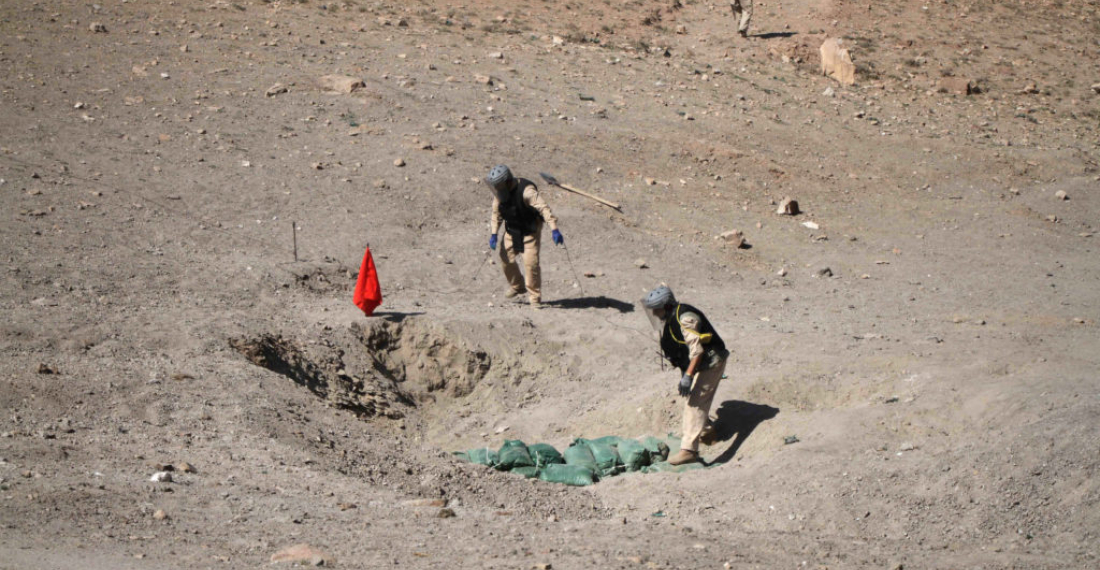
Landmine contamination in the South Caucasus remains one of the biggest humanitarian challenges in the region. Since the 1990s, mines have taken the lives of thousands of civilians, and they have left a mark on the natural environment. In addition, development and infrastructure remain limited in contaminated areas, impeding economic recovery and the return of displaced people. While demining in the region has not previously been a priority due to the conflict between Armenia and Azerbaijan, the meeting at the White House in August 2025, where the two countries initialed a draft peace agreement, offers new opportunities for advancing demining efforts.
While the peace agreement is not yet signed, mine clearance could and should function as a confidence-building measure between Armenia, Azerbaijan, and Georgia. This is not something new; in 2004-2005, the US Department of State implemented the “Beecroft Initiative” involving the three countries, and it conducted joint humanitarian demining training. In 2005, the OSCE held another workshop in Tbilisi entitled “Confidence-building and Regional Cooperation through Mine Action”. The meeting advocated for the creation of a system of open information exchange and establishing regional cooperation. Moreover, LINKS Europe Foundation has, since 2018, been promoting a holistic region-wide approach to clear the South Caucasus of landmines. The campaign Landmine Free South Caucasus 2025/2026, initiated by LINKS Europe, is continuing these efforts.
While advocating for mine-action as a confidence-building mechanism may not be new, its coordinated regional implementation could yield substantial positive outcomes for the countries in the South Caucasus.
Take, for example, the regional approach to Mine Action in southeastern Europe. In November 2000, three national mine-action centres (Albania, Croatia, and Bosnia and Herzegovina) and the ITF established the South-Eastern Europe Mine Action Coordination Council (SEEMACC), a technical regional body whose goal is to make southeastern Europe free of mines. SEEMACC managed to depoliticise mine action in a region that has seen bitter conflicts and divisions. SEEMACC has become essential in helping those countries clear mines efficiently while also contributing to confidence-building among the participating states. While there are many differences between southeastern Europe and the South Caucasus, lessons can be learnt. Cooperation on mine action among countries can serve as an important first step toward building confidence, as demonstrated by experiences in Southeastern Europe.
The regional coordination of mine action in the South Caucasus cannot wait. The humanitarian, environmental, and economic risks are too big. The campaign Landmine Free South Caucasus 2025/2026 proposes recognising landmine contamination as a regional challenge and establishing a working group appointed by the governments of Armenia, Azerbaijan, and Georgia to develop a coordinated regional response. Secondly, the three governments need to establish mutually agreed landmine- and UXO-free zones in border areas, with all parties committing to their clearance and long-term maintenance. Thirdly, the governments have a responsibility to help and protect communities living near contaminated areas.
Source: This briefing was first published in the South Caucasus Landmine Observer on 26 March 2026. It was prepared by Alexandra Dumitrescu, editor of South Caucasus Landmine Observer and International Coordinator at LINKS Europe.