Commonspace.eu special correspondent in Vilnius, Polina Ivanova captures the mood at today's Civil Society Forum being held in the framework of the Eastern Partnership summit.
The LITExpo stands cold and empty on the outskirts of the city of vilnius, last night's snow turned to mud, with a few of the more hardened journalists wading through it. There is a sense among them that Vilnius has failed; that the train, which should have left Prague with six carriages but only really had five, has now arrived at Vilnius with another three lost along the way - to paraphrase Ian Bond, from the Centre for European Reform.
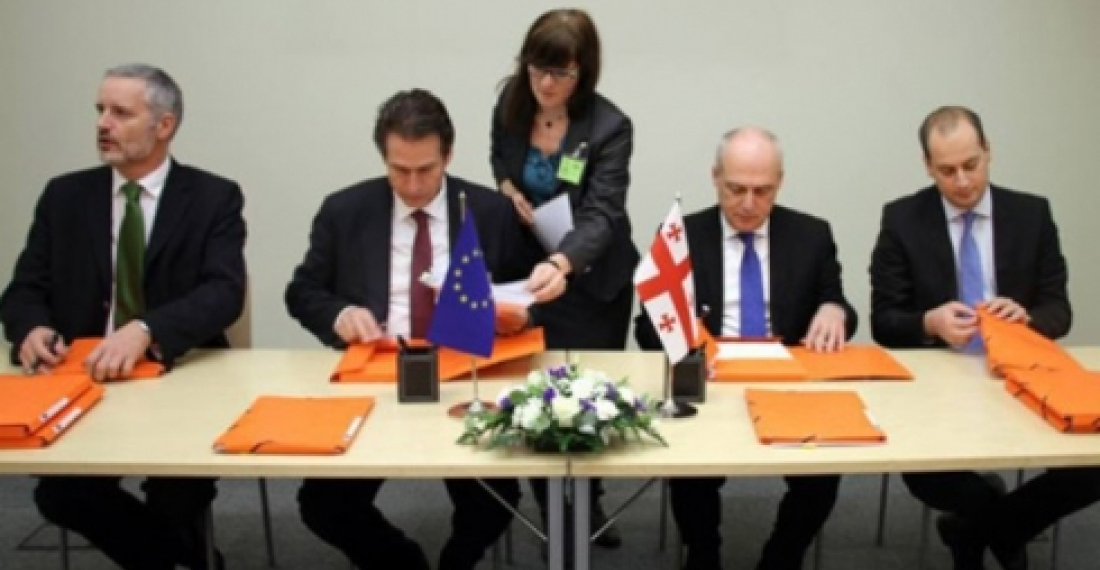
But this afternoon the conference hall became the venue for the initialing of Association Agreements between the European Union and two of its Eastern Partners, Georgia and Moldova, which participants of today's CIvil Society Forum have spoken of as nothing other than an inspiring success. The shadow of Ukraine's eleventh-hour decision, - so last minute that there's a pro-association advert in this week's London New Statesman magazine, paid for by the Ukrainian embassy - to abandon plans to sign this agreement, and to take a step away from extensive economic integration with the European Union, is conspicuous. However, the message of the Forum so far has been one of hope and progress towards a European future. A moving expression of this hope closed this morning's discussion ‘Eastern Partnership Policy: From Warsaw to Vilnius' as Ukrainian civil society activists took to the stage to sign their own, symbolic, agreement with the EU on a sheet of A3 paper, in colourful marker pens.
Despite the flurry of media activity and slight sense of elation that followed this moment, a number of uncomfortable questions remain. The congratulations extended to Georgia on its political and economic reforms, that have been so substantial as to make the final signing and implementation of the Association Agreement possible in 2014, raises the issue of actual EU membership. Whereas this was always on offer to Western Balkan states as they were making the necessary and difficult reforms to align their political, judiciary and economic systems to those of the EU member states, there isn't a clear "membership carrot" for the Eastern Partners. Article 49 of the Treaty of the European Union allows for all "European states" to be potential members of the EU, but there has been some speculation over the language used to describe Georgia and Moldova in the two Association Agreements, and whether the lack of any reference to this Article in them is significant.
Yesterday's open letter by the Prime Minister of Georgia stated that the initialing of the Agreement launches a process that "will eventually lead to the accession of Georgia into the European Union." Speaking at the Forum today Maia Panjikidze, Deputy Prime Minister and Foreign Minister of Georgia, stated that "Article 49 is the one that is most important for us," and expressed her hope that the EU would share this view with the 80% of Georgian people that voted for Western-oriented parties in last month's presidential election. However the message from Carl Bildt, Sweden's Foreign Minister, at today's Forum indicated that any mention of EU membership at this point in time would create a false sense of hope in Eastern Partnership countries such as Georgia, as they have such a way to go before they will fulfill the criteria necessary for membership to be considered. There is a feeling that perhaps Tbilisi and Brussels are not exactly on the same page.
The issue of the "frozen regions" of Transnistria, Abkhazia and South Ossetia, raised by SciencesPo professor and member of the EU-Russia Centre in Brussels Marie Mendras, are a serious obstacle to further integration with Europe and complicate the path ahead after Vilnius. Ms Panjikidze argued that steps such as the Association Agreement help to resolve this issue by making Georgia a place that appeals to all sections of the Georgian territory, whether occupied by Russia or not, and would therefore help to unify the country. Bearing in mind the aggressive pressure that Russia has been using against those countries seeking closer relationships with the EU, it is difficult to see the process outlined by Ms Panjikidze as realistic.
Tomorrow is still being considered by delegates here as a watershed moment. European leaders have stressed that the door is still open for Ukraine to sign the Association Agreement and, rather surprisingly, one phrase has been used informally a great deal - "it all depends on what Ukraine does tomorrow".
Polina Ivanova is in Vilnius covering the Eastern Partnership Summit for Commonspace.eu
Photo: Philippe Cuisson, chief negotiator on DCFTA from the European Commission's directorate general for trade; Gunnar Wiegand, director of Russia, Eastern Partnership, Central Asia and Regional Cooperation at EU's external relations service; Georgia's First Deputy Foreign Minister Davit Zalkaliani and Georgia's Deputy Economy Minister Mikheil Janelidze initial AA/DCFTA between Georgia and the EU in Vilnius, November 28, 2013. Photo courtesy of the Georgian Foreign Ministry)