


This is a commentary by the political editor of commonspace.eu. A shorter version of this commentary appeared on our weekly newsletter Caucasus Concise on 11 February 2021
Azerbaijan plans to spend up to $59 billion over the next ten years to rehabilitate the territories it has recently taken back after being for decades under Armenian control. It is a huge sum even for an oil rich country, but for President Ilham Aliyev developing the new territories now has become the primary mission of his presidency. Aliyev, still basking in popularity after the convincing victory in the 44 day war with Armenia last autumn, has been visiting the regained territories and giving instruction on their development.
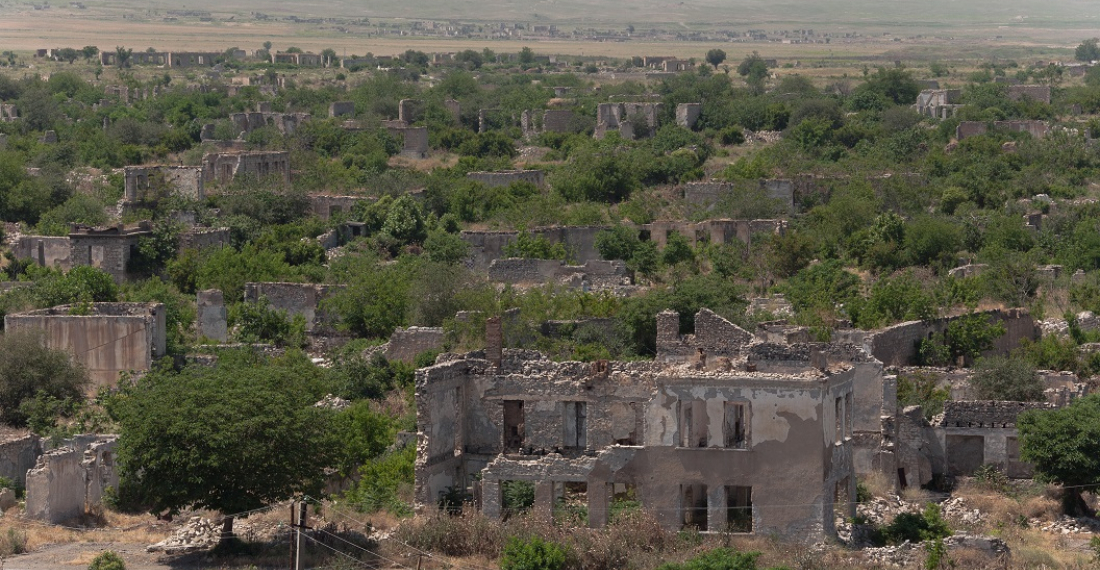
The majority of Azerbaijanis who in the past had lived in the Karabakh territories that came under the control of Baku after November 10, 2020, would like to return, several sources in the local government told Izvestia. However, there is nowhere to return to, only the names and endless minefields remain. Nonetheless, the Azerbaijani authorities are confident that the active development of the seven regions in question will soon turn Karabakh into a driver of economic development for the entire country.
"The regions should not only be revived and brought into sync with the socio-economic development of the entire country, but [they] also should be territories of advanced development, Azerbaijani Economy Minister Mikayil Jabbarov told the Russian newspaper Izvestia, earlier this week. The economy minister noted that the Karabakh territories are considered advantageous from an economic point of view, since the mining and agriculture sectors are present there, and in the long run, tourism and logistics may enable the area to serve large flows of cargo. Moreover, Baku noted that Armenia would also benefit from the development of road and rail communications. These measures will help create jobs and industries not related to the oil industry, Jabbarov said.
But this will be easier said than done. Three months after the end of the 44-day Second Karabakh War, Armenia, Azerbaijan and Russia are still trying to tie up loose ends following their 10 November trilateral declaration. The process of searching for bodies of missing servicemen continues, and there are still issues related to the exchange of prisoners, particularly a large group of Armenians in Azerbaijan captivity who Azerbaijan says continued to fight after 10 November.
The bigger challenge, however, is related to post-war reconstruction. Both sides have a lot of work ahead, but the challenge facing Azerbaijan is enormous. Diplomats based in Baku were last weekend taken to visit some of the territories retaken by Azerbaijan after nearly three decades of Armenian control. They were genuinely shocked at the state of ruin of what had previously been bustling communities. Azerbaijan President Ilham Aliyev is making reconstruction and the return of the Azerbaijanis displaced from these territories in the 1990s the core objective of his government for the next 5-10 years.
Shusha will be the dream city at the top of the mountain
At the centre of this plan is Shusha, a small citadel and city sitting atop Stepanakert, and what remains of Armenian controlled Nagorno-Karabakh. While both sides claim their historical connections with Shusha, all anecdotal evidence suggests that this was in recent centuries a mainly Azerbaijani town. Militarily it dominated the settlements below it. Aliyev has a different strategy for Shusha going forward. He wants to turn it into a shining light to which Armenians below can look up in awe and envy. He has already declared Shusha Azerbaijan’s capital of culture.
Going forward there are three problems:
Reconstruction will be difficult, not only because the level of destruction is high but also due to the problem of landmines which infest most of the areas that have reverted back to Azerbaijani control. Azerbaijan is complaining that Armenians are refusing to give up the maps of minefields, and in any case, that will only help a little bit. Already several Azerbaijani soldiers and civilians have been killed by landmines in the last three months, and the scale of the problem will be daunting;
The second problem for Aliyev is more home-grown. Given the potential of Shusha to become one of the most expensive pieces of real estate in Azerbaijan, greedy Azerbaijani officials have been looking how to get a part of the cake. A fuming Aliyev told journalists that departments ranging from the Ministry of Emergency Situations to the Central Bank had been asking to open branches in Shusha. What for? Aliyev asked, there is nothing and no one there. Aliyev issued a warning across the board that he will not allow officials to carve up Shusha, or any of the rest of the regained territories, and that reconstruction and rehabilitation had to be done according to a master plan;
The third problem is less easily solved. It is about security. If Shusha, and places like it in the regained territories, become the shining light to which Armenians will look in awe and envy, then this may not only lead them to seek peace and reconciliation in the hope of sharing the new bonanza, but may lead, at least some, back to violence. For Shusha, and for the rest of the regained territories, peace and stability are going to be hugely important. Securing that peace is now central for Azerbaijani strategy.
Unsurprisingly, Armenian perspectives are different, as Benyamin Poghosyan argued in an op-ed on commonspace.eu a few days ago. Read more: In 2021 Armenia can only wait and watch whilst others decide the fate of Karabakh
The future of Shusha as the beacon at the top of the mountain, and of the other territories Azerbaijan has regained, may well depend on how quickly all the sides share in a vision for future peace. One can sense conflict fatigue across the region. This now needs to evolve into a genuine desire for peace, which political leaders must harness as they plan the future.
source: This is a commentary by the political editor of commonspace.eu. A shorter version of this commentary appeared on our weekly newsletter Caucasus Concise on 11 February 2021
photo: The town of Agdam was left in ruins for the last three decades (archive picture)
The views expressed in opinion pieces and commentaries do not necessarily reflect the position of commonspace.eu or its partners
You may subscribe to the Caucasus Concise newsletter, here



