


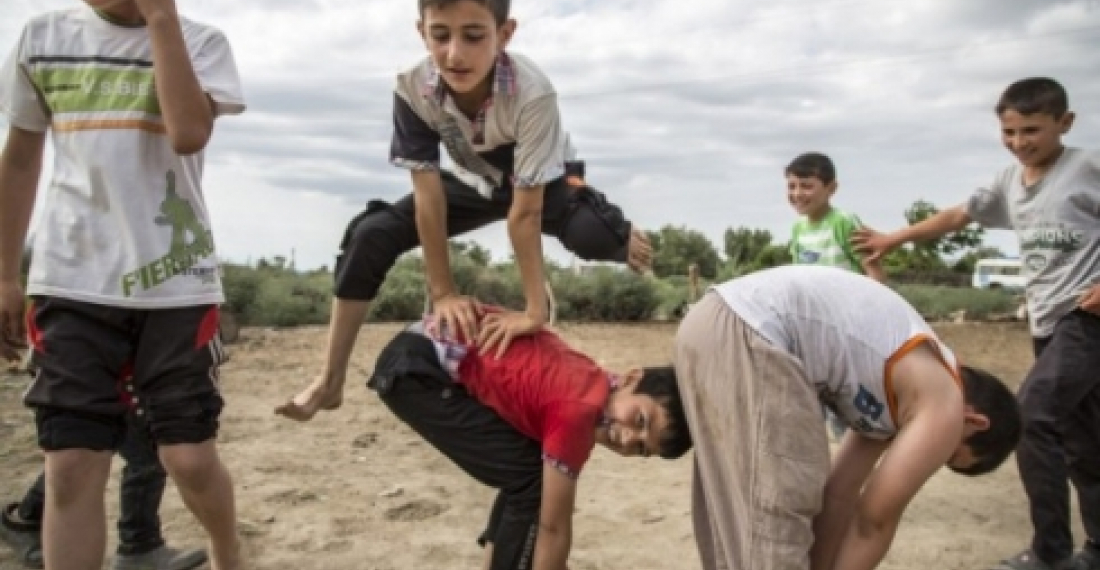
Suffering with dignity. London´s OXO Gallery hosts photo exhibition that brings to life the suffering of the displaced of the Karabakh conflict

Dennis Sammut has been at the OXO Gallery to view a photo exhibition that brings to life the suffering of hundreds of thousands of refugees displaced by the Karabakh conflict and was impressed by the ability of photojournalist Ed Kashi  to bring across the suffering of those he photographed whilst respecting their dignity.

The prestigious OXO Gallery on London´s South Bank is this week the venue for an exhibition of photographs by leading photo-journalist Ed Kashi that capture on camera the daily lives of some of the hundreds of thousands of Azerbaijanis that remain displaced as a result of the Nagorno Karabakh conflict. Over a million persons, mostly Azerbaijanis but some Armenians also, were uprooted and obliged to abandon their homes as the conflict raged in the early 1990´s. They remain displaced, their communities scattered, and longing to return to their homes.

Ed Kashi travelled to Azerbaijan last year to document the plight of some of these victims of conflict. His pictures capture moments in their daily life as they continue to strive to create normality in a very abnormal situation. And this is where Kashi´s talent as a photojournalist comes out most impressively. His pictures capture the suffering in the eyes of the people he photographed without having to resort to grotesque scenes of pain and poverty.

As I walked around the exhibition my first thought was how normal and familiar the scenes and the people in them looked. But a closer look soon revealed, often in the eyes of those photographed, the silent cry of people who yearn to return to the peace and tranquility of a life they left behind in fear of their lives. and of their children, confused by their environment, but trying to cope despite the limited possibilities and difficult living conditions.

At the official opening of the exhibition on Wednesday I asked Kashi what made him opt for this subtle approach and he immediately replied that he was sensitive to respect the dignity of those he photographed. Indeed for people who have lost all their material belongings dignity is often the only thing that they have left. To rob them of that too would be nothing short of criminal. Kashi has ably reminded us of the suffering caused by the Karabakh conflict without needing to resort to that.

The exhibition "Unresolved Dreams: Azerbaijan´s refugees and IDPs is open at the Gallery@OXO until Sunday. The exhibition is organised by TEAS - The European Azerbaijan Society.

source:commonspace.eu

photo: Young boys playing leapfrog in Taxta Korpu, Aghjabedi Region, Azerbaijan on 28 May 2013. Picture courtesy of Ed Kashi and TEAS.
 

Related articles

Editor's choice
News
Borrell tells the European Parliament that the situation in Afghanistan was critical, but the EU will remain engaged

Borrell tells the European Parliament that the situation in Afghanistan was critical, but the EU will remain engaged

Borrell underlined that the European Union will make every effort to support the peace process and to remain a committed partner to the Afghan people. "Of course, we will have to take into account the evolving situation, but disengagement is not an option.  We are clear on that: there is no alternative to a negotiated political settlement, through inclusive peace talks.
Editor's choice
News
Pope's visit to Türkiye and Lebanon has a strong ecumenical character, and places interreligious dialogue at its centre

Pope's visit to Türkiye and Lebanon has a strong ecumenical character, and places interreligious dialogue at its centre

Pope Leo XIV has begun the first overseas trip of his pontificate, a six-day visit to Türkiye and Lebanon, which started yesterday (27 November) and ends on Tuesday (2 December). According to Vatican Radio, the visit "carries a strong ecumenical character and places interreligious dialogue at its centre. It will also be a moment of closeness to Christian communities and local populations across the region".   During nearly a week in the region, Pope Leo XIV will meet civil and religious authorities, visit mosques and ancient churches, pray at Beirut’s port in memory of the victims of the 2020 explosion, and hold private meetings with Presidents Recep Tayyip Erdoğan and Joseph Aoun.   A highlight of the visit will be a visit to Nicaea, where the Pope will mark the anniversary of the Council of Nicaea. Christians of many traditions recognise the Council of Nicaea as a foundation of shared faith. One of the most anticipated moments will be the Pope’s encounter with Lebanese youth in Bkerké, at the Maronite Patriarchate, a meeting expected to carry strong messages of hope in the Jubilee Year. A central event will be the ecumenical celebration in İznik, where the Pope and Ecumenical Patriarch Bartholomew will walk together toward the ruins of the Basilica of St Neophytos. The prayer, held before icons of Christ and the Council, will conclude with the lighting of a candle—a symbolic gesture of unity. The journey will also highlight interreligious engagement.   Memorable moments are expected throughout the trip: a wreath at Atatürk’s mausoleum, prayer inside the Blue Mosque, Mass at Istanbul’s Volkswagen Arena, the planting of a cedar at the presidential palace in Beirut, and prayer at the tomb of St Charbel in Lebanon. The Vatican said that "Pope Leo XIV’s pilgrimage to Türkiye and Lebanon aims to offer a voice of peace, unity, and hope at the heart of the Middle East."

Popular

Editor's choice
News
Pope's visit to Türkiye and Lebanon has a strong ecumenical character, and places interreligious dialogue at its centre

Pope's visit to Türkiye and Lebanon has a strong ecumenical character, and places interreligious dialogue at its centre

Pope Leo XIV has begun the first overseas trip of his pontificate, a six-day visit to Türkiye and Lebanon, which started yesterday (27 November) and ends on Tuesday (2 December). According to Vatican Radio, the visit "carries a strong ecumenical character and places interreligious dialogue at its centre. It will also be a moment of closeness to Christian communities and local populations across the region".   During nearly a week in the region, Pope Leo XIV will meet civil and religious authorities, visit mosques and ancient churches, pray at Beirut’s port in memory of the victims of the 2020 explosion, and hold private meetings with Presidents Recep Tayyip Erdoğan and Joseph Aoun.   A highlight of the visit will be a visit to Nicaea, where the Pope will mark the anniversary of the Council of Nicaea. Christians of many traditions recognise the Council of Nicaea as a foundation of shared faith. One of the most anticipated moments will be the Pope’s encounter with Lebanese youth in Bkerké, at the Maronite Patriarchate, a meeting expected to carry strong messages of hope in the Jubilee Year. A central event will be the ecumenical celebration in İznik, where the Pope and Ecumenical Patriarch Bartholomew will walk together toward the ruins of the Basilica of St Neophytos. The prayer, held before icons of Christ and the Council, will conclude with the lighting of a candle—a symbolic gesture of unity. The journey will also highlight interreligious engagement.   Memorable moments are expected throughout the trip: a wreath at Atatürk’s mausoleum, prayer inside the Blue Mosque, Mass at Istanbul’s Volkswagen Arena, the planting of a cedar at the presidential palace in Beirut, and prayer at the tomb of St Charbel in Lebanon. The Vatican said that "Pope Leo XIV’s pilgrimage to Türkiye and Lebanon aims to offer a voice of peace, unity, and hope at the heart of the Middle East."

