


Road safety becomes a priority in Abkhazia as fatalities increase

Abkhazia has one of the highest per capita road fatality rates in the region; a fact often obscured by the territory's status as a statistical "black hole".

By Joseph Alexander Smith

The break-away republic of Abkhazia usually garners a mention in the press only in the context of the unresolved conflict with Georgia and ever-deepening ties with Russia. However, inside Abkhazia itself, the alarmingly high rate of fatalities on the territory's roads has become an increasingly hot topic, spurring the republic's authorities into action.

The figures are indeed shocking. During the first 11 months of 2014, the republic's road inspectorate, known as GAI, recorded 104 traffic accidents in which 126 were wounded and 48 were killed with a further 13 fatalities in December. With a population of around 240, 000 people, these figures give Abkhazia one of the highest per capita road fatality rates in the region; a fact often obscured by the territory's status as a statistical "black hole": Abkhazia is recognized by all but a handful of UN member states as part of Georgia.

"Everybody is affected directly or indirectly" says Madina Sulava, a civil society activist from Sukhumi. "Almost every week an accident occurs which takes the lives of several people, mainly young guys. Abkhazia is a comparatively small society, so everybody knows each other and is aware of these accidents."

"Three years ago my cousin died in a car accident" she adds. "He was driving at high speed and did not manage to deal with his car in a danger zone. He left behind him a two-year old son, and his second son was born a month after his death."

In recent months, some road-safety activists have been claiming that as many civilians have died in road accidents in Abkhazia since the territory's war of secession from Georgia in 1992-1993 than died in the fighting itself. Abkhazia claims around 1,800 civilian deaths in that conflict and according to deputy head of GAI, Batal Khondzia, while the number of road fatalities since the early 90s is not quite that high yet, it is certainly close.

"If we take the average [fatality] figure it's between 40 and 70 people a year" Khondzia says. "The main cause of fatalities is exceeding speed limits. Another thing is that the roads need to be repaired. What we have today is many young people buying big powerful cars. The roads [in Abkhazia] are hilly with many turns and they're in a bad condition ... Young people are driving these cars pretty fast and this has tragic consequences."

Khondzia is one of a team of officials working to reduce road fatalities in an initiative driven by the republic's new interior minister, Raul Lolua. After his appointment to the post in the wake of the dismissal of ex-President Aleksandr Ankvab's government in summer last year, Lolua has been active in highlighting the issue of fatalities on Abkhazia's roads. He regularly shares articles on road safety on his Facebook page, as well as posting live from GAI's inspections on the roads, providing statistics on fatalities, injuries and traffic code violations as they occur.

"First I would say that when he came, he tightened up the work [of GAI]" Khondzia says. "He demands more from his employees ... he also demands [the same level of work] from everyone regardless of position. We can see that he is very eager to improve the situation and that he wants to put everything in order." As we speak, cleaning ladies mop the corridors as workers refurbish the crumbling, soviet-era offices of the road inspectorate. But the make-over of GAI is not merely cosmetic: after taking office, Lolua brought in a new head of the road inspectorate.

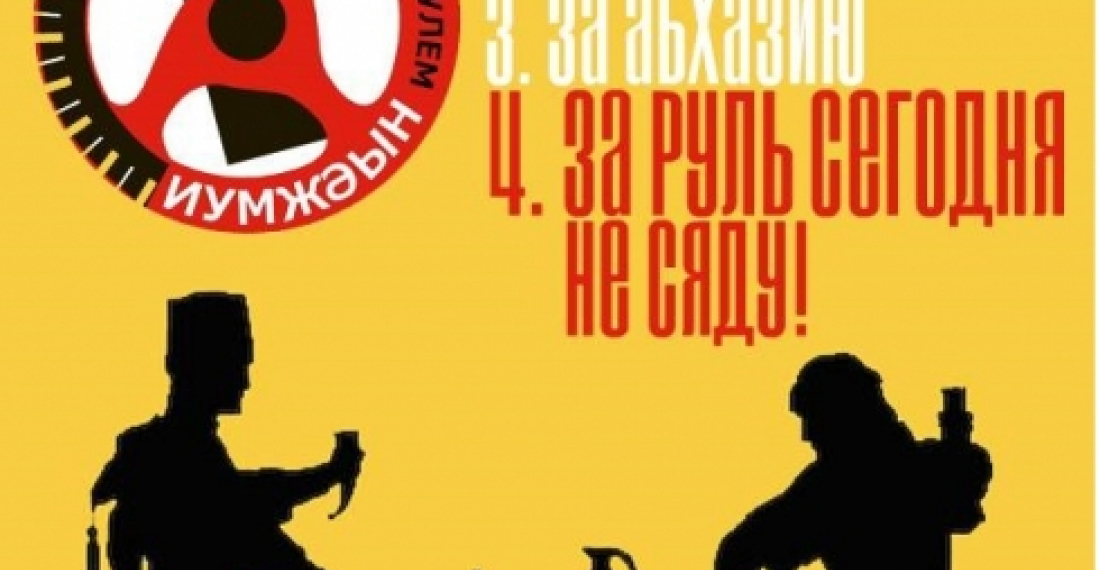
One of the civil society initiatives that Lolua has been sharing most actively on his wall is the campaign "Ya nye p'yu za rulem" or "I don't drink at the wheel", which has been emblazoned on billboards in the Abkhaz capital Sukhumi. Stickers featuring the slogan and logo have also been printed and appear around the city. According to GAI, driving while intoxicated is one of the top three causes of fatal road accidents.

Lolua's team-up with online campaigning has been warmly received by civil society activists. "[The minister's team] seem to be transparent and are sharing their new initiatives" Sulava says. "In addition, they seem to be listening to suggestions on how to solve the issue coming from the population. The ministry of the interior is quite active on Facebook, on its official page, where any user can ask them a questions and have a conversation on any topic."

Given Abkhazia's small size, it's hoped the message of safe driving can be 'driven home' soon enough to prevent further tragedies on the roads. "No matter where you go, everywhere you'll hear people talking about this" says Khondzia. "This is a time when we all have to stand together and stop these fatalities on the road. I'm not talking about small violations of the traffic code. There's absolutely no going back when someone's lying dead in the road."

source: Joseph Alexander Smith filed this report for commonspace.eu

photo: A poster cautioning against drinking and driving, part of an awareness campaign aimed at reducing traffic fatalities in Abkhazia.
Related articles

Editor's choice
News
Russia adds pressure on Armenia ahead of key elections; recalls Ambassador in Yerevan for consultations

Russia adds pressure on Armenia ahead of key elections; recalls Ambassador in Yerevan for consultations

Ahead of key parliamentary elections,scheduled to be held in Armenia on Sunday, 7 June, Russia continues to attempt to put pressure on the Armenian Government led by prime minister Nikol Pashinyan. On 30 May, Russia recalled its Ambassador to Yerevan for consultations. A terse statement, published on the website of the Russian Foreign Ministry, said, "The Ambassador of the Russian Federation to the Republic of Armenia , S.P. Kopyrkin, has been summoned to Moscow for consultations in connection with the steps taken by the Armenian leadership to move closer to the European Union, which are detrimental to cooperation within the EAEU." This followed a statement issued the day before, by the leaders of the Eurasian Economic Union (EAEU) that challenges the Armenian trajectory towards approximating to the European Union. Vladimir Putin is undertood to have personally pushed the other four EAEU leaders to issue the statement, which said: "Taking into account the significant risks to the economic security of the member states of the Eurasian Economic Union (hereinafter referred to as the Union) arising in connection with the preparation of the Republic of Armenia for accession to the European Union, as well as the need to prevent the associated damage to the member states of the Union: decided that the members of the Eurasian Intergovernmental Council from the Republic of Belarus, the Republic of Kazakhstan, the Kyrgyz Republic and the Russian Federation will report at the next meeting of the Supreme Eurasian Economic Council in December 2026 on the possible consequences of the suspension of the Treaty on the Eurasian Economic Union with respect to the Republic of Armenia. We share the position on the need to hold a national referendum in the Republic of Armenia as soon as possible on joining the European Union or continuing to be part of the Eurasian Economic Union."
Editor's choice
News
The leaders of the states of the Eurasian Economic Union issued a tough statement warning fellow-member state Armenia of the consequences of its desire to join the European Union.

The leaders of the states of the Eurasian Economic Union issued a tough statement warning fellow-member state Armenia of the consequences of its desire to join the European Union.

The leaders of the states of the Eurasian Economic Union (EEAS) issued a tough statement warning fellow-member state Armenia of the consequences of its desire to join the European Union. The stark, sharply worded,  warning, comes days before crucial parliamentary elections in Armenia, scheduled for 7 June. The full statement said, “We, the Presidents of the Republic of Belarus, the Republic of Kazakhstan, the Kyrgyz Republic and the Russian Federation, Taking into account the actions of the Republic of Armenia aimed at joining the European Union, including the approval in 2025 by the National Assembly of the Republic of Armenia and the signing by the President of the Republic of Armenia of the Law of the Republic of Armenia "On the Start of the Process of Accession of the Republic of Armenia to the European Union", as well as the confirmation by the European Union of the European aspirations of the Government of the Republic of Armenia, expressed in the joint declaration following the first Armenia-European Union summit, adopted on 5 May 2026, Taking into account the significant risks to the economic security of the member states of the Eurasian Economic Union (hereinafter referred to as the Union) arising in connection with the preparation of the Republic of Armenia for accession to the European Union, as well as the need to prevent the associated damage to the member states of the Union: decided that the members of the Eurasian Intergovernmental Council from the Republic of Belarus, the Republic of Kazakhstan, the Kyrgyz Republic and the Russian Federation will report at the next meeting of the Supreme Eurasian Economic Council in December 2026 on the possible consequences of the suspension of the Treaty on the Eurasian Economic Union with respect to the Republic of Armenia. We share the position on the need to hold a national referendum in the Republic of Armenia as soon as possible on joining the European Union or continuing to be part of the Eurasian Economic Union. Astana, May 29, 2026” A meeting of the Supreme Eurasian Economic Council was held in Astana, Kazakhstan, on May 29, 2026. The meeting of the Supreme Eurasian Economic Council in a restricted format was attended by Russian President Vladimir Putin, Belarusian President Alexander Lukashenko , Kazakh President Kassym-Jomart Tokayev , Kyrgyz President Sadyr Japarov , Armenian Deputy Prime Minister Mher Grigoryan, and Chairman of the Board of the Eurasian Economic Commission Bakytzhan Sagintayev. From the Russian side, the meeting was also attended by Deputy Prime Minister and member of the Council of the Eurasian Economic Commission Alexey Overchuk and Presidential Aide Yury Ushakov . The heads of delegations from EAEU observer states, including President of Uzbekistan Shavkat Mirziyoyev , Vice President of Cuba Salvador Valdés Mesa, Minister of Industry, Mines, and Trade of Iran Mohammad Atabak, and CIS Secretary General Sergei Lebedev, joined the expanded meeting . Following the meeting of the Supreme Eurasian Economic Council, a number of documents were signed .

Popular

Editor's choice
Interview
Thursday Interview: Murad Muradov

Thursday Interview: Murad Muradov

Today, commonspace.eu starts a new regular weekly series. THURSDAY INTERVIEW, conducted by Lauri Nikulainen, will host  persons who are thinkers, opinion shapers, and implementors in their countries and spheres. We start the series with an interview with Murad Muradov, a leading person in Azerbaijan's think tank community. He is also the first co-chair of the Action Committee for a new Armenian-Azerbaijani Dialogue. Last September he made history by being the first Azerbaijani civil society activist to visit Armenia after the 44 day war, and the start of the peace process. Speaking about this visit Murad Muradov said: "My experience was largely positive. My negative expectations luckily didn’t play out. The discussions were respectful, the panel format bringing together experts from Armenia, Azerbaijan, and Turkey was particularly valuable during the NATO Rose-Roth Seminar in Yerevan, and media coverage, while varied in tone, remained largely constructive. Some media outlets though attempted to represent me as more of a government mouthpiece than an independent expert, which was totally misleading.  Overall, I see these initiatives as important steps in rebuilding trust and normalising professional engagement. The fact that soon a larger Azerbaijani civil society visits to Armenia followed, reinforces the sense that this process is moving in the right direction." (click the image to read the interview in full)

