


On January 24, 2026, President Donald Trump announced on Truth Social that U.S. Vice President J.D. Vance will travel to Armenia and Azerbaijan in February 2026 to build on recent peace efforts and advance the Trump Route for International Peace and Prosperity (TRIPP). In his statement, President Trump said the visit would “build on our peace efforts, and advance the Trump Route for International Peace and Prosperity,” signaling Washington’s intent to maintain high-level engagement in a region of growing strategic significance.
The announcement came just days after January 14, 2026, when U.S. Secretary of State Marco Rubio and Armenian Foreign Minister Ararat Mirzoyan signed the Implementation Framework for TRIPP in Washington, D.C. The agreement translated commitments reached at the August 8, 2025, Washington Summit into a practical roadmap for achieving unimpeded multimodal transit connectivity between Azerbaijan and its Nakhchivan Autonomous Republic through Armenian territory. According to official statements, the framework provides mechanisms for planning, construction, operation, and oversight of infrastructure while fully affirming Armenia’s sovereign authority over the route.
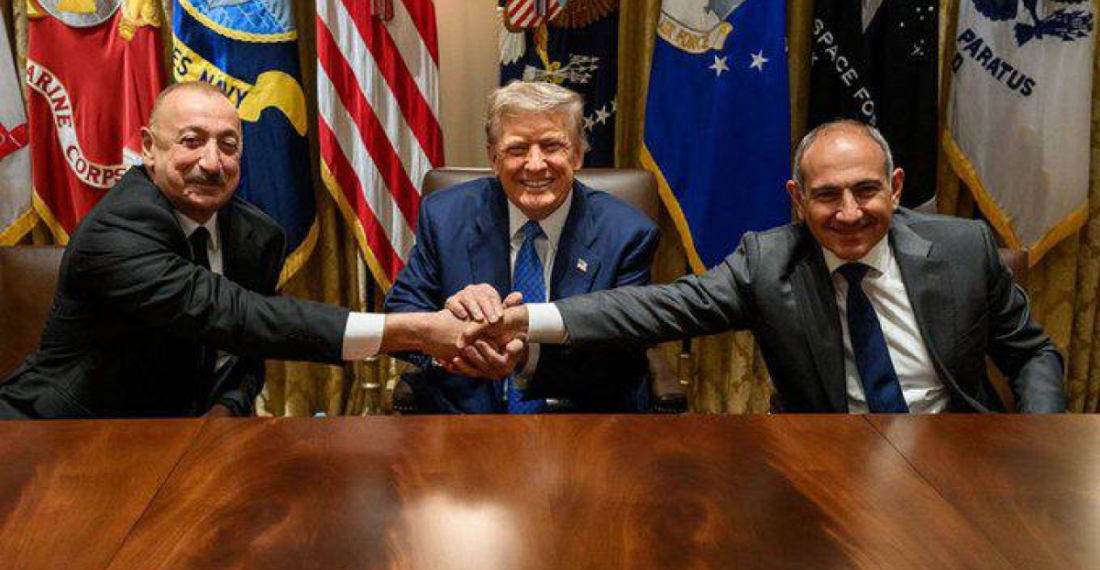
The January 2026 framework represents the most detailed operational document to emerge from the Armenia–Azerbaijan normalization process since the Washington Summit, where President Trump hosted Azerbaijani President Ilham Aliyev and Armenian Prime Minister Nikol Pashinyan. The summit produced a trilateral Joint Declaration and brought the peace treaty process close to legal finality with the initialing of the treaty text by both foreign ministers. The TRIPP framework builds directly on that political breakthrough by anchoring it in infrastructure and economic integration, thereby raising the costs of renewed confrontation and narrowing the space for spoiler behavior in a volatile regional environment.
These two events – the August 8 summit and the January 14 implementation framework – are milestones in a steadily advancing U.S. strategy in the South Caucasus. The Washington Summit moved the Armenia–Azerbaijan peace process from abstract diplomacy to executable commitments. The TRIPP framework then translated these commitments into practical mechanisms linking transit, infrastructure, and prosperity with long-term stability.
This evolution reflects a broader shift in how Washington views the South Caucasus. The United States has moved beyond episodic engagement to assume a central role in shaping regional outcomes. TRIPP is not merely symbolic; it embeds U.S. participation directly into the mechanics of peace and connectivity, placing Washington at the center of a strategic architecture once dominated by other powers.
The growing American role became particularly visible during the inauguration of the Board of Peace in Davos, a U.S.-supported initiative designed to institutionalize conflict resolution. The participation of Armenia and Azerbaijan’s leaders, seated next to President Trump, affirmed that these two South Caucasian republics are key partners in America’s broader peace strategy. Trump has highlighted the Armenia–Azerbaijan process as one of eight conflicts in which his administration has played a decisive role, marking it as a notable success of his peace agenda.
The symbolism of shared leadership at the Board of Peace was not merely ceremonial. The initiative positions the United States as a global mechanism for advancing peace and stability, and its early association with the South Caucasus reinforces the message that the region occupies a central place in U.S. geopolitical thinking.
This engagement complements mounting U.S. involvement in Central Asia, exemplified by the November 2025 summit of the United States and Central Asian leaders in Washington. The South Caucasus, situated at a strategic crossroads, serves as a gateway to Central Asia, which is one reason President Trump attaches such importance to the region.
The expanded American role in the South Caucasus has elicited reactions from other regional powers. Russia, previously the primary security guarantor in the region and the former key mediator in the talks on the Zangezur corridor, has seen its influence overtaken by U.S. participation under TRIPP. Iranian officials have voiced objections as well, concerned about increased U.S. involvement near their borders and potential shifts in regional security dynamics. While both powers have expressed discontent, they have been unable to prevent these changes. Baku and Yerevan, however, understand that their region must remain a platform for cooperation among all external actors, not a theater of confrontation.
Against this backdrop, the missing piece in U.S. policy toward the South Caucasus is Georgia, long regarded as Washington’s closest ally in the region. Its absence from the Board of Peace and other high-profile U.S. engagements signals a decline in its prominence within American regional strategy. The Trump administration has not yet articulated expectations for Georgia or outlined steps to rebuild bilateral relations. Georgia’s complex security situation and ongoing conflict with Russia make the future trajectory of its relations with the West uncertain.
Taken together, these developments indicate that the South Caucasus has moved from the periphery to the forefront of U.S. foreign policy. The sequence of the Washington Summit, the January 14 TRIPP implementation framework, and the upcoming Vice Presidential visit reflects a sustained strategy aimed at consolidating peace, promoting connectivity, and advancing American influence. By anchoring peace agreements in infrastructural and economic frameworks, embedding strategic oversight in implementation mechanisms, and elevating regional partners within its broader peace architecture, Washington is consolidating its role in a region of enduring strategic importance.
source: This op-ed was prepared for commonspace.eu by Dr Vasif Huseynov, a Senior Advisor at the Center of Analysis of International Relations (AIR Center) and Adjunct Lecturer at Khazar University in Baku, Azerbaijan.
photo: The leaders of Armenia, Azerbaijan and the United States at the White House on 8 August 2025
The views expressed in opinion pieces and commentaries do not necessarily reflect the position of commonspace.eu or its partners



