Benyamin Poghosyan discusses the relationship between Armenia and Georgia and argues that despite the close relations, and the efforts of the leaders, it is not yet strategic.
Two key topics concerning Georgia dominated the attention of the international media and expert community interested in the South Caucasus in past week. One was the outbreak of the novel Coronavirus and the growing number of cases identified in Georgia; the second issue was connected with domestic politics. After months of negotiations facilitated by the US and EU diplomats, the ruling Georgian Dream party and the united opposition reached an agreement to amend the electoral code before the crucial October 2020 Parliamentary elections, agreeing to significantly reduce the number of the majoritarian constituencies, and the threshold required for parties to enter the Parliament. The agreement stipulates that 120 seats in the legislative body will be distributed via a proportional vote and the remaining 30 via the majoritarian system. It also foresees a fair delineation of boundaries of election districts, a 1% threshold, and a cap recognizing that no single party that wins less than 40% of the votes should be able to form a government.
However, from regional perspective the key event of the past week was the official visit of Armenian Prime Minister Nikol Pashinyan to Georgia on March 3 - 4. It should be noted that Pashinyan emphasized the significance of relations with Georgia from the very beginning of his tenure in office. Just 22 days after becoming Prime Minister in May 2018 Pashinyan paid a visit to Georgia and met with than Georgian Prime Minister Georgi Kvirikashvili. After the latter was dismissed in June 2018 Pashinyan made efforts to cultivate personal chemistry with next Prime Minister Mamuka Bakhtadze receiving him in September 2018 in Yerevan and holding two unofficial meetings in January 2019 in Bolnisi, Georgia and in March 2019 in Yenokavan, Armenia. After yet another government reshuffle in Georgia in September 2019, the new Prime Minister Giorgi Gakharia visited Yerevan on October 15, 2019 where both leaders reaffirmed the mutual interest in developing economic ties, protecting cultural heritage and promoting peace and stability in the region. According to Georgian official data the Armenia - Georgia trade turnover was 614 million USD in 2018 and 679.9 million USD in 2019 showing more than 10 percent increase.
During the March 3-4, 2020 official visit Pashinyan met with Prime Minister Gakharia, President Zurabishvili, Parliament Speaker Talakvadze and Catholicos Patriarch of all Georgia, His Holiness Ilia II. During these meetings the strategic significance of development of Armenia - Georgia relations were emphasized and Pashinyan stated that the new factor and major cornerstone in strengthening the Armenian-Georgian relations was the shared commitment to democratic values. During the visit a memorandum was signed according to which citizens will have the opportunity to cross the Georgian and Armenian borders with their ID cards.
However, despite all the positive rhetoric of official speeches during high level meetings, the bilateral relations between states are often assessed and measured by the convergence/divergence of their strategic interests, and the implementation of the strategic cooperation projects. In this context Georgia is significant for Armenia as the main transit route towards the outside world and as an important member of the Iran - Armenia - Georgia - Russia North - South electricity corridor, the establishment of which was envisaged in the Road map signed by the representatives of all four countries in April 2016 in Yerevan.
The Road map envisaged putting in operation the Armenia-Georgia 400/500 kV power transmission lines and powering substation by the end of 2018/beginning of 2019. If implemented, the exchange of electric/energy power between two countries could reach up to 350 MW in the first phase and reaching up to 700MW in 2021. However, despite the agreements with KfW German development bank for the funding of the project, as of March 2020 the construction of power transmission lines and powering substation has not started yet, thus endangering the implementation of this strategically important project for Armenia.
Even more, if in mid 2000s 10-15 percent of electricity consumed in Georgia was imported from Armenia, in 2019 Armenian export of electricity to Georgia fell to zero. Given the export oriented structure of Armenian energy infrastructure, the factual lost of the Georgian market is a significant blow to the Armenian energy security. Meanwhile, Azerbaijan has significantly increased its electricity export to Georgia becoming the number one electricity exporter in 2019.
Another significant development in Armenia - Georgia relations could be the agreement on purchase, or the long term lease, of any Georgian Black sea ports' terminal to exclusively serve the import - export operations from and to Armenia. However, to be able to secure the necessary international investments for such an endeavor Armenia needs a Georgian agreement to grant customs privileges for goods exported from or imported to Armenia. However, albeit some initial discussions there are no concrete achievements in this direction.
Thus, we may conclude that despite some recent positive developments in Armenia - Georgia relations including the increase of bilateral trade volume and the intensified dialogue at the leaders' level, no strategically significant achievements have been made since May 2018. The two sides should put more efforts in obtaining tangible results especially in the energy and transport spheres.
source: Benyamin Poghosyan is the Founder and Chairman of the Center for Political and Economic Strategic Studies in Yerevan.
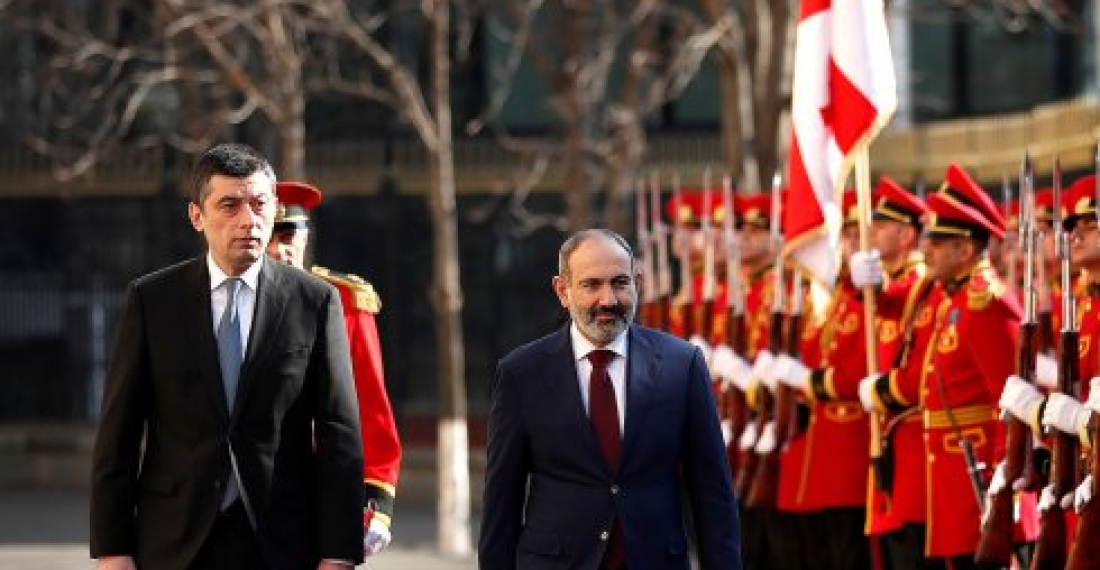
photo: Armenian prime minister Nikol Pashinyan being welcomed in Georgia by prime minister Gaharia on 4 March 2020 (picture courtesy of the press service of the government of Armenia)
The views expressed in opinion pieces and commentaries do not necessarily reflect the position of commonspace.eu or its partners