


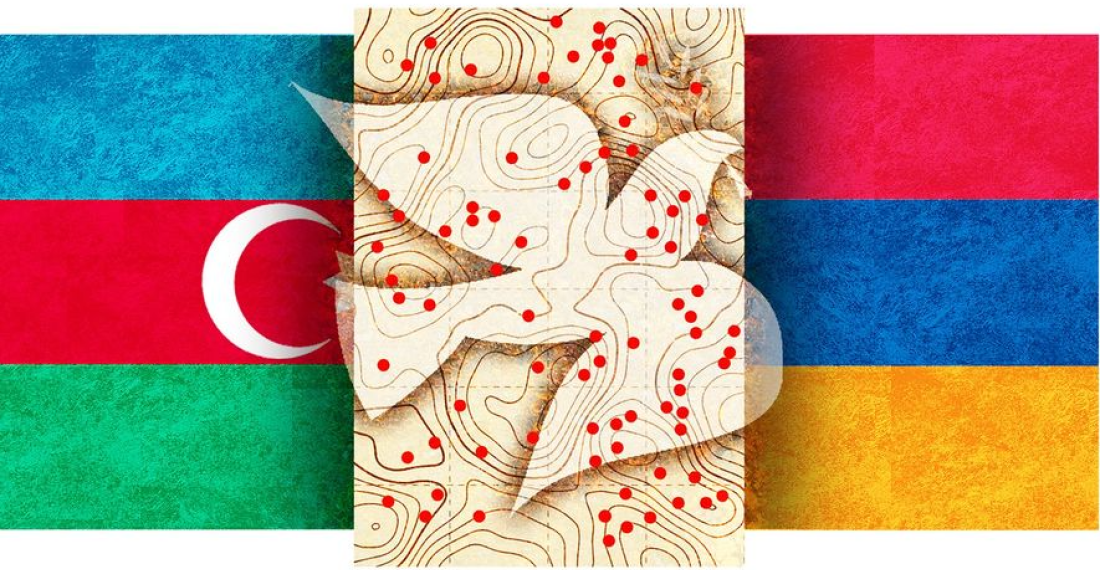
Opinion: the road to an Armenia-Azerbaijan peace treaty is an undeniably challenging one

"The legacy of two devastating wars, different motives and the underlying need of the conflicting parties towards the normalization of relations, and geopolitical implications of the Second Karabakh War, act as stumbling blocks that complicate the overall peace process," writes Gulshan Pashayeva for commonspace.eu. "Today it is paramount that Armenia abandons its territorial claims against Azerbaijan and accepts Azerbaijan’s territorial integrity, including the recognition of Azerbaijani sovereignty over Karabakh. Azerbaijan, on the other hand, should continue its work to reach out to Karabakh Armenians in order to incorporate them into the Azerbaijani society," she adds.

There was some cautious optimism among the expert community that a peace treaty between Armenia and Azerbaijan could have been signed in 2022. However, these hopes were unjustified and, by the end of the year, the negotiations had stalled and this is still the case. 

To date, there are certain stumbling blocks which divide Armenian and Azerbaijani societies, including the fate of Karabakh’s ethnic-Armenian population which occupies a particular place in the normalization of relations between Armenia and Azerbaijan. 

First of all, the legacy of two devastating wars that left deep scars in the memories of these two nations should be highlighted. There are people from both sides who are directly affected by the hostilities and have experienced personal tragedy and loss. So far, some estimates put the number of deaths on both sides at 30,000 in the First Karabakh War and around 7,000 in the Second Karabakh War. 

Today, Azerbaijan continues to carry out large-scale post-conflict reconstruction efforts in the liberated territories in order to return about 700,000 Azerbaijani IDPs to their homes in the coming years. However, the destruction is almost total and at least one million anti-personnel, anti-tank mines and other unexploded or abandoned munitions were left behind by Armenian forces. In fact, since the signing of the Trilateral Statement in November 2020, 290 people have become victims of landmines, of whom 51, including 3 journalists, were killed and 239 seriously injured.

Armenia also continues to plant mines on the territory of Azerbaijan, and in total, 2,728 landmines, made in Armenia in 2021, have been found in sovereign territories of Azerbaijan. These were transferred via the Lachin road, which is a flagrant abuse of the humanitarian purpose of this road, hence Azerbaijani demands to establish customs and border checkpoints at the entrance and exit into that part of Karabakh where the Russian peacekeeping contingent has been temporarily deployed.

In Armenia there is no consolidated vision about a peace treaty

Secondly, there are different motives and underlying needs of the conflicting parties towards the normalization of relations. Azerbaijan strives to sign a peace treaty with Armenia and submitted a proposal containing five basic principles for the normalization of relations to Armenia in March 2022. Azerbaijan assumes that Armenia must recognize the part of Karabakh where an Armenian population lives as an integral part of the territory of Azerbaijan, and needs to concentrate on its own internationally recognized sovereign territory in the future. 

In contrast, in Armenia there is no consolidated vision about a peace treaty. There is opposition in parliament, in Armenian diaspora communities in the US and France, and in Karabakh separatist leaders who do not want to accept the defeat in the Second Karabakh War, and oppose any peace treaty between two states. 

Initially, Armenia expressed its preliminary agreement with the above-mentioned five basic principles put forward by Azerbaijan; however, afterwards it responded with additional principles that included security and the rights of ethnic Karabakh Armenians. Moreover, Armenia later agreed to the draft of a peace treaty, submitted by Russia, that stipulates the postponement of the so-called Karabakh issue to the future and, thus, to prevent recognition of Karabakh as part of Azerbaijan by Armenia. Azerbaijan, however, refused this proposal.

Thus, there is a certain inconsistency in Armenia’s policy with regard to the normalization of relations with Azerbaijan. At a meeting in November 2022 with Dirk Schuebel, the European Union’s special envoy for the Eastern Partnership, Azerbaijani President Ilham Aliyev underlined that "statements from Armenia are very controversial. They say they recognize our territorial integrity and sovereignty. Not only say but they signed under that in Prague and Sochi."

However, Armenia wants, at the same time, to incorporate issues relating to the Armenian minority in Azerbaijan into a peace agreement, to which Azerbaijan will not agree. Therefore, he thinks that "a very clear position from the Armenian government about their agenda" is needed. From President Aliyev’s perspective it is necessary to have two tracks: (1) on the Armenia–Azerbaijan normalization process and (2) on issues relating to the Armenian minority in the Karabakh region of Azerbaijan and concerning their rights and security.

There are geopolitical implications to consider

Thirdly, the geopolitical implications of the Second Karabakh War should also be taken into consideration. Today Russia has become a key regional peacekeeper due to its temporary peacekeeping contingent in a particular part of the Karabakh economic region, and facilitating the Armenia–Azerbaijan normalization process. In contrast, Türkiye has also recently increased its influence in the region with the establishment of a joint Russian–Turkish Center for ensuring the ceasefire and the cessation of all hostilities in the Aghdam district of Azerbaijan. 

The change in the balance of power in the region has also led to a sharp increase in Armenia’s dependence on external actors. In fact, instead of persuading Armenia to abandon its revanchist aspirations, some of those powers are, in contrast, supporting Armenia’s vindictive behavior. This aspect has also gained particular importance against the backdrop of the war raging in Ukraine, which is accompanied by an unprecedented deterioration in relations between Russia and the West. 

From the perspective of many Armenians the war in Ukraine has produced a vacuum of power in the South Caucasus and they think that Moscow no longer supports them as it would have before. Therefore, from a security perspective Armenia is keen to bring other external actors into the region and the recent establishment of a two-year EU Mission is a good example of this. Incidentally, Russia considers this as an attempt to undermine their position in the South Caucasus. Azerbaijan also expressed its concerns that this EU Mission can serve as a pretext for Armenia to evade the fulfillment of commitments of the 2020 Tripartite Declaration. Meanwhile, Armenia also tries to involve Iran, which is dissatisfied with the new geopolitical reality.

The road to an Armenia-Azerbaijan peace treaty is undeniably challenging

Thus, in a nutshell, the legacy of two devastating wars, different motives and the underlying need of the conflicting parties towards the normalization of relations, and geopolitical implications of the Second Karabakh War, act as stumbling blocks that complicate the overall peace process.  

However, the recent provocation committed by the Armenian Armed Forces on the undelimited Armenian-Azerbaijani border which led to the death and injury of several Armenian and Azerbaijani servicemen once again demonstrates the necessity of the work on the delimitation of the state borders as well as the finalization of the Armenia-Azerbaijan peace treaty. 

Today it is paramount that Armenia abandons its territorial claims against Azerbaijan and accepts Azerbaijan’s territorial integrity, including the recognition of Azerbaijani sovereignty over Karabakh. Azerbaijan, on the other hand, should continue its work to reach out to Karabakh Armenians in order to incorporate them into Azerbaijani society through attractive political, economic, social, and other developments in the coming years.


source: Dr. Gulshan Pashayeva is a Board Member of the Baku-based Center of Analysis of International Relations. She is also a former Senior Adviser in the Office of the President of Azerbaijan and Deputy Director of Azerbaijan’s Center for Strategic Studies. Dr.Pashayeva previously worked for UN Office in Azerbaijan as National Programme Coordinator for the UNIFEM regional project “Women for Conflict Prevention and Peacebuilding in the South Caucasus” and Public Information Associate for the UNDPI. She also directed the NGO “Conflict Research Center” and taught at various state and private universities in Azerbaijan. Dr.Pashayeva specializes in conflict resolution and security studies, as well as gender and language policy. She is the author of more than 150 publications.
photo: Alexander Hunter/Washington Times
The views expressed in opinion pieces and commentaries do not necessarily reflect the position of commonspace.eu or its partners

Related articles

Editor's choice
News
10th anniversary of a failed coup that redefined Turkiye

10th anniversary of a failed coup that redefined Turkiye

Ten years ago, parts of the Turkish military attempted to overthrow the government of President Recep Tayyip Erdogan. The consequences of the failed coup continue to shape Turkiye to this day.  It was the evening of July 15, 2016. A warm summer day was coming to an end. Many people were spending their Friday evening with friends or family, looking forward to the weekend. There was nothing to suggest that Turkiye was about to be fundamentally transformed. Then, just a few hours later, tanks were rolling through the streets. Fighter jets flying over Ankara and Istanbul. Soldiers blocking the Bosphorus Bridge, the link between Europe and Asia. The parliament in Ankara came under fire. Turkish President Recep Tayip Erdogan called on the public via a video call broadcast to take to the streets and stop the coup. The coup attempt failed that very night, but its political consequences continue to impact the country The Turkish government blamed the Gulen movement for the coup attempt. Its founder, the Muslim cleric Fetullah Gulen was based in the United States. The government accused Gulen of having infiltrated the judiciary, police, military, and other state institutions with followers over decades in an effort to undermine the state. Gulen and his followers denied any involvement in the coup. Many high-ranking military officials with alleged ties to Gulen were arrested.. Gulen died in the US aged 83 in the US in 2024. In Turkey, July 15 is now a national holiday. The former Bosphorus Bridge was renamed the "Bridge of the Martyrs of July 15." It commemorates the people who lost their lives that night. According to official figures, 253 people died, most of them civilians. Many streets, squares and schools also bear the name "July 15". However, the anniversary is not just about commemorating the victims. It also marks a profound political turning point. The Gulen movement was designated a terrorist organization, and its alleged supporters were largely extracted from the state apparatus. Six days after the coup, parliament approved a state of emergency. It was initially limited to three months but did not end until July 19, 2018. During those two years, the president governed largely by emergency decrees, issuing 32 decrees in total. The consequences of these political purges have been enormous. More than 125,000 members of the civil service and the armed forces were dismissed. According to official figures, approximately 390,000 people had been detained or arrested between 2016 and 2025 on suspicion of ties to Gulen.
Editor's choice
News
Ukraine Intercepts Ballistic Missiles as Russia Continues Nationwide Air Assault

Ukraine Intercepts Ballistic Missiles as Russia Continues Nationwide Air Assault

Ukraine's air defenses intercepted five Russian ballistic missiles during a large-scale overnight attack on July 14–15, marking the first reported successful interceptions of ballistic missiles in nearly two weeks as Kyiv seeks to strengthen its air defense capabilities amid continuing Russian strikes. According to the Ukrainian Air Force, Russia launched eight Iskander-M/S-400 ballistic missiles, two Kh-59/69 cruise missiles, and 135 attack drones overnight. Ukrainian forces said they destroyed seven missiles, including five ballistic missiles, and intercepted 108 drones. However, several missiles and drones penetrated the country's defenses, damaging civilian infrastructure in Kyiv and other regions. In the capital, explosions were reported shortly after midnight, with President Volodymyr Zelensky saying that 16 sites were damaged, including a school and a civilian enterprise. Kyiv Mayor Vitali Klitschko reported fires at two warehouses. While no fatalities were recorded in the capital, Russian attacks elsewhere in the country killed at least seven people and injured 78, according to regional authorities. Casualties were reported in Kherson, Zaporizhzhia, Sumy, Dnipropetrovsk, Kharkiv, and Chernihiv oblasts, with critical infrastructure also struck in several regions. The successful interceptions come after weeks of concern over Ukraine's dwindling supply of interceptor missiles. Following a massive Russian strike on July 6, Ukrainian officials said they failed to intercept any of the 29 ballistic missiles launched, prompting Air Force spokesperson Yurii Ihnat to warn that the country lacked sufficient interceptor missiles to counter such attacks. Although the Ukrainian Air Force did not specify which system was used during the latest attack, the ballistic missiles were likely intercepted by U.S.-supplied Patriot systems, Ukraine's most effective defense against Russian ballistic threats. President Volodymyr Zelensky himself has repeatedly cautioned that Patriot interceptor stocks are critically low, a shortage that recently prompted the United States to approve a licensing agreement allowing the missiles to be produced in Ukraine with U.S. support. Speaking after the latest bombardment, Zelensky has once again renewed calls for tougher sanctions against Russia and urged the European Union to adopt its 21st sanctions package. "Every day sanctions are delayed gives Russia additional time to prepare. Everything Russia uses to prolong this war and attack people – chips, microelectronics, dual-use goods – must be stopped," Zelensky argued. He also reiterated the need to establish a European anti-ballistic missile defense system, describing it as a more affordable, mass-produced complement to the U.S.-made Patriot system. The appeal comes as Ukraine and its allies expand defense cooperation. During Bastille Day events in Paris on July 14, Zelensky announced the creation of a coalition of ten countries to develop a shared European ballistic missile shield. He said the initiative aims to create a more affordable, mass-produced system that would complement existing Patriot batteries. During the same gathering of the “coalition of the willing,” France also pledged additional military assistance, including advanced SAMP/T-NG air defense systems, Rafale fighter jets, and cooperation on domestic production of Western missiles and precision-guided munitions. The initiative follows a separate agreement with the United States, conceived at the NATO Summit in Ankara, allowing Ukraine to begin licensed production of Patriot interceptor missiles. 

Popular

Editor's choice
Interview
Thursday Interview: Murad Muradov

Thursday Interview: Murad Muradov

Today, commonspace.eu starts a new regular weekly series. THURSDAY INTERVIEW, conducted by Lauri Nikulainen, will host  persons who are thinkers, opinion shapers, and implementors in their countries and spheres. We start the series with an interview with Murad Muradov, a leading person in Azerbaijan's think tank community. He is also the first co-chair of the Action Committee for a new Armenian-Azerbaijani Dialogue. Last September he made history by being the first Azerbaijani civil society activist to visit Armenia after the 44 day war, and the start of the peace process. Speaking about this visit Murad Muradov said: "My experience was largely positive. My negative expectations luckily didn’t play out. The discussions were respectful, the panel format bringing together experts from Armenia, Azerbaijan, and Turkey was particularly valuable during the NATO Rose-Roth Seminar in Yerevan, and media coverage, while varied in tone, remained largely constructive. Some media outlets though attempted to represent me as more of a government mouthpiece than an independent expert, which was totally misleading.  Overall, I see these initiatives as important steps in rebuilding trust and normalising professional engagement. The fact that soon a larger Azerbaijani civil society visits to Armenia followed, reinforces the sense that this process is moving in the right direction." (click the image to read the interview in full)

