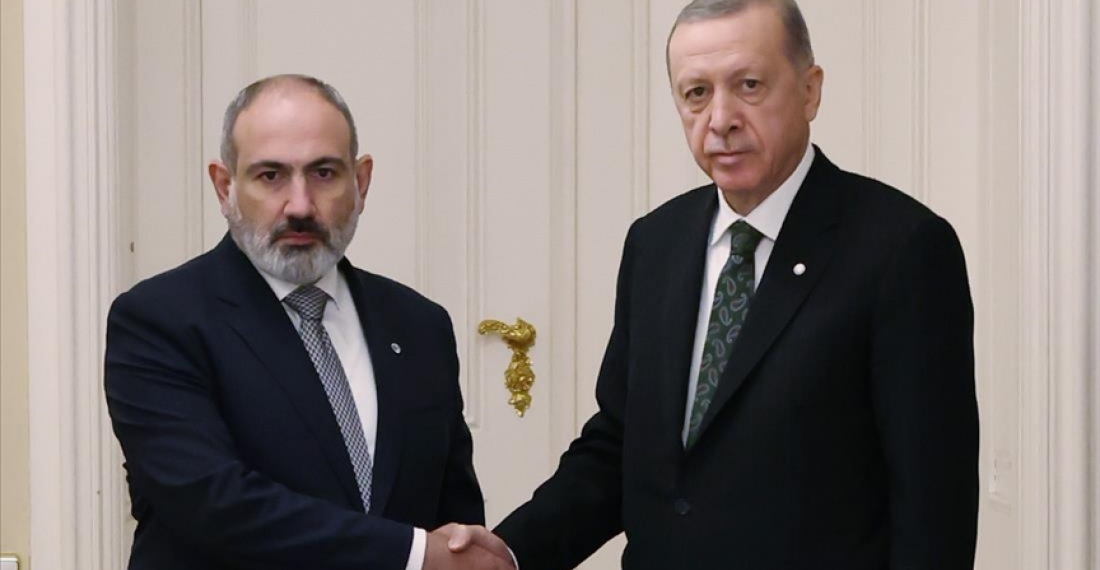
The first face to face meeting between Armenian prime minister, Nikol Pashinyan, and Turkish President, Recip Tayip Erdogan, took place in Prague on 6 October, on the margins of the summit of the European Political Community. In this op-ed for commonspace.eu, Benyamin Poghosyan says that whilst in the summer there was hope of an early breakthrough in the Armenia-Turkey normalisation process, decisions agreed by the special envoys of the two countries have not been implemented. Poghosyan wonders if the Pashinyan-Erdogan meeting may stimulate the process, or if further work in the process of building confidence and trust is required?
The first week of October 2022 was marked by intensive diplomacy around the geopolitics of the South Caucasus. The September 13-14, 2022, Azerbaijani aggression against Armenia threw the region back to the brink of a new large-scale war. It seemed that months-long Armenia – Azerbaijan negotiations facilitated by the European Council President Charles Michel were fruitless. However, despite bleak predictions, a new wave of diplomatic activity was launched immediately after the ceasefire was reached on September 14.
This time the US, alongside the EU, actively pushed the process forward. Armenian and Azerbaijani foreign ministers met in New York under the mediation of the US Secretary of State. Secretary of the Armenian Security Council met President Aliyev's top foreign policy aide at the White House. Armenian and Azerbaijani foreign ministers met again on October 2, 2022, in Geneva, finalizing the preliminary agreements reached during the meetings in the US.
This latest round of diplomacy reached its peak on October 6, 2022, in Prague, during the inaugural summit of the European Political Community. After hours of discussions with the direct participation of the French President and President of the European Council, the Armenian and Azerbaijani leaders agreed a joint statement whereby Armenia and Azerbaijan confirmed their commitment to the UN Charter and the Alma-Ata Declaration of 1991, through which both sides recognized each other's territorial integrity and sovereignty. They confirmed that this would serve as the basis for the work of the commissions on delimitation. Armenia agreed to facilitate the European Union civilian mission along the border with Azerbaijan, which should start work in October 2022 for a maximum period of two months.
The Prague statement is a significant milestone in Armenia – Azerbaijan negotiations towards the signature of a peace treaty. The statement did not clarify all issues, and the situation on the ground remains volatile – the Armenian Ministry of Defense reported the shelling of its positions on the evening of October 8. Nevertheless, the statement and the deployment of an EU civilian mission in Armenia will significantly decrease the risk of another large-scale attack by Azerbaijan, at least until the end of 2022, assuming nothing completely unexpected happens before the mission's arrival.
While Pashinyan – Aliyev – Macron – Michel meeting was at the center of attention of the media and that of the expert community, another important meeting took place in Prague. The Armenian Prime Minister met with the President of Turkey. It was their first face-to-face meeting. Armenia and Turkey officially launched the new phase in the process of normalizing their relations in January 2022, when their special representatives met for the first time in Moscow. Several other meetings followed, and on July 1, 2022, they agreed to open their common border for third-country nationals and to begin direct cargo flights. It seemed a remarkable achievement and was followed by a phone conversation between Pashinyan and Erdogan. Armenian officials hoped the July 1 agreements would be implemented by the end of Summer. However, as of now, nothing happened on the ground. Turkey fully supported Azerbaijan's position during the September 13-14 large-scale fighting and demanded that Armenia “accept peace offered by Azerbaijan and Turkey."
From the beginning of the Armenia – Turkey normalization process, both sides publicly stated their readiness to pursue the process without any preconditions. However, Turkey never hid the fact that Armenia – Turkey and Armenia – Azerbaijan negotiations are connected. Any real breakthrough in Armenia – Turkey track is possible only after the signature of an Armenia – Azerbaijan peace agreement. President Erdogan reiterated this position once more in Prague. He clearly stated that Turkey would open the border with Armenia, including Kars – Gyumri railway route, as soon as Armenia and Azerbaijan sign a peace agreement. Probably Turkey has other preconditions regarding Armenia’s policy toward the international recognition of the Armenian Genocide.
No one can force President Erdogan to abandon his position, which makes Armenia – Turkey normalization process fully dependent on developments in the Armenia – Azerbaijan track. Meanwhile, as the future of the Armenia – Azerbaijan peace treaty is not clear yet, both in terms of its signature and its ratification by the Armenian Parliament, the pause in Armenia – Turkey normalization process may ruin the already low trust between Armenia and Turkey. Armenia remembers well the 2008-2009 “football diplomacy," which ended abruptly as Turkey, under Azerbaijani pressure, connected the ratification of Zurich protocols with the future of Armenia – Azerbaijan negotiations.
As we mentioned, no one can force Turkish leaders to change their position. However, the international community, particularly the EU, may foster expert and civil society-level dialogue between Armenia and Turkey to keep the momentum. In this context, confidence-building measures may play a vital role in establishing trust between sides. The EU's experience of pushing forward confidence-building measures, including between Armenia and Azerbaijan after the 2020 Karabakh war, can and should be used in this area too.
source: Benyamin Poghosyan is the founder and Chairman of the Centre for Political and Economic Strategic Studies in Yerevan.
photo: Prime Minister Pashinyan and President Erdogan at their meeting in Prague on 6 October 2022.
The views expressed in opinion pieces and commentaries do not necessarily reflect the position of commonspace.eu or its partners.