In this op-ed for commonspace.eu, Dr Benyamin Poghosyan, Executive Director of the Political Science Association of Armenia, comments about EU-Armenia relations now that the two sides have initialled a new framework agreement
On March 21, 2017 Armenia and the EU initialed a new bilateral Comprehensive and Enhanced Partnership Agreement. The negotiations were launched in December 2015 and a decision on their start was made during the Eastern Partnership May 2015 Riga summit. This is an important milestone in bilateral relations, especially taking into account Armenia's last minute withdrawal in 2013 from initialing its Association Agreement negotiated within the framework of the EU Eastern Partnership program.
Armenia's relations with the West are one of the key foreign policy priorities of the country. The landlocked country attempts to pursue a more balanced foreign policy, trying to leverage its dependence on Russia through fostering deeper relations with the US, NATO and EU. The task is not an easy one, however, especially after the start of Russian President Vladimir Putin's third term, which was marked by a sudden and steep deterioration of Russia's relations with key Western players due to the conflicts in Ukraine and Syria, and as well as in response to Western concerns over growing Russian authoritarianism.
Hard security dilemmas compel Armenia to be in a military alliance with Russia, and to hosting Russian military base in its territory. The country's membership in the Collective Security Treaty Organization (CSTO) should also be viewed through the paradigm of the Armenian - Russian strategic alliance. The decision to withdraw from its Association Agreement with the EU and instead, to enter the Russia-led Customs Union and then the Eurasian Economic Union (EAEU) was based mostly on this security calculus too.
Simultaneously, Armenia understands that it urgently needs sweeping reforms in almost all spheres of the society to overcome the legacy of the Soviet period and to be able to turn back the negative trends in economy and demography. Obviously developed and functioning institutions are key prerequisites for statehood and this is especially true for Armenia, as it is located in the nexus of geopolitical struggle between much more powerful neighbors. The growing discontent among the society towards the domestic status quo established since the mid-1990s is another factor to accelerate the reforms.
Therefore, it is not surprising that all political forces, including the ruling Republican Party, involved in the current parliamentary elections are pointing out the necessity to launch fundamental reforms dealing with corruption and provide sufficient level of management within state institutions. And in this process, the best example and primary source for inspiration is not Russia, but the EU.
Armenia is perceived as a "small Russia", with the same domestic problems seen in Russia. The only difference is in scale. Russia, therefore cannot be the model for dramatically changing the current state system in Armenia. Even more, for some parts of Armenian society, Russia is viewed as an obstacle to successful and systemic domestic reforms.
In contrast, despite the EU's many internal problems - the rise of populism, the migrant crisis, growing terrorist threats, Brexit, Greece debt, and so on - the Armenian public perceives the EU as a key source of support for fostering much anticipated and necessary economic, political and judicial reforms aimed at improving institution building process and thus creating a healthier base for further development of independent statehood. Functioning state institutions, the rule of law, relatively low level of corruption, welfare system, - are all tangible achievements in Europe, which may and should adapted for the local circumstances in Armenia, and implemented. Of course, everybody understands that a strategic alliance with Russia puts some limitations on Armenia's ability to interact with the EU, especially taking into account the current impasse in Russia - West relations, but there is a clear perception in Armenian society that if Armenia wants to keep its independence, the reforms in key areas should be undertaken as soon as possible. The April 2016 short war in Karabakh revealed the fact that even the strategic alliance with Russia does not automatically guarantee the security of Armenia and Karabakh.
Thus, there is a clear understanding both in Armenian society and within the political establishment that the EU may play vital role in transforming Armenia into a modern state. The Comprehensive and Enhanced Partnership Agreement is a right step towards closer cooperation, but it is only the beginning. As with any agreement the implementation stage is the most important one. And here much depends not only from Armenia but from EU too. For example, the EU should not view Armenia as a state totally within Russian sphere of influence where nothing can be reached without Moscow's consent. Supporting Armenia through fostering various reforms and institution building process is the only viable way for the West to keep channels open for interaction with Armenia and have additional sources of leverage in the rapidly changing geopolitical juncture of the South Caucasus. Even more, Armenia, as a member of the Eurasian Economic Union and with close ties with EU, in a midterm perspective, can become a platform for EU - EAEU dialogue and engagement. The level of trusted relations with the US and active cooperation with NATO makes Armenia more suitable for a role of a connection point and not as a competition between Russia and the West. Thus, Armenia and the EU will only gain in furthering bilateral cooperation, but both sides need to demonstrate more political will and determination to turn the possibilities deriving from the Comprehensive and Enhanced Partnership Agreement into real and relevant opportunities.
Dr Benyamin Poghosyan is the Executive Director of the Political Science Association of Armenia.
related content on commonspace.eu:
Armenia and EU initial "Comprehensive and Enhanced Partnership Agreement"
LIVE BLOG: Visit of President Serzh Sargsyan to Brussels
EU and Armenia upbeat on progress in negotiations on a new agreement
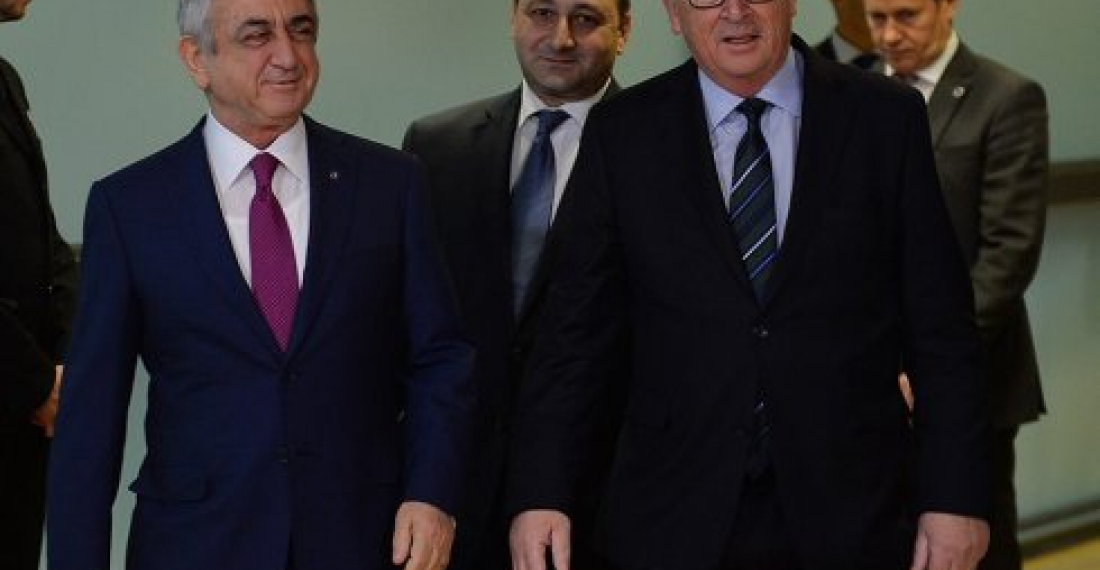
Photo: President Serzh Sargsyan of Armenia and European Commission President Jean Claude Juncker at their meeting in Brussels in February 2017.