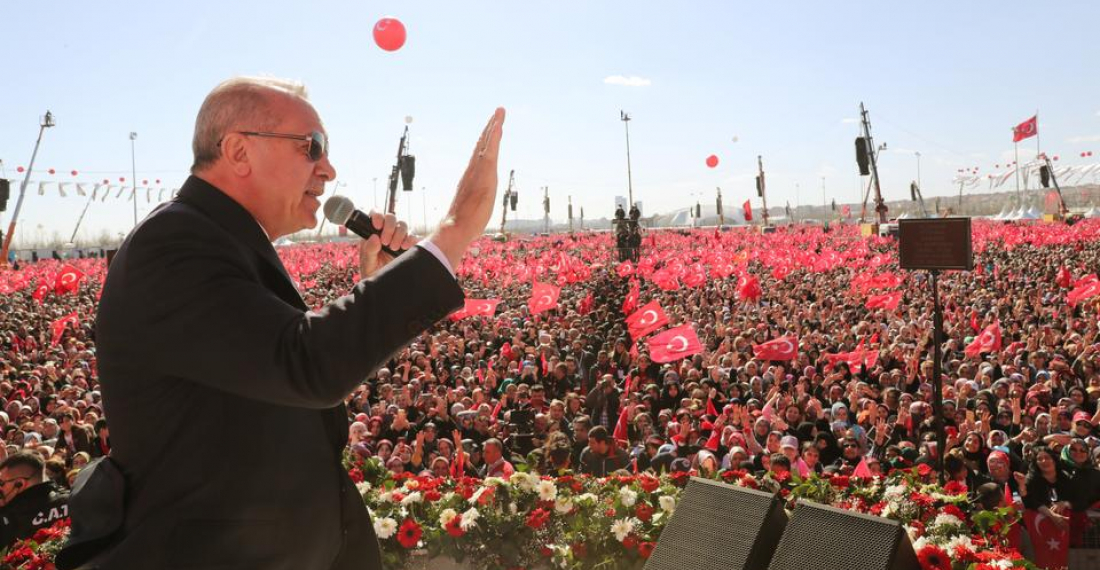
2023 will be a crucial elections year in Turkey, and their is no certainty that president Erdogan and his AK Party can maintain there hold on power, argues Benyamin Poghosyan in this op-ed. The stakes are high and political turmoil will have implications way beyond Turkey itself.
The latest Russia-US and Russia-NATO tensions have entirely shifted the attention of the media and the expert community to Ukraine. Tens, if not hundreds, of papers and policy briefs are published daily, seeking to understand what Russia wants in Ukraine and whether Russia and the West will come to a diplomatic solution and avoid war. As a NATO member and Black Sea littoral state Turkey has a significant role in these calculations. What will be Turkey's reaction if war breaks out in or around Ukraine, and how will the war impact Russia - Turkey relations in other regions – the Middle East, South Caucasus, Balkans, and North Africa? Up to now, Turkey has implemented a two-prong strategy. It underscores its support for Ukraine's sovereignty and territorial integrity, and deepens its military-technical cooperation with Kyiv, while simultaneously calling for a diplomatic solution and offering its services as a mediator between Russia and Ukraine.
However, the future of Turkey in the short term is also itself a question mark. Turkey faces presidential and parliamentary elections in 2023, and for the first time since the ruling AK party came to power in November 2002, there is doubt if President Erdogan will win them. Without going into the details of the AKP's almost 20 years rule in Turkey, it should be underscored that in 2002-2013 the party and its leader Erdogan were highly popular both in Turkey and abroad. Erdogan secured impressive Turkish economic growth after the turmoil of 2000-2001, boosting Turkish exports and rising living standards of millions of Turks. Turkey launched EU membership negotiations in 2005, took actions to improve Kurdish minority rights, including education and broadcasting in the Kurdish language, started negotiations with PKK, and significantly reduced the military's role and influence over Turkish politics in line with the liberal standards requiring civilian democratic control over the armed forces. The West hailed the launch of the Armenia-Turkey normalization process of 2008-2009, dubbed as "football diplomacy," even if in the end of the day, it failed for several reasons, including the fierce opposition from Azerbaijan.
As the Arab spring started in 2011, the US and some in the EU looked to Turkey with hope, as a country that could combine moderate Islam and democracy, viewing Turkey as a role model for Arab states. They perceived Turkey as evidence that there was an alternative for Muslim states besides binary choice between secular authoritarianism and radical Islam.
The perceptions of Turkey started to change in 2013, as the Gezi Park protests, and the state's subsequent brutal reaction to them, showed that Turkey is still far from the Western standards of liberal democracy. Gezi park events were only the tip of the iceberg, as AKP leader Erdogan moved towards more personal control over state institutions. The stalemate in Cyprus, and Turkey's drilling activities in the Eastern Mediterranean, alienated the EU. At the same time, the US support for the Kurdish PYD in Syria, as America's main ally in the fight against the Islamic State, negatively impacted Turkey-US relations. The authoritarian tendencies at home - arrests of journalists, pressure on the opposition, and shady business deals involving people close to the AK Party were another part of the Turkish puzzle in the recent decade.
The Turkish government’s heavy-handed response to the July 2016 failed military coup attempt, including the massive purge of civil servants afterwards, further tarnished Turkey's image in the West. The growing Russia - Turkey cooperation, including Turkey's decision to buy Russian S-400 systems, put additional strains on the US-Turkey relations, resulting in the ousting of Turkey from the F-35 program and the imposition on Turkey of sanctions envisaged by the "Countering America's Adversaries Through Sanctions Act." Many in the West started to question Turkey's role as a genuine ally, viewing it mainly as a problematic partner, which creates as many problems as it solves.
Meanwhile, President Erdogan successfully turned Turkey into a Presidential Republic and assumed de facto unrestricted powers. Erdogan supporters narrowly won the Constitutional amendments referendum in April 2017, and Erdogan received 52.6 percent votes during the June 2018 Presidential elections. However, the deteriorating economic situation in Turkey has significantly reduced Erdogan's popularity in Turkey. The 2019 local elections delivered a hard blow to Erdogan, as the ruling party lost several megapolises, including Ankara and Istanbul. The economic situation continued to deteriorate, while President Erdogan pushed forward his vision of problem-solving, forcing the Central Bank to decrease the interest rate despite the growing inflation and rapid devaluation of the Turkish Lira. Erdogan believes that a depreciated Lira will boost Turkish exports and secure Turkey a new production and export hub role, as the West seeks to re-organize global supply chains and decrease its dependence on China. This vision is quite controversial, and if its mid-and long-term implications can be debated, its short-term negative impact on the economy and population's living standards is evident.
Thus, for the first time since 2002, the ruling AKP and President Erdogan go to the elections with little or no assurance of the results. The increased polarization may result in the main opposition parties uniting their forces before the elections, and putting forward a single candidate as part of an "All against Erdogan" logic. Given the controversies President Erdogan has created in political and business life, he may face criminal prosecution if he loses power. It makes the 2023 elections for Erdogan a win-or-die dilemma, creating significant preconditions for post-election instability and turmoil.
Erdogan may seek to rig elections in his favor and then suppress the street protests, rather than face electoral defeat; he may himself instigate street protests claiming election fraud. One of the options could be to provide Erdogan and his family a guarantee of personal and financial security after leaving power. However, in the current situation in Turkey, it is challenging to assess if the opposition is ready to provide such guarantees, or indeed if Erdogan is ready to accept them. Another option is that Erdogan may decide not to participate in the elections himself, but to support a less controversial candidate from his inner circle, such as incumbent Defense Minister Hulusi Akar, while partly keeping his power through the control over the AKP.
In any case, Turkey is heading towards a very turbulent year, and the upheaval in Turkey will trigger domestic and international repercussions. It will impact the balance of power in many regions, and influence the Russia-West impasse. If Erdogan loses power, the new President of Turkey may seek to improve its relations with the US and NATO, though a complete return to its Cold war role as the US junior partner is unlikely. Better US-Turkey relations will impact the delicate balance in Turkey's partnership with Russia, and may cancel the understanding reached between them in areas such as Syria, Western Balkans, and the South Caucasus. In the case of the South Caucasus, this may shake the post-2020 Karabakh war status quo, and slow down the Armenia - Turkey normalization process and the restoration of railways and highways connecting Turkey with Azerbaijan, and beyond to Russia via Armenia.