


"It is very unfortunate that in the Caucasus, rather than learning from the mistakes of politicians on the other side of Europe, many have singled out events and decisions on the Iberian peninsula to justify similar mistakes in their own context", writes Dennis Sammut in this op-ed
The independence referendum held in Catalunya on Sunday (1 October) was closely watched in the Caucasus region, where issues related to secession have dominated politics for the last three decades and defined the region's post-Soviet identity.
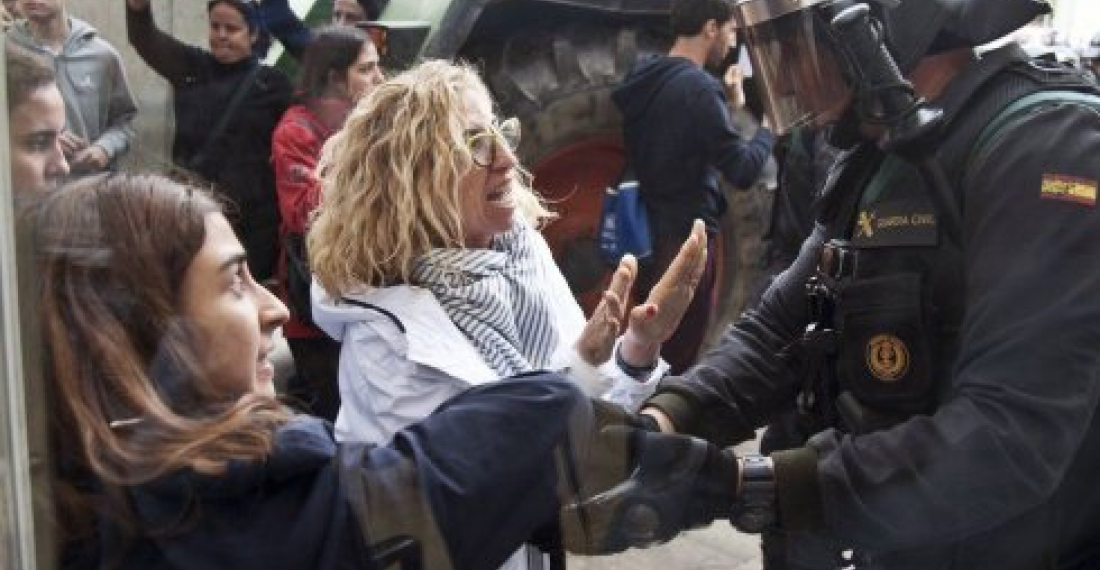
More than 800 hundred people were injured in Catalunya on Sunday, as police and Guardia Civil personnel, responding to orders from Madrid, used heavy handed methods to try to stop a referendum instigated by the Catalan regional government that provides for Catalunya's independence from the Kingdom of Spain as an independent republic. The Catalans have said that more than 90% of those that voted supported independence, but the poll was held under very difficult circumstances, with Madrid using all means at its disposal to disrupt the poll. The biggest mistake on the part of both Madrid and Barcelona is that they built-up to this confrontation without exhausting all the means at their disposal to resolve the problem amicably, as one would have expected from a functioning democracy.
The police heavy-handed tactics to try to stop the referendum from taking place seem to have backfired, stirring memories of not so long ago when Spain was ruled by a fascist dictatorship, and emboldening the "separatists". Memories of that dictatorship linger in Spain, which is why the government should have considered its approach to the Catalan referendum more carefully. They should have learned from the experience of other functioning democracies facing similar challenges in the past - the Canadians in Quebec, the British in Scotland, to mention two. There, separatism was not stopped by smashing polling stations or beating up old women.
The Catalan authorities on their part needed to consider more carefully the cost on their own society of pushing forward a divisive policy on which many Catalan have serious misgivings.
Over the next few days the national government in Madrid, the "separatists" in Barcelona, and the somewhat stunned Union leaders in Brussels will have to see how to pick up the pieces, and avoid throwing the whole Iberian peninsula into the abyss.
Europe, Spain and Catalunya are sophisticated societies and they have the capacity to resolve this problem, through innovative, creative and democratic solutions. This process must now start as soon as possible. Business as usual is clearly no longer an option. Whilst the scenes from Catalunya on Sunday shame Spain and Europe, the situation can yet be retrieved, because at every level there are strong institutions, an effective system of checks and balances, and a free press and vibrant civil society.
Both Spanish and Catalan leaders now need to take a step back and allow a period of cooling of. The EU must step in to broker talks.
Back in the Caucasus they will be watching. Whilst the circumstances are very different, some of the arguments being used by both sides in Spain sound eerily familiar in Armenia, Azerbaijan and Georgia, and in the regions that seceded: Abkhazia and South Ossetia (from Georgia) and Nagorno-Karabakh (from Azerbaijan). Some are even finding similarities in the trajectory of events now unfolding in Spain, and those in the early 1990s in the Caucasus. This is a distortion of reality.
It is very unfortunate that comments on media and social media over the weekend give the impression that in the Caucasus, rather than learning from the mistakes of politicians on the other side of Europe, many have singled out events and decisions on the Iberian peninsula to justify similar mistakes in their own context in the Caucasus.
On the Iberian peninsula, as in the Caucasus, the biggest lesson is that dialogue is the key - not violent confrontation that inevitably leads to tragedy and suffering.
source: Dr Dennis Sammut is the Executive Director of LINKS (Dialogue, Analysis and Research); (dennis@links-dar.org). He contributed this op-ed to commonspace.eu
photo: Police confront voters in Catalunya on 1 October 2017 (picture courtesy of the BBC)



