

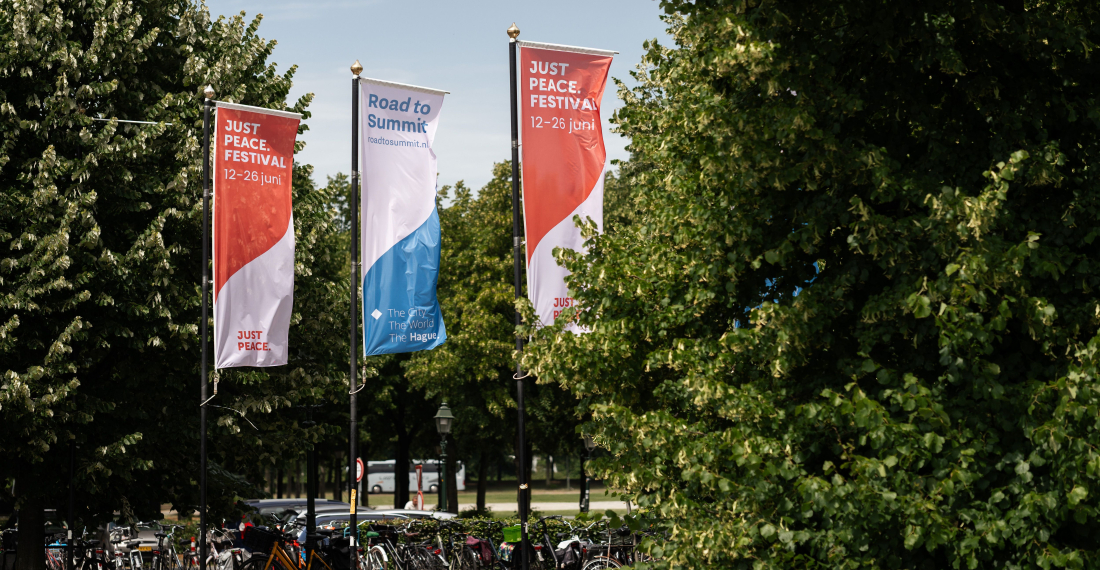
Last week, as NATO leaders gathered in Brussels for their summit, LINKS Europe joined other civil society organisations in a public statement. The Statement was the initiative of The Hague Humanity Hub.
The statement called for a balanced vision of peace and security, one that places people at its heart.
At a time when the focus is increasingly drawn toward defense capabilities and military preparedness, the statement urged equal and sustained attention to and investment in the long-term work of building resilient, inclusive, and just societies. This is not an alternative to security, it is the foundation of it, the statement added.
The Statement
As global leaders prepare to gather in The Hague for the 2025 NATO Summit, we call for a balanced vision of peace and security, one that places people at its heart.
At a time when the focus is increasingly drawn toward defense capabilities and military preparedness, we urge equal and sustained attention to and investment in the long-term work of building resilient, inclusive, and just societies. This is not an alternative to security. It is the foundation of it.
We cannot rely solely on military force to prevent and resolve conflicts. We also need policies that eliminate the social, economic and political roots of conflict. This means investing in resilience, in stable institutions, equitable economies, inclusive and just societies, and the rule of law. Today’s complex and compounding global problems: conflicts and geopolitical tensions, the climate crisis, deepening inequalities all call for a balanced approach. Our collective security and well-being everywhere—including here in the Netherlands—relies on it.
However, while military spending is increasing, investments in prevention of root causes of conflict are decreasing.
We need to act now. Here in the Hague, across the Netherlands and beyond, many individuals and institutions are working tirelessly to prevent conflict, protect human rights, uphold international law, and build the foundations of just and peaceful societies. These efforts are essential to global security and must be valued and resourced alongside defense.
We therefore call on political leaders, civil society, international institutions, and concerned citizens to:
-
Champion policies that recognize addressing root causes as a vital part of our approach to security alongside defense;
-
Ensure that the pursuit of peace remains a shared and resourced priority in both national and international agendas;
-
Increase investments in developing stable institutions, equitable economies, inclusive and just societies, and the rule of law;
-
Recognise and support the vital contributions of peacebuilding and humanitarian organisations and professionals in the Netherlands and worldwide;
As the Just Peace Festival reminds us, peace is not found in the absence of war— it is found in building resilient, inclusive and just societies as the pathway to sustainable peace. Let us not lose sight of that truth. And let us act on it.
We invite all individuals and institutions committed to a more just and peaceful world to endorse this statement and stand together in building a future where peace is not only protected, but cultivated.
This statement is an initiative of The Hague Humanity Hub
If you have any questions or would like to get in touch with us please drop a line to hello@humanityhub.net
Endorsed by:
Organisations
- 1646, The Netherlands
- Asia Justice Coalition*, The Netherlands
- Asylos, UK/Netherlands
- Climate Legal Consulting, The Netherlands
- Civil Society Platform for Peacebuilding and Statebuilding (CSPPS), The Netherlands
- Cordaid, The Netherlands
- Commit Global, The Netherlands
- CyberPeace Institute, Switzerland
- Defend Democracy, The Netherlands
- Didi, Israel
- Find Out Why, The Netherlands
- Foundation Max van der Stoel, The Netherlands
- Free Thought, UK/The Netherlands
- Gender Concerns International, The Netherlands
- Global Human Rights Defence, The Netherlands
- Global Shapers The Hague, The Netherlands
- HiiL, The Netherlands
- HVFC International, The Netherlands / USA
- Integrity Initiatives International Europe, The Netherlands
- International Centre for Counter-Terrorism, The Netherlands
- International Human Rights Commission-RFT, The Netherlands
- International Institute of Social Studies, The Netherlands
- Leaders for Climate Action, The Netherlands
- Leiden University, The Netherlands
- LINKS Europe Foundation, The Netherlands
- MasterPeace, The Netherlands
- Netherlands Institute for Multiparty Democracy, The Netherlands
- Oranjeconsult, The Netherlands
- Partos, The Netherlands
- PAX, The Netherlands
- Rhubarb Effect, The Netherlands
- Somaliland Lawyers Association (SOLLA), Somaliland
- Stichting HALO Trust Europe, The Netherlands
- Stichting Takecarebnb, The Netherlands
- Stichting Vreedzaam, The Netherlands
- The Global Pro Bono Bar Association, United States
- The Hague Academy for Local Governance, The Netherlands
- The Hague Humanity Hub, The Netherlands
- The Impact Canopy, The Netherlands
- Topaze, The Netherlands
- United Network of Young Peacebuilders, The Netherlands
- Werkplaats van de Woestijne, The Netherlands
- Women in International Security Netherlands, The Netherlands
- ZOA, The Netherlands
Individuals
- Alexander Gunkel, CEO, Space4Good, The Netherlands
- Angelica Cibrian, Scientist, Naturalis, Netherlands/Mexico
- Antonietta Elia, Professor of International Law / Senior Legal Adviser / Human Rights Activist, Spain
- Ali Al Bayati, Founder and CEO, Stichting Defenders for Human Rights, The Netherlands
- Anthony Forde, Academic / Human Rights / War Crimes Investigations Training, 4RDE Consulting, United Kingdom
- Benjamin Duerr, International Lawyer and Writer, The Netherlands
- Christophe Paulussen, Senior Researcher, T.M.C. Asser Instituut, The Netherlands
- Christelle Menassa, Media Development Expert, The Netherlands
- Clair Moore, Programme Manager, Centre of Expertise, Global and Inclusive Learning, The Netherlands
- Claudia Arana, Finance and Operations Manager, The Netherlands
- Daniel Shynn, Programme Officer, Justice & Peace Netherlands, The Netherlands
- Daphne Nederhorst, Social Entrepreneur, Sustainability in Action, The Netherlands
- Edward Meijer, Engineer, The Netherlands
- Emmanuel Tombe John, Advocate of Peace leveraging traditional Media for outreach, South Sudan
- Emmylou Aben, CEO, Pitztop, The Netherlands
- Faatimah Clarke, Communications and Marketing Associate, The Netherlands
- Gordon Graham, Rotary Club The Hague Metropolitan, Rotary International, The Netherlands
- Guy van Eijkeren, Manager, Economic Board The Hague (EBTH), The Netherlands
- Harry Hummel, Human Rights Campaigner, The Netherlands
- Heleen Weening, Connector, builder, Witte Raaf Realisatie, The Netherlands
- Ieva Cesnulaityte, Researcher of democratic innovation, Lithuania
- Ilaria Blasi, Senior Communications & Marketing Associate, Italy
- Ilse Valkering, Stakeholder Manager, The Netherlands
- Inge Hutter, Professor of Participatory and Qualitative Research in Population and Development, Erasmus University Rotterdam, The Netherlands
- Irene Juffermans, International development / Human Rights, The Netherlands
- Jan Aart Scholte, Professor, Leiden University, The Netherlands
- Kalina Kalpakchieva, Intern, The Netherlands
- Karla Espinoza, Fundraising Consultant, The Netherlands
- Kasper Vrolijk, Managing Director, The Netherlands
- Katarzyna Gardapkhadze, Senior Manager / Director of Global Programs, Poland
- Krijn van Beek, Strategy Designer, Policy Design Studio, The Netherlands
- Leila Prnjavorac, Moderator, public speaker, guest lecturer and peace ambassador of The Hague, The Netherlands and Bosnia and Herzegovina
- Liane Lankreijer, Wisdom Keeper, Regenboogcirkel, The Netherlands
- Liselotte de Koning, Lead, Red Cross Princess Margriet Fund, The Netherlands
- Liv Toonen, Tech Project Lead, Space4Good, The Netherlands
- Machiko Kanetake, Associate Professor of Public International Law, Utrecht University, The Netherlands
- Maja Vodoopivec, Assistant Professor of Peace and Conflict Studies, Leiden University, The Netherlands
- Maria Luisa Avila Jimenez, Innovation Consultant, Spain
- Maral Khajeh, Programme Coordinator, Justice & Peace Netherlands, The Netherlands
- Mary Kaburura, Advocate, Isaac Newton Advocates, Uganda
- Melissa Tepper, Producent, The Netherlands
- Michiel Hardon, Retired, The Netherlands
- Mijanou Edink, Editor, The Netherlands
- Nasya Handzhiyska-Westra, International Business Advisor, The Hague & Partners, The Netherlands
- Paulien Boone, Consultant, The Netherlands
- Piero Gandini, Sherpa for Changë, Disяuption, and Personal Transformation, The Netherlands
- Pieter Wismans, Medical Professional PhD, The Netherlands
- Prateek Shankar, Strategic Designer, Dark Matter Labs, India
- Säde Aurora Aalto-Setälä, Communications and Marketing Analyst, The Netherlands
- Sajad Sepehri, Educational Development and Innovation Strategist, Institute for Social Sciences & Humanities / VU, The Netherlands / Iran
- Salah, Project Manager, The Netherlands
- Sara Dzafic, Political Sociologist & Socioeconomic Researcher-Consultant, The Netherlands
- Sarah Abdelatif, Founder, Propel, The Netherlands
- Sidney Primm, Student, The Netherlands
- Siobhan, Fundraiser, The Netherlands
- Solange Hai, Case Writer, Erasmus University Rotterdam, The Netherlands
- Stefan Noël Hageman, Process Manager, MIRCURY, Netherlands
- Stéphane Duguin, Chief Executive Officer, CyberPeace Institute, Switzerland
- Tania Bernath, Self-employed, Gen X for Justice, USA
- Thirza Pluimer, Corporate Communication Manager, The Netherlands
- Tomas Kidd, Consultant, The Netherlands
- Wim Nusselder, Financieel Administrateur, The Netherlands
- Yvonne Versteeg, Mens, The Netherlands
*This does not reflect the views or positions of all AJC members