After years of uncertainty in EU-Azerbaijan relations, co-operation between the two sides has finally been put on a strategic footing with the signing in Baku on Monday (19 July) of a new "Memorandum of Understanding on a Strategic Partnership in the Field of Energy".
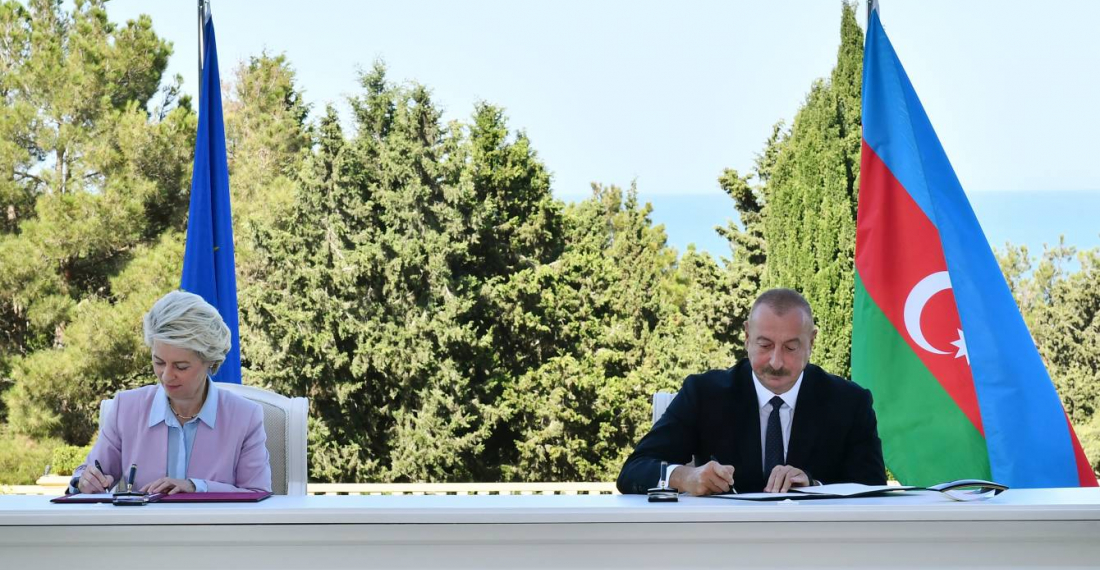
The President of the European Commission, Ursula von der Leyen, and Commissioner for Energy Kadri Simson were personally in Baku for the signing, indicating the importance the Commission attaches to the document. They met with President Ilham Aliyev and Azerbaijani Energy Minister Parviz Shahbazov before the two presidents then signed the Memorandum.
Currently, the EU and Azerbaijan are also negotiating a new comprehensive agreement, which will allow for enhanced cooperation in a wide range of areas, including economic diversification, investment, trade and making full use of the potential of civil society, while underscoring importance of human rights and rule of law.
Following the visit in Baku today, the EU-Azerbaijan Cooperation Council will meet on 19 July in Brussels to review the overall relations and discuss potential areas of mutual interest for cooperation in the future.
President von der Leyen said:
Today, with this new Memorandum of Understanding, we are opening a new chapter in our energy cooperation with Azerbaijan, a key partner in our efforts to move away from Russian fossil fuels. Not only are we looking to strengthen our existing partnership which guarantees stable and reliable gas supplies to the EU via the Southern Gas Corridor. We are also laying the foundations of a long-term partnership on energy efficiency and clean energy, as we both pursue the objectives of the Paris Agreement. But energy is only one of the areas where we can enhance our cooperation with Azerbaijan and I look forward to tap the full potential of our relationship.
Securing alternative gas supplies for Europe
The signing of the MOU comes at a crucial time when Europe is frantically trying to replace gas and other energy supplies from Russia, in the aftermath of the latter's invasion of Ukraine. A report on the website of the European Commission said that the memorandum signed by the two Presidents today includes a commitment to double the capacity of the Southern Gas Corridor to deliver at least 20 billion cubic metres to the EU annually by 2027. This will contribute to the diversification objectives in the REPowerEU Plan and help Europe to end its dependency on Russian gas. Based on the strengthened energy cooperation, Azerbaijan is already now increasing deliveries of natural gas to the EU, from 8.1 billion cubic metres in 2021 to an expected 12 bcm in 2022.
As stated in the MoU, the EU and Azerbaijan share the ambition to accelerate the development and deployment of renewable energy generation and transmission capacity to fully reap the synergies between the EU's clean energy transition and Azerbaijan's strong untapped renewable energy potential, in particular in the offshore energy sector.
Speaking after the signing of the MOU, president Ilham Aliyev said:
The Memorandum signed today is a kind of road map for the future. If we take into account that we have implemented all the issues we planned at first, I am sure that we will achieve great success in the future. Among the other issues we discussed today was the issue of building networks. Considering Azerbaijan's geographical position and modern transportation infrastructure, we should work more actively on building a network among our potential. Here, on the western coast of the Caspian Sea, Azerbaijan has the largest merchant fleet in the Caspian Sea, modern infrastructure, shipbuilding facilities, a new sea port, railways connecting us with all our neighbours. Therefore, there is a great need for a concerted effort to make network as important as energy in our relationships. Of course, our agenda is very broad. We are working on a new agreement between Azerbaijan and the European Union. We have just discussed this with Madam President and we hope to complete it next month. This will be an important contribution to our bilateral cooperation. We work bilaterally within the framework of the Eastern Partnership Program. The European Union is the main trade partner for Azerbaijan. The implementation of our plans will certainly increase the trade turnover for the sake of the welfare of our people. I am sure that relations between the European Union and Azerbaijan have a great future, and we will manage to solve all the issues we have planned. The European Union is the main trade partner for Azerbaijan. The implementation of our plans will certainly increase the trade turnover for the sake of the welfare of our people. I am sure that relations between the European Union and Azerbaijan have a great future, and we will manage to solve all the issues we have planned.
commonspace.eu political editor said in a comment that yesterday's signing in many ways justifies and recognises the importance of Azerbaijan's energy policy over the last three decades, from the early decision to sign the contract of the century with western energy companies, to the building of the Baku-Tbilisi-Ceyhan pipeline, to later initiatives such as the development of the Southern Gas Corridor. "The importance of these projects for Europe's energy security is today well understood. EU-Azerbaijan relations have passed through some difficult moments over the past decade, with the two sides often openly criticising each other. But energy has been one sector were it was mutually beneficial to continue the co-operation, and the signing of yesterday's memorandum is a justification of that policy. EU-Azerbaijan relations need to continue to be build, based on mutual respect and recognising the importance of people to people contacts for the future of the relationship. The EU on its part, especially now that the stakes are higher, needs to put more efforts in supporting lasting peace in the region. The energy agenda has its specific importance and aspects, but it cannot be seen in isolation of wider issues."
source: commonspace.eu with agencies
photo: European Commission President Usuala von der Leyen and Azerbaijani president, Ilham Aliyev sign a new MOU on energy in Baku on 18 July 2022 (picture courtesy of the press service of the president of Azerbaijan)