NKR at 22 - Unrecognised but entrenched

The self-declared Nagorno-Karabakh Republic on Monday celebrated the 22nd anniversary of its declaration of independence. On 2 September 1991 a joint session of the Nagorno Karabakh Oblast and Shahoumian regional councils of people's deputies with the participation of deputies of councils of all levels issued the following declaration:

"Expressing the will of people, in fact, fixed by a referendum and in the decisions of the NKAO and Shahoumian regional authorities in 1988-1991, its strive for freedom, independence, equality and good neighbourly relations;

ascertaining proclamation by the Azerbaijani Republic of the "restoration of 1918-1920 state independence";

taking into consideration that the policy of apartheid and discrimination pursued in Azerbaijan created an atmosphere of hatred and intolerance in the Republic towards the Armenian people, which led to armed conflict, human victims, mass deportation of the population from peaceful Armenian villages;

being guided by the USSR acting Constitution and laws giving the population of autonomous units and compactly living ethnic groups the right to decide independently the issue of their state-legal status in case of a Soviet Republic's secession from the USSR;

considering the Armenian people's strive for unification natural and in line with the norms of international law;

striving for restoration of good neighbourly relations between Armenian and Azerbaijani peoples, based on mutual respect of each other's rights;

taking into consideration the complexity and contradictoriness of the situation in the state, uncertainty of the Union's future, Union's structures of authority and governance;

respecting and following the principles of General Declaration on Human Rights and International Pact on Economic, Social and Cultural Rights, International Pact on Civil, Political and Cultural Rights and with hope for international community's understanding and support,

PROCLAIMS:

THE NAGORNO KARABAKH REPUBLIC WITHIN THE BORDERS OF THE CURRENT NAGORNO KARABAKH AUTONOMOUS OBLAST AND NEIGHBORING SHAHOUMIAN REGION. (NKR)

The Nagorno Karabakh Republic enjoys the authorities given to Republics by the USSR Constitution and legislation and reserves the right to decide independently the issue of its state-legal status based on political consultations and negotiations with the leadership of Union and Republics.

The USSR Constitution and legislation, as well as other laws currently in force, which do not contradict the goals and principles of this Declaration and peculiarities of the Republic apply on the territory of the Nagorno Karabakh Republic, until the NKR Constitution and laws are adopted."

Commenting on the 22nd anniversary of the establishment of the NKR, commonspace.eu political editor said:

"Twenty-two years later the Nagorno-Karabakh Republic continues to remain unrecognised internationally, but firmly well entrenched internally. Behind a wall of trenches and barbed wire, and with the help of thousands of soldiers from Armenia, it has frustrated Azerbaijan's ambitions to re-assert control over its territory. In these twenty-two years NKR has developed its own mini institutions, a Presidency, a government, parliament, political parties, army, and even a small civil society. They are often show-cased as a sign of its success. Yet this is a society under siege, militarised in many ways, and constantly reminded of the perils and dangers from the enemy at the gates. That enemy has changed a lot in the last twenty two years. In 1991 Azerbaijan emerged from the ashes of the USSR divided, weak and in political turmoil. Today it is a confident country, which whilst not without its own serious problems, has all the hallmarks of success. It has invested a lot of its revenues from oil into building a strong Armed Forces whose primary aim is to prepare to reverse the political and military defeats of two decades ago and bring back Nagorno-Karabakh within the Azerbaijani fold. The Karabakh conflict is often depicted as a struggle between the two well entrenched principles - the right for self determination, as expressed by the resolution adopted twenty two years ago, and the principle of territorial integrity, based on the recognition of Azerbaijan by the international community within the borders of the Azerbaijan SSR, which included Nagorno-Karabakh. In this case the two principles contradict each other and any solution is going to require compromise, flexibility and ingenuity. With the Armenian population of Karabakh living for a generation under siege, and with the Azerbaijani population of Karabakh living for the same amount of time as refugees displaced by the conflict, there are in this story no winners, only losers. Nor will there be any winners in case a new war is fought. One generation has been lost already. It is time to give the next one a better future."

source: commonspace.eu. Text of the declaration of the Nagorno-Karabakh Republic reproduced from www.nkr.am

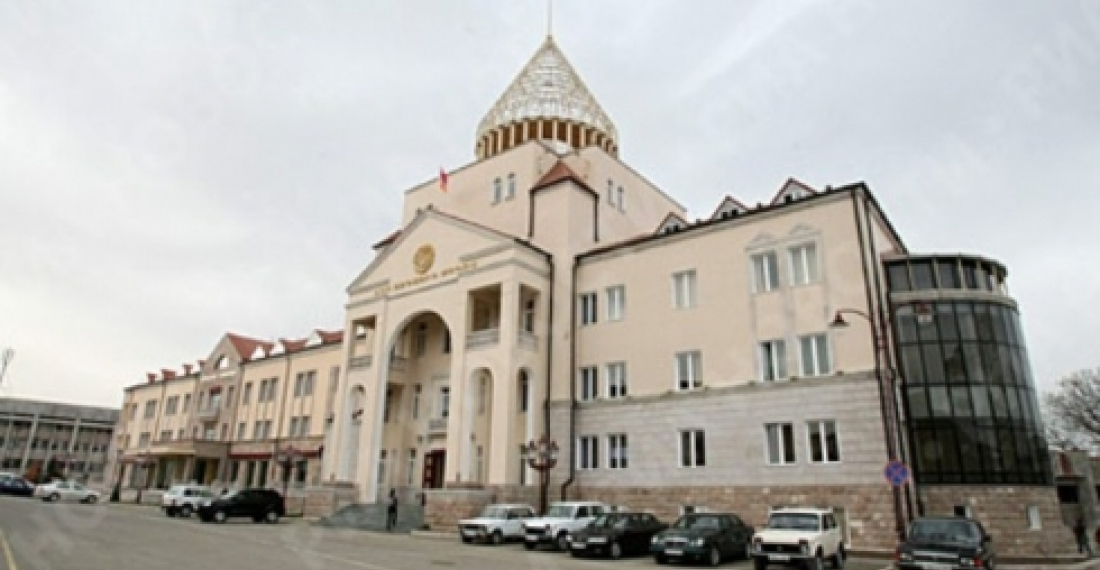
photo: The government building in the NKR capital, Stepanakert.
Related articles

Editor's choice
News
Aden under curfew, as problem in Yemen's south deepens

Aden under curfew, as problem in Yemen's south deepens

The port city of Aden, in Yemen's south, has been put under curfew, as the rift in the country between  the Saudi led coalition which  backs Yemen's presidential governing council, and the southern forces led by the Southern Transitional Council (STC), deepens. Abdul Rahman al-Mahrami, a member of the Yemeni Presidential Governing Council and commander of the al-Amalik brigades, has ordered a curfew in the temporary capital, Aden, "to maintain security". "A curfew has been imposed throughout Aden Governorate from 9:00 p.m. to 6:00 a.m., in accordance with the instructions of Commander Abdul Rahman al-Mahrami, a member of the Presidential Management Council," the statement said. It states that only security and military personnel, as well as medical and technical teams with approved permits, will be allowed to move in the area during these hours. Yemen's presidential council, which is backed by Saudi Arabia and which already is in a struggle with the Houthi Movement in the north of the country who also occupy the capital Sanaa, two days ago issued an order for the arrest of the head of the Southern Transitional Council (STC),, Aidarous al Zubaidi. The STC have wide support among people in the South, and advocate that South Yemen restores its independence. The coalition warned of further escalation in Aden, long regarded as an STC stronghold, as the Presidential Leadership Council (PLC) chief accused STC leader Aidarous Al Zubaidi of “high treason” and announced the revocation of his membership in the governing body. The moves mark a sharp escalation in tensions within the anti-Houthi camp, despite National Shield Forces, rivals of the STC and former allies, having recently retaken control of Hadhramaut and Mahra from southern fighters. The STC’s takeover of the two regions last month angered Saudi Arabia and contributed to igniting the current internal conflict. (click the picture to read more)

Popular

Editor's choice
Event
commonspace.eu is getting better

commonspace.eu is getting better

Commonspace.eu will this year celebrate its 15th anniversary. In this period we provided space for different opinions, including to persons from the countries and areas we are focused on, which have included Georgians, Armenians, Azerbaijanis, Yemenis, Ukrainians and many others. We have also, as much as is possible for a news outlet that does not have a network of paid journalists, provided accurate information, especially at times of crises. We have done so whilst remaining inspired by our vision for a just and peaceful world, of a Europe that works in peace and collaboration with its neighbourhood, and to give a voice to youth, women, minorities and other groups that struggle to be heard. This week we are launching new features, and strengthening established ones, to make commonspace.eu more effective, and more useful for our eclectic readership. On Thursday, we launch our new series, THURSDAY INTERVIEW. The interviews will be conducted by Lauri Nikulainen, and the first interview is with Murad Muradov, Vice President of the Topchubashov Centre in Baku. On Friday we will have a selection from our regular newsletters: Caucasus Concise, Arabia Concise and Central Asia Concise. We hope to add a fourth newsletter shortly. On Monday, the Monday Commentary by our Managing Editor, Dr Dennis Sammut, is back. The commentaries reflect the author’s years of experience, but equally his passion for change and a better world. On Tuesday and Wednesday, we feature articles by our regular guest contributors, including Onik Krikorian, Benyamin Poghosyan and Vasif Huseynov. We will of course also feature daily news stories from Europe, and the regions around it, the neighbourhood with which we need to build a common future. We hope that you will find commonspace.eu interesting and useful.
Editor's choice
Event
commonspace.eu is getting better

commonspace.eu is getting better

Commonspace.eu will this year celebrate its 15th anniversary. In this period we provided space for different opinions, including to persons from the countries and areas we are focused on, which have included Georgians, Armenians, Azerbaijanis, Yemenis, Ukrainians and many others. We have also, as much as is possible for a news outlet that does not have a network of paid journalists, provided accurate information, especially at times of crises. We have done so whilst remaining inspired by our vision for a just and peaceful world, of a Europe that works in peace and collaboration with its neighbourhood, and to give a voice to youth, women, minorities and other groups that struggle to be heard. This week we are launching new features, and strengthening established ones, to make commonspace.eu more effective, and more useful for our eclectic readership. On Thursday, we launch our new series, THURSDAY INTERVIEW. The interviews will be conducted by Lauri Nikulainen, and the first interview is with Murad Muradov, Vice President of the Topchubashov Centre in Baku. On Friday we will have a selection from our regular newsletters: Caucasus Concise, Arabia Concise and Central Asia Concise. We hope to add a fourth newsletter shortly. On Monday, the Monday Commentary by our Managing Editor, Dr Dennis Sammut, is back. The commentaries reflect the author’s years of experience, but equally his passion for change and a better world. On Tuesday and Wednesday, we feature articles by our regular guest contributors, including Onik Krikorian, Benyamin Poghosyan and Vasif Huseynov. We will of course also feature daily news stories from Europe, and the regions around it, the neighbourhood with which we need to build a common future. We hope that you will find commonspace.eu interesting and useful.