


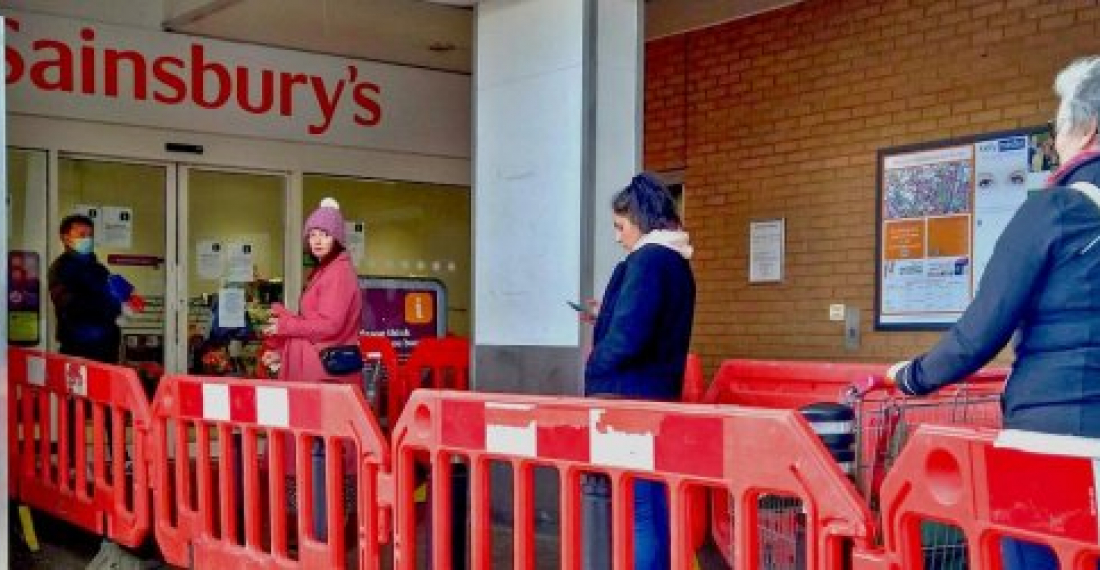
What's the end game?

At what point will the lockdown end?  William Murray looks at the WHO Europe's policy guidelines to this question we are all asking, in this short piece for commonspace.eu

On the 23rd of January, the city of Wuhan, China - where the coronavirus emerged - was put into a lockdown, which lasted 76 days until the 8th of April. With most of us having now been living under some degree of lockdown for over a month, people are beginning to ask when preventative measures are likely to ease up elsewhere. World leaders now find themselves at a crossroads and must decide whether to sustain lockdown measures, limiting loss of life and taking the pressure off health services but with considerable economic cost; or to ease measures but risk an even bigger second wave of infection, potentially undoing what has been achieved by the measures in place.

To help countries to responsibly assess requirements for ongoing preventative measures, the World Health Organization (WHO) has published a set of key policy considerations for European states centring around the following six criteria. Countries considering easing up COVID-19 lockdown measures must ensure:

  1. that evidence shows COVID-19 transmission is controlled;
  2. that public health and health system capacities are in place to identify, isolate, test, trace contacts and quarantine them;
  3. that outbreak risks are minimized in high-vulnerability settings, particularly in homes for older people, mental health facilities and crowded places of residence;
  4. that workplace preventive measures are established, including physical distancing, handwashing facilities and respiratory etiquette;
  5. that importation risks can be managed; and
  6. that communities have a voice and are aware, engaged and participating in the transition.

Whilst the WHO emphasises that there is no 'one-size-fits-all' approach - and that even within Europe, there are vast differences in infection rates and healthcare service capacities - such criteria should be taken as guidelines. Dr Hans Henri P. Kluge, WHO Regional Director for Europe, has said: "This document aims to support countries by providing key considerations for the slow easing of restrictions and transitioning to a 'new normal'. While everyone wishes the return of economic activity, it's important to be clear that this will be a gradual process, requiring strict monitoring and a possible reintroduction of measures should there be a new increase in cases." [1]

The WHO has also recommended staggering the easing of restrictions as due to the nature of COVID-19, the knock-on effects of relaxing measures will not be completely clear until 10-15 after the lifting of restrictions. Additionally, countries must acknowledge that there may need to be a quick reintroduction of certain physical distancing measures if further outbreaks occur.

The full document of WHO policy considerations for European states is available to download here [2].

Source: William Murray, Project Officer and Coordinator at LINKS Europe, for commonspace.eu

Featured Sources:

[1] The WHO - 'WHO/Europe publishes considerations for gradual easing of COVID-19 measures': http://www.euro.who.int/en/health-topics/health-emergencies/coronavirus-covid-19/news/news/2020/4/whoeurope-publishes-considerations-for-gradual-easing-of-covid-19-measures

[2] The WHO - 'Strengthening and adjusting public health measures throughout the COVID-19 transition phases. Policy considerations for the WHO European Region, 24 April 2020': http://www.euro.who.int/en/health-topics/health-emergencies/coronavirus-covid-19/novel-coronavirus-2019-ncov-technical-guidance/coronavirus-disease-covid-19-outbreak-technical-guidance-europe/strengthening-and-adjusting-public-health-measures-throughout-the-covid-19-transition-phases.-policy-considerations-for-the-who-european-region,-24-april-2020


Related articles

Editor's choice
News
Borrell tells the European Parliament that the situation in Afghanistan was critical, but the EU will remain engaged

Borrell tells the European Parliament that the situation in Afghanistan was critical, but the EU will remain engaged

Borrell underlined that the European Union will make every effort to support the peace process and to remain a committed partner to the Afghan people. "Of course, we will have to take into account the evolving situation, but disengagement is not an option.  We are clear on that: there is no alternative to a negotiated political settlement, through inclusive peace talks.
Editor's choice
News
NATO Chief says war is on Europe's doorstep, and warns against complacency

NATO Chief says war is on Europe's doorstep, and warns against complacency

Russia could attack a Nato country within the next five years, the Secretary General of NATO, Mark Rutte, said in a stark new warning. "Nato's own defences can hold for now," Rutte warned in Berlin, but conflict was "next door" to Europe and he feared "too many are quietly complacent, and too many don't feel the urgency, too many believe that time is on our side. "Russia is already escalating its covert campaign against our societies," Rutte said in a speech in Germany. "We must be prepared for the scale of war our grandparents or great-grandparents endured." Earlier this month, Russia's President Vladimir Putin said his country was not planning to go to war with Europe, but it was ready "right now" if Europe wanted to - or started a war. But similar reassurances were given by Moscow in 2022, just before 200,000 Russian troops crossed the border and invaded Ukraine. Putin has accused European countries of hindering US efforts to bring peace in Ukraine - a reference to the role Ukraine's European allies have recently played in trying to change a US peace plan to end the war, whose initial draft was seen as favouring Russia. But Putin was not sincere, Nato's secretary-general said in the German capital, Berlin. Supporting Ukraine, he added, was a guarantee for European security. "Just imagine if Putin got his way; Ukraine under the boot of Russian occupation, his forces pressing against a longer border with Nato, and the significantly increased risk of an armed attack against us." Russia's economy has been on a war footing for more than three years now - its factories churn out ever more supplies of drones, missiles and artillery shells. According to a recent report by the Kiel Institute for the World Economy, Russia has been producing each month around 150 tanks, 550 infantry fighting vehicles, 120 Lancet drones and more than 50 artillery pieces. The UK, and most of its Western allies, are simply not anywhere near this point. Analysts say it would take years for Western Europe's factories to come close to matching Russia's mass-production of weapons. "Allied defence spending and production must rise rapidly, our armed forces must have what they need to keep us safe," the Nato chief said.

Popular

Editor's choice
News
NATO Chief says war is on Europe's doorstep, and warns against complacency

NATO Chief says war is on Europe's doorstep, and warns against complacency

Russia could attack a Nato country within the next five years, the Secretary General of NATO, Mark Rutte, said in a stark new warning. "Nato's own defences can hold for now," Rutte warned in Berlin, but conflict was "next door" to Europe and he feared "too many are quietly complacent, and too many don't feel the urgency, too many believe that time is on our side. "Russia is already escalating its covert campaign against our societies," Rutte said in a speech in Germany. "We must be prepared for the scale of war our grandparents or great-grandparents endured." Earlier this month, Russia's President Vladimir Putin said his country was not planning to go to war with Europe, but it was ready "right now" if Europe wanted to - or started a war. But similar reassurances were given by Moscow in 2022, just before 200,000 Russian troops crossed the border and invaded Ukraine. Putin has accused European countries of hindering US efforts to bring peace in Ukraine - a reference to the role Ukraine's European allies have recently played in trying to change a US peace plan to end the war, whose initial draft was seen as favouring Russia. But Putin was not sincere, Nato's secretary-general said in the German capital, Berlin. Supporting Ukraine, he added, was a guarantee for European security. "Just imagine if Putin got his way; Ukraine under the boot of Russian occupation, his forces pressing against a longer border with Nato, and the significantly increased risk of an armed attack against us." Russia's economy has been on a war footing for more than three years now - its factories churn out ever more supplies of drones, missiles and artillery shells. According to a recent report by the Kiel Institute for the World Economy, Russia has been producing each month around 150 tanks, 550 infantry fighting vehicles, 120 Lancet drones and more than 50 artillery pieces. The UK, and most of its Western allies, are simply not anywhere near this point. Analysts say it would take years for Western Europe's factories to come close to matching Russia's mass-production of weapons. "Allied defence spending and production must rise rapidly, our armed forces must have what they need to keep us safe," the Nato chief said.

