


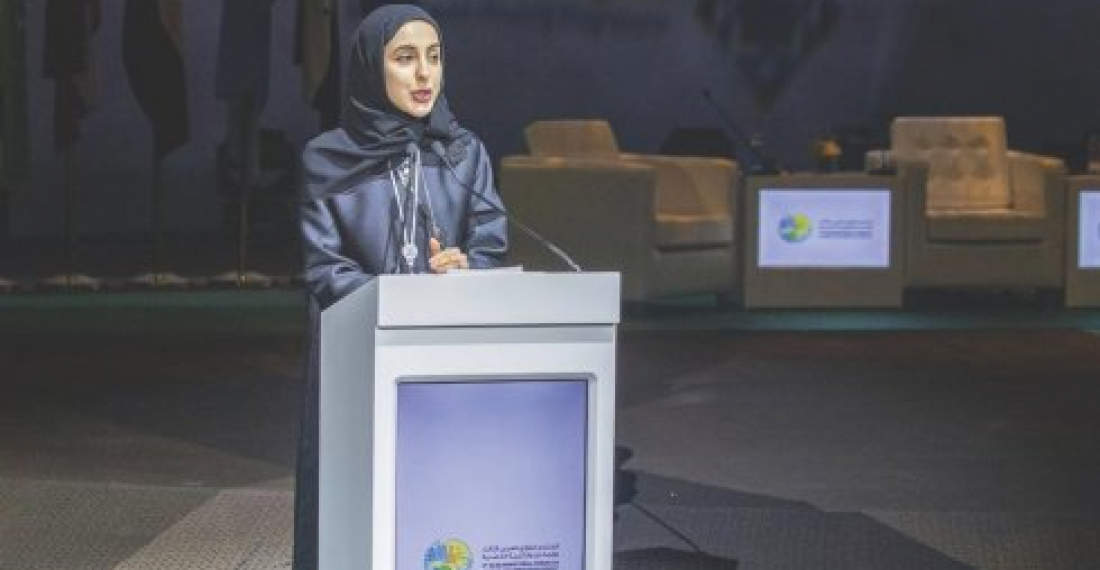
UAE Youth Minister urges governments to treat youth as drivers of development

The Arab region is heavily infested with crisis and conflicts on many scales. However, if one keeps in mind the UN Sustainable Development Goals (SDGs), it also has a key ingredient necessary to achieve regional development: nearly one-third of all population in the Arab world is made up of youth aged 15-29 . Many of those join the labour force every year eager to contribute to their families and communities. Unfortunately, many challenges stand in their way. It is, therefore, of the utmost priority to nurture the young people, and pave opportunities on their way. Youth development is important in the Arab world because the region has the highest concentration of youth in the entire world. Therefore, commitment is required to make sure this force is used for development and ensure they contribute significantly to the UN's SDGs.

A recent report by the Arab Youth Center, based in Abu Dhabi highlighted this opportunity. The study surveyed nearly 7,000 young people across 21 Arab countries. The findings from the Youth Priority Survey indicated that youth seek safety, education and healthcare as the basis for communities where they can thrive.

The need to pay attention to youth development is also acknowledged by the UAE Minister of State for Youth Affairs, Shamma bint Suhail Faris Al-Mazrui. In an interview with Arab News newspaper she said "I honestly believe if there's a big change that can revolutionize the world, it would be done by a young person . . . and I think it's time to unleash the potential of Arab youth entrepreneurs,"

Al-Mazuri recognises the lack of hope among today's youth. She adds that Arab youth aspirations are not only attainable but can be exceeded, provided governments make available the proper platforms for unlocking their full potential. Al-Mazuri herself was appointed to the government in 2016 at the age of 22.

To start with youth must be seen as an asset and an opportunity, rather than a problem. Authorities should put themselves in the shoes of the youth and have empathy. The UAE Ministry of Youth is looking forward to collaborating with a number of Arab states on youth development, including Bahrain, Egypt, Jordan and Kuwait.

Also, an interesting finding is the need to feel safe from domestic violence, an issue traditionally a taboo subject in the Middle East. Al-Mazrui said: "For me, it (the finding on domestic violence) was initially a bit surprising, maybe it's because I come from the UAE and this has been tackled early on. I think it is a sign that in the Arab world it (domestic violence) is still an issue and there needs to be discussion about it.

Satisfying the demands of youth is a task for government officials. As authorities, they are to be held liable for providing the correct tools and fostering technological advancements that enable the achievements of quality education and healthcare. The region has already suffered and youth from conflict countries already feel betrayed. It is hence, first and foremost, the task of officials to deliver to youth's demands.  

Al-Mazrui likened her role as a youth minister catering for 50 percent of the UAE's population to that of "an orchestra conductor" - working in coordination with government departments to address the challenges facing this vital demographic.

source: commonspace.eu with Arab News (Jeddah)

Photo: The Minister of State for Youth Affairs of the United Arab Emirates, Shamma bint Suhail Faris Al-Mazrui. (archive picture)


Related articles

Editor's choice
News
Borrell tells the European Parliament that the situation in Afghanistan was critical, but the EU will remain engaged

Borrell tells the European Parliament that the situation in Afghanistan was critical, but the EU will remain engaged

Borrell underlined that the European Union will make every effort to support the peace process and to remain a committed partner to the Afghan people. "Of course, we will have to take into account the evolving situation, but disengagement is not an option.  We are clear on that: there is no alternative to a negotiated political settlement, through inclusive peace talks.
Editor's choice
News
NATO Chief says war is on Europe's doorstep, and warns against complacency

NATO Chief says war is on Europe's doorstep, and warns against complacency

Russia could attack a NATO country within the next five years, the Secretary General of NATO, Mark Rutte, said in a stark new warning. "NATO's own defences can hold for now," Rutte warned in Berlin, but conflict was "next door" to Europe, and he feared "too many are quietly complacent, and too many don't feel the urgency, too many believe that time is on our side. "Russia is already escalating its covert campaign against our societies," Rutte said in a speech in Germany. "We must be prepared for the scale of war our grandparents or great-grandparents endured." Earlier this month, Russia's President Vladimir Putin said his country was not planning to go to war with Europe, but it was ready "right now" if Europe wanted to - or started a war. But similar reassurances were given by Moscow in 2022, just before 200,000 Russian troops crossed the border and invaded Ukraine. Putin has accused European countries of hindering US efforts to bring peace in Ukraine - a reference to the role Ukraine's European allies have recently played in trying to change a US peace plan to end the war, whose initial draft was seen as favouring Russia. But Putin was not sincere, Nato's secretary-general said in the German capital, Berlin. Supporting Ukraine, he added, was a guarantee for European security. "Just imagine if Putin got his way; Ukraine under the boot of Russian occupation, his forces pressing against a longer border with Nato, and the significantly increased risk of an armed attack against us." Russia's economy has been on a war footing for more than three years now - its factories churn out ever more supplies of drones, missiles and artillery shells. According to a recent report by the Kiel Institute for the World Economy, Russia has been producing each month around 150 tanks, 550 infantry fighting vehicles, 120 Lancet drones and more than 50 artillery pieces. The UK, and most of its Western allies, are simply not anywhere near this point. Analysts say it would take years for Western Europe's factories to come close to matching Russia's mass-production of weapons. "Allied defence spending and production must rise rapidly, our armed forces must have what they need to keep us safe," the Nato chief said.

Popular

Editor's choice
News
NATO Chief says war is on Europe's doorstep, and warns against complacency

NATO Chief says war is on Europe's doorstep, and warns against complacency

Russia could attack a NATO country within the next five years, the Secretary General of NATO, Mark Rutte, said in a stark new warning. "NATO's own defences can hold for now," Rutte warned in Berlin, but conflict was "next door" to Europe, and he feared "too many are quietly complacent, and too many don't feel the urgency, too many believe that time is on our side. "Russia is already escalating its covert campaign against our societies," Rutte said in a speech in Germany. "We must be prepared for the scale of war our grandparents or great-grandparents endured." Earlier this month, Russia's President Vladimir Putin said his country was not planning to go to war with Europe, but it was ready "right now" if Europe wanted to - or started a war. But similar reassurances were given by Moscow in 2022, just before 200,000 Russian troops crossed the border and invaded Ukraine. Putin has accused European countries of hindering US efforts to bring peace in Ukraine - a reference to the role Ukraine's European allies have recently played in trying to change a US peace plan to end the war, whose initial draft was seen as favouring Russia. But Putin was not sincere, Nato's secretary-general said in the German capital, Berlin. Supporting Ukraine, he added, was a guarantee for European security. "Just imagine if Putin got his way; Ukraine under the boot of Russian occupation, his forces pressing against a longer border with Nato, and the significantly increased risk of an armed attack against us." Russia's economy has been on a war footing for more than three years now - its factories churn out ever more supplies of drones, missiles and artillery shells. According to a recent report by the Kiel Institute for the World Economy, Russia has been producing each month around 150 tanks, 550 infantry fighting vehicles, 120 Lancet drones and more than 50 artillery pieces. The UK, and most of its Western allies, are simply not anywhere near this point. Analysts say it would take years for Western Europe's factories to come close to matching Russia's mass-production of weapons. "Allied defence spending and production must rise rapidly, our armed forces must have what they need to keep us safe," the Nato chief said.

