


Three weeks of war (Update 2: with EU statement on the bombing of Ganja and Armenia's response)

Update 2 18 October 1300 CEST (1500 Baku/Yerevan)

The Armenian government, on Sunday (18 October) issued a statement deploring the EU statement on the missile attack on Ganja. "Armenia deplores this one-sided, biased and selective statement, which gives Azerbaijan “clearance” to continue breaching with impunity the international law, including the international humanitarian law and international customary law", said a statement issued by the spokesperson of the Ministry of Foreign Affairs in Yerevan. "The European Union has, to date, failed to clearly and explicitly react to these ultimate manifestations of war crimes committed by Azerbaijan with direct involvement of Turkey including through transfer of foreign terrorist fighters from Syria and Libya, and disregarded the existential threat and grave violations of the right to life of Artsakhi people, as well as the severe humanitarian crisis evolving in Artsakh" the statement said.

_________________

Update 1 1545 CEST (1745 Baku/Yerevan)

The European Union has condemned last nights' bombing of the Azerbaijani city of Ganja. A statement by Spokesperson, Peter Stano, issued on Saturday afternoon (17 October) and posted on the website of the European External Action Service said:

‘‘The European Union deplores the strikes on the Azerbaijani city of Ganja during the night of 16-17 October resulting in civilian loss of life and serious injury. All targeting of civilians and civilian installations by either party must stop. The ceasefire of 10 October must be fully respected without delay.''

______________________

For Armenians and for Azerbaijanis, in their home countries or overseas, these have been a difficult three weeks.

The war that started on 27 September appears no closer to ending, despite an attempt to have a cease fire.

Over the last twenty four hours both sides reported intensive fighting. Armenians say that overnight the town of Stepanakert, the administrative centre of Nagorno-Karabakh, was again bombed. Armenia says three people were injured in the bombing.

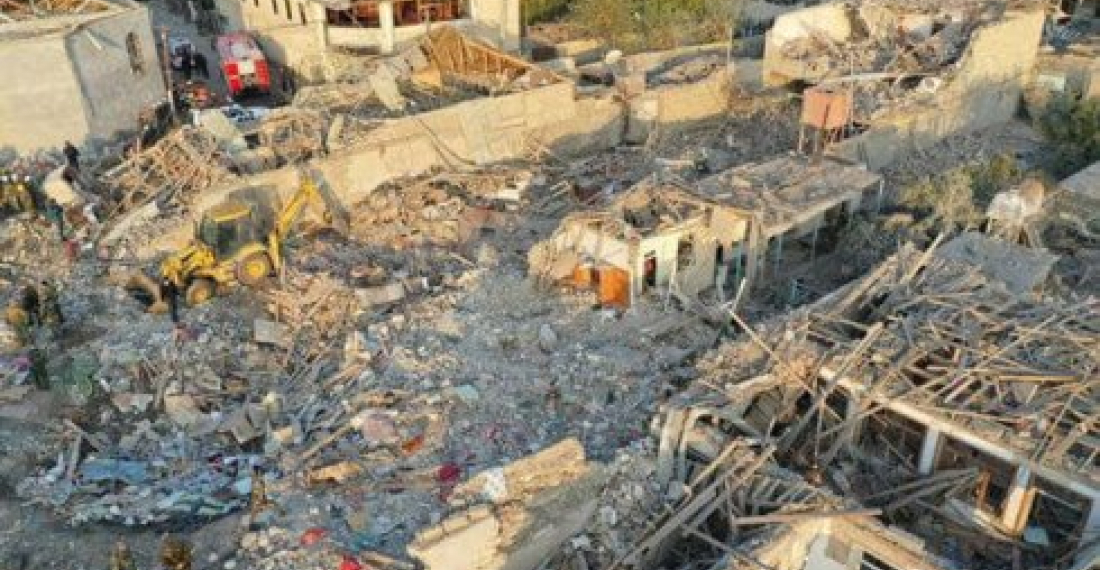
On its part Azerbaijan has reported another hit on a densely populated civilian area in its second largest city, Ganja, which is way away from the conflict zone. Women, children and old people were among the 13 people killed and many others are injured or missing. Azerbaijan says that that the number of civilians killed was now 60 and 270 were injured since September 27. In addition, 327 civilian facilities, 90 residential buildings and 1,704 houses were damaged. Azerbaijan is not giving the number of military casualties, but given the nature of the fighting it is expected that the numbers will be high.

In the attack on Ganja, the Azerbaijan-Georgia power transmission line was damaged. According to the Azerbaijani energy provider, Azenerji JSC the strike in the direction of Ganja caused an accident on the Samukh-Gardabani 500 kV overhead power line. The company said it had now repaired the damage.

Azerbaijani president Ilham Aliyev made a television address on Saturday morning (17 October) during which he said that the town of Fizuli and neighbouring villages had been liberated. Aliyev said people should be aware the Fizuli was completely destroyed during the period of Armenian control, and that there was not one single building standing. He promised that his government will rebuild the town so that its people could return to it.

Diplomacy is working behind the scenes, but the international community appears indecisive in terms of what the next steps should be, or even who should take them. Unconfirmed reports say that the United Nations Security Council will meet on Monday (19 October) for informal consultations at the request of the three OSCE Minsk Group co-Chair countries - France, Russia and the United States.

There are also reports of intensive diplomatic contacts between Russia and Turkey.  Turkey continues to profess full support to Azerbaijan. The Russian newspaper Kommersant yesterday listed the nature of the Turkish military support for Azerbaijan, including advisers and equipment. The newspaper also alleged that Turkey was supplying Azerbaijan by means of flights through Georgia.Georgia has now closed its airspace to all military flights.

A statement by the Georgian foreign ministry said: "Georgia has closed its airspace for military flights and we have publicly stated about it. As for civilian and humanitarian flights, Georgia is sincerely fulfilling its international obligations in this direction. However, we would like to clarify that these types of flights do not require special permits and civilian flights in the airspace are carried out on the basis of notification and provision of relevant information". "If there is a violation and there is strong evidence, Georgia will react harshly and violators will be held accountable under international law," the statement said.

source: commonspace.eu with agencies

photo: Destroyed buildings in Ganja


Related articles

Editor's choice
News
Council of Europe launches new International Claims Commission for Ukraine

Council of Europe launches new International Claims Commission for Ukraine

Thirty-four countries and the European Union have signed a new convention establishing an International Claims Commission for Ukraine at a diplomatic conference co-hosted by the 46-nation Council of Europe and the Netherlands in the Hague. The diplomatic conference was attended by leaders and high-level representatives from over 50 states, including the President of Ukraine, Volodymyr Zelenskyy, the President of the Republic of Moldova, Maia Sandu, and the Prime Minister of the Netherlands, Dick Schoof.  “Today marks a major step forward in ensuring accountability for Ukraine. The International Claims Commission represents justice and hope for tens of thousands of victims—our determination that those who have suffered will not be forgotten. I call for quick ratifications so we can get the commission rapidly up and running for the people of Ukraine,” said Council of Europe Secretary General Alain Berset. Ukrainian President Volodymyr Zelenskyy said: “We expect that every mechanism for compensation from the Register of Damage and Claims Commission to the actual payments – will start working and receive strong and sufficient international support, so that people can truly feel that any kind of damage caused by the war can be compensated. This war, and Russia’s responsibility for it, MUST become a clear example – so that others learn not to choose aggression.” “Accountability is about creating the conditions for peace that endures. And therefore, accountability is a condition of security – today and for the future. But accountability is not only about Ukraine. And it is not only about one aggressor and one victim. Accountability is about Europe. About every country in Europe. It is about whether Europe, as a whole, is willing to defend its peace,” said Maia Sandu, President of the Republic of Moldova, which currently holds the Presidency of the Council of Europe’s Committee of Ministers. The Prime Minister of the Netherlands, Dick Schoof, said: “Every day Russia is deliberately bombarding homes, destroying businesses and damaging infrastructure in Ukraine. Russia must compensate Ukraine for the damage caused. That is why we have launched the International Claims Commission for Ukraine and we are honoured to host it.” The International Claims Commission will be the second part of a comprehensive compensation mechanism related to Russia’s war of aggression, building on the existing Register of Damage for Ukraine. The claims commission will be established within the framework of the Council of Europe and will also be open to other countries. The Register of Damage for Ukraine, created in 2023, collects and records compensation claims submitted by individuals, organisations and public bodies in Ukraine. Forty-four states and the European Union have so far joined the Register, which has already received 86,000 claims. The International Claims Commission will review, assess and decide upon claims submitted to the Register of Damage for Ukraine and determine the amount of compensation, if any, which is due in each case. The convention establishing the commission will enter into force once it has been ratified by 25 signatories, as long as sufficient funds have been secured to support its initial work.

Popular

Editor's choice
News
Council of Europe launches new International Claims Commission for Ukraine

Council of Europe launches new International Claims Commission for Ukraine

Thirty-four countries and the European Union have signed a new convention establishing an International Claims Commission for Ukraine at a diplomatic conference co-hosted by the 46-nation Council of Europe and the Netherlands in the Hague. The diplomatic conference was attended by leaders and high-level representatives from over 50 states, including the President of Ukraine, Volodymyr Zelenskyy, the President of the Republic of Moldova, Maia Sandu, and the Prime Minister of the Netherlands, Dick Schoof.  “Today marks a major step forward in ensuring accountability for Ukraine. The International Claims Commission represents justice and hope for tens of thousands of victims—our determination that those who have suffered will not be forgotten. I call for quick ratifications so we can get the commission rapidly up and running for the people of Ukraine,” said Council of Europe Secretary General Alain Berset. Ukrainian President Volodymyr Zelenskyy said: “We expect that every mechanism for compensation from the Register of Damage and Claims Commission to the actual payments – will start working and receive strong and sufficient international support, so that people can truly feel that any kind of damage caused by the war can be compensated. This war, and Russia’s responsibility for it, MUST become a clear example – so that others learn not to choose aggression.” “Accountability is about creating the conditions for peace that endures. And therefore, accountability is a condition of security – today and for the future. But accountability is not only about Ukraine. And it is not only about one aggressor and one victim. Accountability is about Europe. About every country in Europe. It is about whether Europe, as a whole, is willing to defend its peace,” said Maia Sandu, President of the Republic of Moldova, which currently holds the Presidency of the Council of Europe’s Committee of Ministers. The Prime Minister of the Netherlands, Dick Schoof, said: “Every day Russia is deliberately bombarding homes, destroying businesses and damaging infrastructure in Ukraine. Russia must compensate Ukraine for the damage caused. That is why we have launched the International Claims Commission for Ukraine and we are honoured to host it.” The International Claims Commission will be the second part of a comprehensive compensation mechanism related to Russia’s war of aggression, building on the existing Register of Damage for Ukraine. The claims commission will be established within the framework of the Council of Europe and will also be open to other countries. The Register of Damage for Ukraine, created in 2023, collects and records compensation claims submitted by individuals, organisations and public bodies in Ukraine. Forty-four states and the European Union have so far joined the Register, which has already received 86,000 claims. The International Claims Commission will review, assess and decide upon claims submitted to the Register of Damage for Ukraine and determine the amount of compensation, if any, which is due in each case. The convention establishing the commission will enter into force once it has been ratified by 25 signatories, as long as sufficient funds have been secured to support its initial work.

